
The financial stakes are high. IT downtime now costs businesses an average of $5,600 per minute. For IoT-dependent operations, connectivity failures translate directly to lost revenue, safety risks, and operational chaos. Single-network SIM failures or coverage gaps can trigger total ROI loss and expensive truck rolls to manually swap cards mid-deployment.
This guide cuts through the noise. It presents the 10 most capable IoT connectivity service providers operating in the USA in 2026, evaluated by real-world performance—not just brand size.
Key Takeaways
- IoT connectivity links physical devices to the internet via cellular, LPWAN, or private networks—distinct from general-purpose broadband
- Picking the wrong provider means coverage gaps, compliance failures, and runaway data costs—especially across multi-site deployments
- Top US providers span major carriers (Verizon, AT&T, T-Mobile), specialist MVNOs (KORE, Eseye, Aeris), and platform-first players (Soracom, Telit Cinterion, Lumen, MachineQ)
- Key selection criteria: 5G/LTE-M/NB-IoT support, Private APN availability, multi-carrier redundancy, and compliance coverage (HIPAA, PCI-DSS, CMMC)
What Is IoT Connectivity and Why Does It Matter for US Businesses?
IoT connectivity combines network infrastructure, SIM/eSIM provisioning, and platform software to enable physical devices to transmit data reliably. Unlike consumer broadband, cellular IoT operates in licensed spectrum and follows standards from GSMA and 3GPP, optimizing for low power, specific data rates, and massive scale.
Technologies relevant to the US market include:
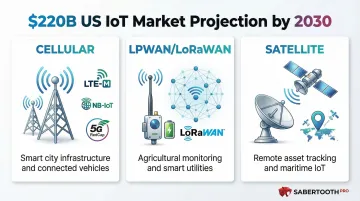
- Cellular: 4G/5G, LTE-M, NB-IoT, 5G RedCap
- LPWAN: LoRaWAN for low-power, wide-area sensor networks
- Satellite: For remote locations beyond cellular reach
The US IoT market is projected to reach $220.47 billion by 2030. Industries like fleet management, healthcare, and retail depend on reliable connectivity to power real-time tracking, remote monitoring, and automated operations. Coverage gaps or compliance failures translate directly into lost revenue and failed audits.
Two traps catch businesses repeatedly:
- Choosing providers on brand name alone, without verifying Private APN support or compliance certifications
- Relying on single-network SIMs that fail when regional outages hit
With dozens of providers competing for enterprise IoT contracts, the list below helps decision-makers cut through the noise and compare providers on coverage, compliance, scalability, and support.
Top 10 IoT Connectivity Service Providers in the USA (2026)
These providers were selected based on US market presence, network reliability, feature depth, industry compliance credentials, and suitability for small-to-large business deployments.
Verizon Business – IoT Solutions
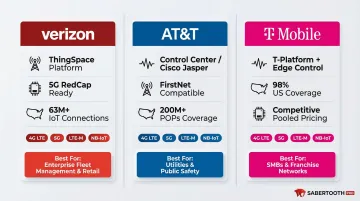
Verizon is the largest US wireless carrier by IoT connections, managing nearly 63 million IoT connections by mid-2024. The carrier offers a full IoT stack spanning cellular (4G LTE, 5G), private APNs, and its ThingSpace platform for device lifecycle management across fleet, healthcare, and retail verticals.
Key differentiators:
- Supports 5G RedCap (Reduced Capability) nationwide — optimized for low-power IoT devices like wearables and industrial sensors
- Verizon Sensor Insights delivers near real-time equipment intelligence and anomaly detection as a turnkey add-on
- ThingSpace handles SIM provisioning, usage monitoring, and advanced device diagnostics — including RF performance and LwM2M diagnostics
| Feature | Details |
|---|---|
| Network Support | 4G LTE, 5G (including 5G RedCap/NR), Cat-M1, NB-IoT |
| Key Platform Feature | ThingSpace: SIM provisioning, usage monitoring, device diagnostics |
| Best For | Enterprise fleet management, retail, smart infrastructure |
AT&T Business – IoT
AT&T Business is a major US IoT carrier with nationwide 5G RedCap coverage serving over 200 million points of presence (POPs) across the US. The carrier offers cellular-based IoT connectivity with dedicated IoT plans and managed connectivity services for large device fleets.
Key differentiators:
- Nationwide 5G RedCap coverage designed specifically for low-power IoT devices
- AT&T Control Center — a Cisco Jasper-powered platform — automates SIM management at scale with real-time data monitoring
- FirstNet compatibility extends IoT connectivity to certified public safety routers, cameras, and sensors
| Feature | Details |
|---|---|
| Network Support | 4G LTE, 5G (RedCap), FirstNet compatibility for public safety IoT |
| Key Platform Feature | AT&T Control Center: automated SIM management, real-time data monitoring |
| Best For | Utilities, public safety, connected vehicles, large enterprise fleets |
T-Mobile for Business – IoT
T-Mobile is the fastest-growing 5G carrier in the US with dedicated IoT business plans. The carrier's 5G network covers 98% of Americans and over 95% of US highway miles, making it a strong fit for mobile asset tracking and fleet operations.
Key differentiators:
- T-Platform provides a unified network management portal for centralized IoT deployment control across all sites
- Edge Control delivers local data breakout and ultra-low latency — a cost-effective alternative to full private network builds
- Competitive pooled data pricing gives SMBs and mid-market businesses flexible consumption without overage traps
| Feature | Details |
|---|---|
| Network Support | 4G LTE, 5G (low-band, mid-band), LTE-M, NB-IoT |
| Key Platform Feature | T-Platform and Edge Control: connectivity management with near-private network performance |
| Best For | SMBs, QSR/franchises, small-to-mid fleet operations, retail |
For teams that need carrier-agnostic flexibility rather than committing to a single network, the next three providers take a different approach entirely.
KORE Wireless
KORE is recognized by analysts like Transforma Insights and Gartner as a top-tier IoT MVNO and visionary. The company offers multi-carrier IoT connectivity, eSIM/OmniSIM plans, and managed services across healthcare, industrial, and logistics verticals—now available through TD SYNNEX distribution.
Key differentiators:
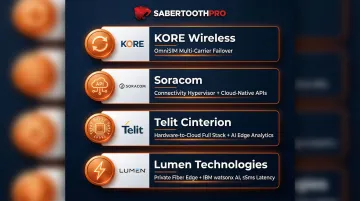
- OmniSIM uses multi-IMSI eSIM technology to automatically failover across networks — no single-carrier dependency
- KORE ONE unifies connectivity, device management, and analytics under a single architecture
- Deployment support, analytics, and specialized vertical expertise across healthcare, industrial, and logistics
| Feature | Details |
|---|---|
| Network Support | Multi-carrier (AT&T, T-Mobile, Verizon) via OmniSIM with automatic failover |
| Key Platform Feature | KORE ONE: unified IoT connectivity + device management + analytics |
| Best For | Healthcare IoT, industrial monitoring, asset tracking, multi-carrier resilience |
Soracom
Soracom, part of the KDDI group, is a cloud-native, developer-first IoT connectivity platform offering global eSIM, dynamic profile switching, and a rich API/marketplace ecosystem suited to technology-forward US enterprises.
Key differentiators:
- The Connectivity Hypervisor — an SGP.32-compatible orchestration layer — lets teams remotely switch operator profiles on a single IoT eSIM without physical intervention
- Native connections to AWS, Azure, and GCP via Soracom Funnel and Beam cut integration overhead significantly
- Developer marketplace with pre-built integrations accelerates time-to-deployment for new IoT applications
| Feature | Details |
|---|---|
| Network Support | Global eSIM with multi-carrier switching; US cellular coverage via major carriers |
| Key Platform Feature | Connectivity Hypervisor: dynamic eSIM profile management + cloud-native API stack |
| Best For | Developer teams, cloud-native IoT deployments, startups scaling IoT globally from US |
Telit Cinterion
Telit Cinterion is a full-stack IoT provider offering cellular modules, routers, global eSIM/multi-IMSI SIMs, and the deviceWISE Intelligence Suite. With headquarters in Irvine, CA, the company maintains a strong US presence with focus on industrial and medical verticals.
Key differentiators:
- Combines modules, connectivity, and platform software in a single hardware-to-cloud stack — reducing integration complexity across vendors
- deviceWISE Intelligence Suite provides AI-enabled device management and edge analytics, enabling autonomous industrial agents to optimize manufacturing workflows without manual intervention
- Deep expertise in mission-critical, regulated applications across industrial and medical verticals
| Feature | Details |
|---|---|
| Network Support | 4G/5G cellular modules + eSIM; multi-carrier global/US connectivity |
| Key Platform Feature | deviceWISE Intelligence Suite: AI-enabled device management + edge analytics |
| Best For | Industrial IoT, manufacturing, medical devices, mission-critical routing |
Lumen Technologies
Lumen is a US-based network infrastructure provider offering edge computing, private connectivity, and IoT-oriented network services for latency-sensitive enterprise applications. The company recently announced integration of IBM watsonx AI into Lumen's edge data centers for real-time AI inferencing.
Key differentiators:
- Edge infrastructure platform delivers ≤5ms latency — built for IoT applications where timing directly affects outcomes
- Fiber backbone projected at 16.6 million intercity miles by end of 2025, providing nationwide private connectivity reach
- IBM watsonx integration processes IoT data intelligently at the network edge — without routing traffic back to centralized cloud
| Feature | Details |
|---|---|
| Network Support | Private fiber + edge cloud; optimized for latency-sensitive IoT applications |
| Key Platform Feature | Edge Cloud: integrated AI (IBM watsonx) + edge infrastructure for real-time IoT processing |
| Best For | Smart manufacturing, financial services IoT, enterprise-grade edge deployments |
MachineQ (A Comcast Company)
MachineQ is Comcast's enterprise IoT division offering a fully integrated IoT platform built on LoRaWAN (LPWAN) networks, designed specifically for indoor and campus-based deployments in retail, healthcare, and smart buildings across the US.
Key differentiators:
- MQinsights delivers an AI-powered "smart summary" feature that automates IoT data analysis and flags anomalies without manual review
- LoRaWAN (LPWAN) network handles dense sensor deployments efficiently with minimal power draw
- Area 8c gateway installs with minimal configuration — optimized for both small-scale and campus-wide indoor coverage
| Feature | Details |
|---|---|
| Network Support | LoRaWAN (LPWAN); optimized for indoor/campus low-power IoT sensor deployments |
| Key Platform Feature | MQinsights: AI-driven IoT data summaries and anomaly reporting |
| Best For | Smart buildings, retail floor monitoring, healthcare facilities, campus deployments |
Eseye
Eseye, headquartered in the UK with a significant US enterprise client base, specializes in highly resilient connectivity. The company's AnyNet+ eSIM claims access to over 800 networks across 190+ countries, including comprehensive US coverage.
Key differentiators:
- AnyNet+ eSIM spans 800+ networks globally, with multi-carrier US coverage and automatic failover built in
- SMARTconnect runs on-device intelligence software that handles network failover, monitors data paths continuously, and simplifies cloud routing
- Direct cloud integrations to AWS, Azure, and GCP reduce routing complexity for enterprise deployments
| Feature | Details |
|---|---|
| Network Support | AnyNet+ eSIM: 800+ networks globally; multi-carrier US coverage with auto-failover |
| Key Platform Feature | SMARTconnect: intelligent network selection + cloud connector (AWS, Azure, GCP) |
| Best For | Global-to-US IoT deployments, automotive, logistics, supply chain |
Aeris Communications
Aeris is a US-founded IoT connectivity specialist with over two decades of experience serving enterprise and government customers. The company offers cellular IoT plans built on major US carrier networks with deep vertical expertise in connected vehicles, utilities, and healthcare.
Key differentiators:
- Aeris IoT Platform provides real-time device visibility, analytics, and automated policy enforcement — including microsegmentation for network security
- Active participation in FCC regulatory proceedings reflects deep US telecom compliance knowledge that matters for regulated industries
- Nearly 30 years focused on IoT connectivity — no adjacent product lines diluting specialization
| Feature | Details |
|---|---|
| Network Support | Multi-carrier US cellular (LTE-M, NB-IoT, 4G LTE); dedicated IoT data plans |
| Key Platform Feature | Aeris IoT Platform: real-time device analytics, automated policy enforcement, usage controls |
| Best For | Connected vehicles, utilities/smart grid, healthcare remote monitoring, government IoT |
How We Chose the Best IoT Connectivity Providers
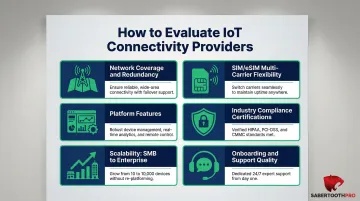
This list was assembled by evaluating providers against six criteria relevant to US businesses:
1. Nationwide network coverage and redundancy Coverage maps mean nothing if they don't match your device locations. We prioritized providers with verifiable nationwide US presence and multi-carrier redundancy options.
2. SIM/eSIM and multi-carrier flexibility Single-network SIMs create fragility. When one carrier experiences a regional outage, devices go offline with no fallback. Providers offering multi-IMSI or eSIM orchestration scored higher.
3. Platform features Device management, analytics, and real-time monitoring capabilities separate commodity connectivity from enterprise-grade solutions. We evaluated platform depth, not just network access.
4. Industry compliance certifications HIPAA, PCI-DSS, CMMC, and SOC 2 Type II certifications aren't optional for regulated industries. We verified which providers support secure data routing and microsegmentation.
5. Scalability for SMB-to-enterprise deployments Solutions that work for 50 devices but break at 5,000 aren't enterprise-ready. We prioritized providers with proven deployment scale.
6. Quality of onboarding and support IoT deployments fail when support disappears post-sale. We evaluated provider reputations for deployment assistance and ongoing support.
Common Mistake Businesses Make
Choosing a provider based solely on brand recognition or pricing—without verifying Private APN availability, LTE-M/NB-IoT support, or compliance with specific industry regulations—often leads to costly mid-deployment switches.
Two risks compound that problem:
- Mid-deployment provider switching is expensive — truck rolls, hardware replacements, and data migration fees add up fast.
- Proprietary hardware and single-network SIMs create vendor lock-in, leaving you exposed to exorbitant roaming fees and no fallback options.
Vendor-Agnostic Advisory
Businesses that need unbiased guidance can work with a vendor-agnostic IoT advisor like SabertoothPro. With carrier-certified Private APNs, multi-carrier access, and a 300+ partner ecosystem, SabertoothPro benchmarks options, negotiates rates, and manages the full IoT connectivity lifecycle without being tied to any single carrier.
Conclusion
The right IoT connectivity provider for a US business depends less on brand size and more on which provider's network, platform, and compliance capabilities align with your specific use case, industry, and deployment scale.
Before committing to any provider:
- Validate coverage maps for your actual device locations
- Confirm technology support (LTE-M/NB-IoT or 5G) for your device types
- Request SLA documentation including uptime guarantees and response times
- Verify compliance certifications match your industry requirements
Businesses that want an unbiased assessment of IoT connectivity options can work with SabertoothPro—a carrier-certified, vendor-agnostic technology advisor—to benchmark real-world pricing and deploy the right solution from day one.
Call +1 888-891-2331 or visit SabertoothPro to get started.
Frequently Asked Questions
What is IoT connectivity and how is it different from regular business internet?
IoT connectivity refers to purpose-built network services (cellular, LPWAN, satellite) designed to connect thousands of low-power devices—not general-purpose broadband. These services include dedicated SIM management, usage controls, and coverage optimized for machine-to-machine communication rather than human data consumption.
What is the difference between an IoT MVNO and a major carrier like AT&T or Verizon?
MVNOs (like KORE or Eseye) lease network capacity from major carriers but layer on multi-carrier SIM flexibility, specialized IoT platforms, and vendor-neutral support. For businesses needing automatic failover or global coverage without carrier lock-in, MVNOs are often the better fit. Major carriers trade that flexibility for deeper infrastructure control and direct network integration.
What is a Private APN and why does it matter for IoT security?
A Private APN creates an isolated network tunnel between IoT devices and your internal systems. Data never touches the public internet, which is critical for HIPAA-compliant healthcare devices, PCI-DSS payment terminals, and government IoT deployments.
How does 5G improve IoT connectivity for businesses in 2026?
5G RedCap (Reduced Capability) cuts battery consumption and hardware costs compared to full 5G, making it practical for wearables and industrial sensors. Full 5G adds ultra-low latency and higher device density for real-time automation scenarios. Not every deployment needs it, though—LTE-M/NB-IoT still handles most low-bandwidth sensor use cases reliably.
What IoT connectivity technology is best for fleet tracking in the USA?
4G LTE or LTE-M with multi-carrier SIM cards is recommended for nationwide fleet tracking coverage. LTE-M supports mobility, voice features, and better burst data transfers, making it well-suited for moving vehicles. Providers like KORE, Verizon, and AT&T offer fleet-specific plans with real-time GPS tracking, geofencing, and data pooling to reduce overage costs.
How do I know if an IoT connectivity provider supports my industry's compliance requirements?
Ask providers directly about HIPAA, PCI-DSS, SOC 2, or CMMC certifications and request documentation before signing anything. Verify that their SIM management platform supports data sovereignty controls, encrypted transmission, and audit logging specific to your industry vertical.