Introduction
Ransomware attacks surged by 41% in 2025, while software supply chain attacks nearly tripled year-over-year. For US businesses managing hybrid cloud estates—which now account for 73% of organizational IT environments—24/7 in-house threat monitoring is no longer just expensive. It's operationally unrealistic. Building a minimum viable Security Operations Center (SOC) costs $1.2 million to $2.5 million annually. Most mid-sized businesses simply can't sustain that.
MDR services deliver continuous, expert-backed security at a fraction of SOC build costs. They combine AI-driven threat detection with human expert response, giving businesses continuous protection across endpoints, cloud, identity, and network. For regulated industries like healthcare, finance, and government contracting, MDR has become the practical path to meeting compliance requirements while addressing persistent security skills gaps.
This guide covers the top 10 MDR providers operating in the USA for 2026, the criteria used to evaluate them, and how to choose the right fit for your organization's size, industry, and compliance obligations.
Key Takeaways
- MDR delivers 24/7 threat monitoring, investigation, and response remotely—pairing behavioral analytics with human analyst oversight
- US businesses adopt MDR to meet HIPAA, CMMC, and PCI-DSS requirements while addressing internal security staffing shortages
- Top 10 providers: CrowdStrike, Sophos, Arctic Wolf, SentinelOne, Rapid7, Red Canary, Expel, Secureworks, eSentire, and Palo Alto Networks
- Key selection criteria: coverage breadth, mean time to respond (MTTR—target under 1 hour), pricing model, compliance support, and integration compatibility
- SabertoothPro's vendor-agnostic advisors benchmark MDR providers and negotiate contracts on your behalf—at no added cost
What Is MDR and Why Does It Matter for US Businesses in 2026?
MDR is a fully managed cybersecurity service that combines continuous telemetry collection, AI-powered analytics, human-led threat investigation, and active incident response. Unlike traditional Managed Security Service Providers (MSSPs) that monitor and alert without hands-on action, MDR teams actively contain threats—isolating endpoints, blocking malicious traffic, and suspending compromised accounts directly within your environment.
The numbers are hard to ignore. According to the 2025 Verizon Data Breach Investigations Report, SMBs are targeted nearly four times more often than large organizations. When breaches occur, the average cost for US companies reached a record $10.22 million in 2025.
Most US small and mid-sized businesses simply don't have the headcount to run a 24/7 SOC. Because modern threats move faster than understaffed teams can respond, MDR delivers continuous coverage at a fraction of what in-house operations cost.
For regulated industries, MDR also directly supports compliance. Key frameworks requiring continuous monitoring and documented incident response include:
- HIPAA — mandates security monitoring and breach notification for healthcare organizations
- CMMC — requires continuous diagnostics and incident response for defense contractors
- PCI-DSS — demands real-time threat detection for any business handling cardholder data
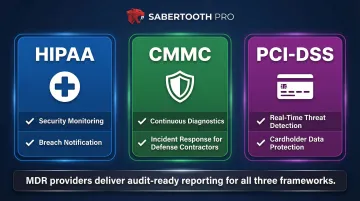
Leading MDR providers map their services directly to these requirements, delivering audit-ready reporting alongside active threat containment.
Top 10 MDR Service Providers in the USA (2026)
Each provider below was evaluated on detection coverage breadth, 24/7 response capabilities, industry certifications, client base diversity, Gartner/Forrester analyst rankings, and overall value for US-based businesses.
CrowdStrike Falcon Complete MDR
CrowdStrike Falcon Complete MDR delivers 24/7 expert-led protection built on the AI-native Falcon platform, serving enterprise and mid-market clients across healthcare, finance, and technology.
What sets it apart:
- Global threat intelligence from CrowdStrike's worldwide sensor network
- Breach prevention warranty up to $2 million for eligible customers
- Recognized as a Leader in The Forrester Wave™ for MDR, Q1 2025
- Compliance support validated by Coalfire for HIPAA, PCI-DSS, SOC 2, and CMMC 2.0
| Best For | Enterprise and mid-market organizations needing fast automated remediation with human expert oversight |
|---|---|
| Key Differentiator | AI + human hybrid SOC model with full-cycle remediation and breach warranty |
| Pricing Model | Per-endpoint, annual billing; custom quote required for Falcon Complete MDR |
Sophos MDR
Sophos MDR serves over 17,000 customers globally with a strong US mid-market footprint. The service integrates third-party telemetry at no additional cost, maximizing value from existing security investments.
Differentiators include:
- Threat hunting using both lead-based and hypothesis-driven methods
- Full incident response included with no extra fees
- Third-party telemetry ingestion (Microsoft O365, Graph Security API) at no added cost
- Microsoft Defender integration via MISA-verified Sophos MDR for Microsoft environments
| Best For | Mid-market businesses and IT/software companies seeking affordable, fully managed threat response |
|---|---|
| Key Differentiator | Full incident response and third-party telemetry ingestion included at no extra cost |
| Pricing Model | Per-user and per-server pricing; custom quote based on environment size |
Arctic Wolf MDR
Arctic Wolf differentiates through a "Concierge Security Team" model—assigning dedicated security experts to each client for personalized guidance and regular security reviews. The provider is especially popular in healthcare and financial services.
Key features:
- Guided remediation and root cause analysis that prevents incident recurrence
- Security Operations Warranty providing up to $3 million in financial assistance
- 4.9 rating on Gartner Peer Insights for MDR Services
- Compliance support for HIPAA, PCI-DSS, SOC 2, and CMMC
| Best For | Healthcare, financial services, and organizations prioritizing relationship-driven, customized MDR support |
|---|---|
| Key Differentiator | Dedicated Concierge Security Team providing personalized, ongoing security guidance beyond just alerting |
| Pricing Model | Based on number of users, sensors, and servers; custom quote via website |

SentinelOne Vigilance MDR (Wayfinder)
SentinelOne's Wayfinder MDR (formerly Vigilance) combines curated threat intelligence with 24/7/365 expert analysts operating natively within the Singularity Platform. Coverage spans endpoints, cloud, identity, and third-party telemetry.
What makes it stand out:
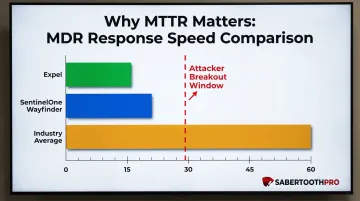
- 18-minute MTTR target against a 60-minute SLA
- Purple AI + Singularity Hyperautomation delivering rapid response
- Google Threat Intelligence integration for comprehensive, timely threat data
- Breach Response Warranty up to $1 million
| Best For | Organizations wanting AI-automated response with elite human backup; resource-constrained security teams |
|---|---|
| Key Differentiator | Purple AI + Singularity Hyperautomation delivering fast MTTR with curated Google + S1 threat intel |
| Pricing Model | Subscription-based; custom quote tied to Singularity Platform licensing tiers |
Rapid7 MDR
Rapid7 MDR is an exposure-led service built on the Rapid7 Insight platform, offering 24/7 SOC coverage and unlimited incident response with no caps on DFIR actions. A dedicated security advisor is assigned in Advanced and Ultimate tiers.
Key differentiators:
- Full transparency into SOC activity through XDR/SIEM tools
- Unlimited DFIR actions with no activity caps or hourly limits
- Monthly proactive threat hunting included
- Ranked a Contender in Forrester Wave Q1 2025
| Best For | Organizations wanting transparent SOC access and unlimited IR without activity caps |
|---|---|
| Key Differentiator | Exposure-led approach with no limits on DFIR actions and direct client access to investigation data |
| Pricing Model | Asset-based pricing; Essentials and Elite tiers available — custom quote required |
Red Canary MDR
Red Canary is recognized as a Leader in the Forrester Wave for MDR, known for behavior-based detection mapped to MITRE ATT&CK and cross-environment coverage across endpoint, network, cloud, identity, and SaaS.
Standout features:
- Low false positive rates reducing noise for lean security teams
- Agentless approach ingesting telemetry from existing customer tools
- Playbook-driven automated response with human validation
- Transparent incident reporting that makes threat context accessible to non-technical stakeholders
| Best For | Mid-market organizations needing low false positive rates and MITRE ATT&CK-aligned detection |
|---|---|
| Key Differentiator | Behavior-based detection across all environments with transparent, context-rich incident reporting |
| Pricing Model | Per-endpoint, annual billing; custom quote required |
Expel MDR
Expel stands out for agentless deployment integrating with 160+ existing security tools without requiring agent installation or platform replacement. Designated a Leader in Forrester Wave MDR, Q1 2025, it's also one of the fastest MDR services to deploy.
Key differentiators:
- Ruxie AI engine that automates triage and focuses analysts on the top 1% of threats
- 14-minute median MTTR on critical/high incidents
- Expel Workbench™ dashboard providing real-time visibility into SOC operations
- SOC 2 Type 2 audited with support for PCI-DSS, HIPAA, and CMMC
| Best For | Organizations wanting rapid deployment and full visibility into SOC operations without replacing existing tools |
|---|---|
| Key Differentiator | Ruxie AI triage engine + agentless integration with 160+ tools; ~14-minute median MTTR |
| Pricing Model | Custom quote; typically subscription-based tied to environment scale |
Secureworks Taegis ManagedXDR
Secureworks brings over 20 years of threat intelligence through its Counter Threat Unit™. Taegis ManagedXDR is a cloud-native platform unifying endpoint, network, cloud, and log telemetry into a single managed XDR service.
Differentiators:
- AI-enhanced threat analytics combined with human threat hunters
- Unified management console simplifying cross-domain investigation
- Global threat research team continuously updating detection content
- Proven, research-backed threat intelligence at scale
| Best For | Organizations requiring mature, research-backed XDR-level threat coverage with unified console management |
|---|---|
| Key Differentiator | 20+ years of threat intelligence powering AI-enhanced analytics; unified XDR management console |
| Pricing Model | Subscription-based; custom quote based on environment and service tier |
eSentire MDR
eSentire delivers multi-signal MDR powered by its Atlas XDR Platform, offering coverage across endpoints, network, cloud, identity, and vulnerabilities. Proprietary AI reduces investigation time from hours to minutes, backed by 24/7 Elite Threat Hunters.
What sets it apart:
- Active response capabilities including host isolation, malicious traffic blocking, and account suspension executed directly by analysts
- Dark web monitoring and high-touch service model
- Evaluated as a Strong Performer in Forrester Wave Q1 2025
- Suitable for complex enterprise environments in regulated US industries
| Best For | Mid-to-large enterprises in regulated industries (financial, healthcare, legal) needing high-touch MDR |
|---|---|
| Key Differentiator | Atlas XDR Platform with active containment actions (host isolation, account suspension) executed by analysts |
| Pricing Model | Custom enterprise pricing; quote-based depending on environment scope and service tier |
Palo Alto Networks Cortex MDR (Unit 42)
Palo Alto's MDR is delivered through its elite Unit 42 threat intelligence team, built natively on the Cortex XDR platform. It provides 24/7 expert-led monitoring across endpoint, network, and cloud with automated data correlation.
Key differentiators:
- Hypothesis-driven proactive threat hunting using Unit 42's global telemetry
- Massive threat intelligence scale: 30 million new malware samples and 500 billion daily events
- Guided step-by-step remediation with direct analyst engagement
- Deep integration with Palo Alto NGFW and SASE ecosystems
| Best For | Enterprise organizations in Palo Alto ecosystems or needing Unit 42 threat intelligence integration |
|---|---|
| Key Differentiator | Unit 42 proactive threat hunting backed by massive global telemetry; deep Cortex XDR integration |
| Pricing Model | Custom enterprise quote; typically tied to existing Cortex XDR platform licensing |
How We Chose the Best MDR Providers
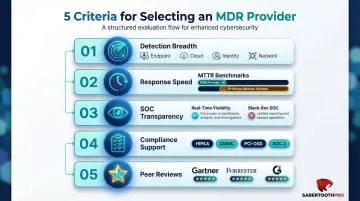
With over 600 MDR providers competing for market share, choosing the right one demands a methodical evaluation framework. These providers were assessed based on five core criteria:
Detection and response breadth — coverage across endpoints, cloud, identity, and network. A common mistake is selecting an MDR provider based on brand recognition alone without verifying coverage fit for your specific environment.
Response speed and MTTR benchmarks — median attacker breakout time is now 29 minutes. Your MDR must respond faster.
Transparency and client visibility — does the provider offer real-time SOC visibility, or is it a black-box service?
US-market compliance support — explicit support for HIPAA, CMMC, PCI-DSS, and SOC 2 with audit-ready reporting.
Verified peer reviews — Gartner Peer Insights, G2 ratings, and analyst reports like the Forrester Wave for MDR (Q1 2025).
Many businesses fail to ask whether an MDR provider can ingest telemetry from their current EDR, SIEM, or cloud platforms before signing a contract — leading to costly tool replacement or blind spots. Pricing models also vary significantly (per endpoint vs. per user vs. custom), making side-by-side comparison difficult without benchmarked data.
Organizations in regulated sectors should verify that their MDR provider explicitly supports relevant compliance frameworks and can generate audit-ready reporting. This gap is often overlooked until after deployment.
A vendor-agnostic IT advisor like SabertoothPro, which draws on real-world pricing benchmarks across a 300+ partner ecosystem, can help businesses identify the MDR solution that fits their stack, budget, and compliance obligations — without relying on vendor claims alone.
Conclusion
The MDR landscape in 2026 is mature and genuinely competitive. The right provider is the one whose detection depth, response speed, integration flexibility, and compliance coverage fit your specific environment—not the one with the largest marketing budget.
Evaluate MDR providers beyond marketing claims. Ask for MTTR benchmarks. Request clarity on what "active response" actually means in their SLA. Verify integration compatibility with your existing stack before committing to a contract. Treat scalability and pricing transparency as baseline requirements, not selling points.
If shortlisting and comparing providers independently feels like a full-time job, SabertoothPro's vendor-agnostic IT advisory service can help. Drawing on a 300+ provider ecosystem, the team benchmarks MDR options against your compliance requirements, negotiates pricing using real-world contract data, and cuts through vendor claims to surface the right fit. Reach out at 1-888-891-2331 or visit SabertoothPro.com to get started.
Frequently Asked Questions
What is the difference between MDR and MSSP?
MSSPs primarily monitor and alert on security events without taking hands-on response action. MDR providers actively investigate threats, validate incidents, and take containment actions like isolating endpoints or blocking traffic directly within your environment—making MDR a more proactive and intervention-focused service.
How much do MDR services typically cost for US businesses?
MDR pricing is typically based on endpoints, users, or servers monitored. For a 500-endpoint environment, expect $8–$35 per endpoint per month ($48K–$210K annually). Enterprise providers usually require a custom quote; mid-market providers like BitLyft offer tiered monthly pricing.
Is MDR suitable for small and mid-sized businesses?
Yes. MDR works well for SMBs because it removes the need to build and staff an in-house SOC. Many providers like Sophos, Arctic Wolf, and Red Canary cater specifically to mid-market clients, and subscription-based pricing models make it accessible without large upfront investments.
Can MDR services help with compliance requirements like HIPAA or CMMC?
Many leading MDR providers explicitly support US regulatory frameworks including HIPAA, CMMC, PCI-DSS, and SOC 2. They provide audit-ready reporting, incident documentation, and continuous monitoring that satisfies compliance requirements for threat detection and response programs.
What key features should I look for when evaluating an MDR provider?
Key criteria to evaluate:
- Coverage breadth: endpoint, cloud, network, and identity monitoring
- Response benchmarks: documented MTTR and SLA commitments
- Tool compatibility: integrations with your existing security stack
- SOC transparency: visibility into analyst activity and decision-making
- Compliance reporting: audit-ready documentation for HIPAA, CMMC, PCI-DSS
- Containment scope: confirm whether active response is included or billed separately
How quickly should an MDR provider respond to a detected threat?
Response times vary significantly. Best-in-class providers like Expel report median MTTRs around 14 minutes, while SentinelOne targets approximately 18 minutes. Businesses should request documented SLA commitments for detection-to-containment time before signing any MDR contract.