Introduction
Contact centers processing payment card data face a critical compliance challenge: every credit card number collected over voice or chat channels creates significant PCI DSS audit exposure. When agents handle cardholder data directly—whether keyed into a CRM, spoken aloud, or entered via phone keypad—the entire contact center infrastructure falls within the Cardholder Data Environment (CDE) scope. According to the IBM 2025 Cost of a Data Breach report, third-party vendor breaches cost an average of $4.91 million, making vendor selection a business-critical decision.
Choosing the wrong CCaaS platform can dramatically expand your audit scope, drive up compliance costs, and expose your organization to breach liability. A platform that holds PCI DSS certification but still routes raw card data through agent systems offers far less protection than one that actively removes payment data from the CDE through DTMF masking, tokenization, and secure IVR capture.
This guide covers the top PCI DSS-compliant CCaaS providers, the technical features that reduce audit scope, and the evaluation criteria that distinguish genuine compliance capability from marketing claims.
Key Takeaways
- PCI DSS-compliant CCaaS platforms use DTMF masking, pause/resume recording, and tokenization to keep cardholder data out of scope
- Vendor certifications vary: QSA-validated AOCs, self-assessments, and coverage that may not include every deployment type
- Leading providers include NICE CXone, Genesys Cloud CX, Five9, Talkdesk, and 8x8 Contact Center
- Evaluate on native scope-reduction features and shared responsibility documentation, not certification logos alone
What Is PCI DSS Compliance in the Context of CCaaS?
The Payment Card Industry Data Security Standard (PCI DSS) is a set of security requirements managed by the PCI Security Standards Council to protect cardholder data during storage, transmission, and processing. As of June 2024, the current standard is PCI DSS v4.0.1.
Any contact center that receives, transmits, or stores payment card data—whether through voice, chat, email, or digital channels—must comply with PCI DSS audit requirements.
According to the PCI SSC's "Protecting Telephone-Based Payment Card Data" supplement, if account data flows through your contact center environment, every system and network involved falls within PCI DSS scope — including agent desktops, VoIP networks, call recording storage, and CRM integrations.
Descoping the Contact Center from PCI DSS Audit
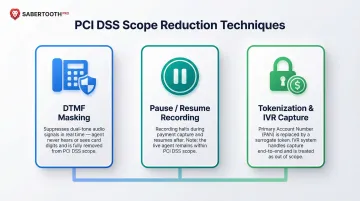
The goal of a PCI DSS-compliant CCaaS deployment is scope reduction — removing as much of the contact center infrastructure as possible from the cardholder data environment (CDE). Three technical approaches accomplish this:
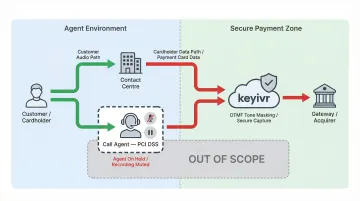
- DTMF Masking — Suppresses the audio tones generated when a customer enters card digits via keypad, preventing agents, recordings, and monitoring systems from capturing the card number. This effectively removes the agent environment from PCI DSS scope.
- Pause/Resume Call Recording — Temporarily stops recording during payment capture, removing call storage from scope. Note: the agent and agent desktop remain in scope, since the agent can still hear or see cardholder data.
- Tokenization and IVR Payment Capture — Replaces the Primary Account Number (PAN) with a surrogate token. Per PCI SSC tokenization guidelines, properly segmented systems processing only tokens can be treated as out of scope for PCI DSS.
The Shared Responsibility Model
Even when using a PCI DSS-compliant CCaaS vendor, compliance responsibility is shared. The PCI SSC Cloud Computing Guidelines explicitly state that a cloud provider's compliance does not exempt the customer.
The vendor secures the platform infrastructure — but your organization remains responsible for how agents interact with payment data, how recording policies are configured, and how data flows through integrations. Selecting the right scope-reduction features matters just as much as the vendor's certification status.
Top CCaaS Providers with PCI DSS Compliance
The providers below were selected based on verifiable PCI DSS certification documentation, native scope-reduction capabilities, deployment maturity in regulated industries, and industry recognition from analyst firms like Gartner and Forrester.
NICE CXone
NICE CXone is one of the largest cloud contact center platforms globally, widely deployed in financial services, insurance, and retail—industries with strict PCI DSS obligations. The platform is assessed annually by an Internal Security Assessor (ISA) against PCI DSS controls and provides an Attestation of Compliance (AOC) and PCI Responsibility Matrix to business units under contract or prospective clients under NDA.
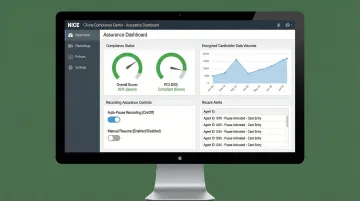
What sets NICE CXone apart for PCI DSS environments is its Compliance Center, which includes Assurance Dashboards offering actionable insights on stored and encrypted cardholder data. The platform provides automated pause and resume of recordings, retroactive encryption of historical interactions, and TLS 1.2 with end-to-end encryption.
NICE CXone is also FedRAMP Authorized at the Moderate Impact Level—a strong signal of its security posture for organizations managing multiple compliance frameworks simultaneously.
| Feature | Details |
|---|---|
| PCI DSS Feature Set | DTMF suppression, automated call recording pause/resume, retroactive encryption, TLS 1.2 end-to-end encryption, AES 256 for data in transit and at rest |
| Deployment Type | Cloud-native SaaS; FedRAMP Moderate authorized |
| Best Fit Industries | Financial services, insurance, healthcare, retail |
Documented deployments include Hastings Direct (insurance) and Blue Cross of Idaho (healthcare), both of which required strict compliance controls for cardholder and sensitive health data handling.
Genesys Cloud CX
Genesys Cloud CX is an enterprise-grade CCaaS platform with strong compliance credentials, frequently chosen by large financial institutions and multi-site enterprises managing PCI DSS compliance across hundreds of agents. The platform is Service Provider Level 1 compliant with PCI DSS version 4.0, validated by an external Qualified Security Assessor (QSA), with the AOC available to interested parties under NDA.
For scope reduction, Genesys Cloud CX offers Secure Pause (which temporarily stops recording) and Secure Call Flows (which prevent system recording or agent access to sensitive information). The platform mandates TLS v1.2 for authentication and disables DTMF logging and media capture when PCI DSS compliance is enabled.
Genesys also publishes a detailed PCI DSS customer responsibility matrix that clearly outlines compliance obligations between the platform and its customers—a level of transparency often missing from competitor documentation.
| Feature | Details |
|---|---|
| PCI DSS Feature Set | Secure Pause, Secure Call Flows, TLS v1.2 mandatory, DTMF logging disabled, tokenization support |
| Deployment Type | Cloud-native (Genesys Cloud Voice, BYOC Cloud, BYOC Premises options) |
| Best Fit Industries | Financial institutions, insurance, retail, healthcare |
Genesys offers multiple deployment models—cloud-native, Bring Your Own Carrier (BYOC) Cloud, and BYOC Premises—each with different PCI DSS audit implications clearly outlined in vendor documentation.
Five9
Five9 is a cloud-native CCaaS provider with a strong track record in compliance-heavy industries such as banking, collections, and healthcare. Five9 is a Level 1 PCI DSS Service Provider that engages an independent QSA to perform an annual assessment covering all 12 PCI DSS requirements. The company provides an annual Report on Compliance (ROC) and associated AOC.
Five9's standout feature is Secure Payment Capture, which supports both self-service IVR and agent-assisted call flows. During agent-assisted flows, the agent is placed on hold and the recording is muted so PCI data is not captured. Data in transit is secured using HTTPS, sFTP, sRTP, and VPN protocols. Five9 uses a multi-tenant infrastructure with strict data partitioning and also offers private cloud options for organizations requiring dedicated environments.
| Feature | Details |
|---|---|
| PCI DSS Feature Set | Secure Payment Capture (IVR and agent-assisted), DTMF masking, recording mute during payment capture, HTTPS/sFTP/sRTP/VPN encryption |
| Deployment Type | Cloud-native multi-tenant; dedicated private cloud instances available |
| Best Fit Industries | Banking, collections, healthcare, financial services |
Documented case studies include OceanFirst Bank and Central Bank, both requiring comprehensive PCI DSS controls for card-not-present transactions.
Talkdesk
Talkdesk is a modern AI-driven CCaaS platform that has made significant investments in compliance infrastructure. Talkdesk holds PCI DSS Level 1 certification alongside SOC 2 Type II, ISO 27001, HIPAA, and GDPR, making it attractive to mid-market and enterprise buyers in regulated sectors.
Talkdesk's Secure Payments solution ensures credit card information never surfaces in call recordings or on agent screens. For healthcare specifically, Agentless Payments for Epic (powered by Sycurio) lets patients pay bills through a secure IVR channel with no agent involvement.
Talkdesk operates under a shared responsibility model for business continuity and compliance, backed by over 30 security certifications that support multi-jurisdictional deployments.
| Feature | Details |
|---|---|
| PCI DSS Feature Set | Secure Payments (no agent screen or recording exposure), Agentless IVR payments, agent screen masking |
| Deployment Type | Cloud-native; Regional Cloud and Hybrid Cloud deployment options |
| Best Fit Industries | Healthcare billing, retail, financial services, insurance |
Talkdesk's Flexible Deployment options include Regional Cloud, allowing customers to select data residency locations to meet local compliance regulations—a key differentiator for multinational organizations.
8x8 Contact Center
8x8 Contact Center is a unified communications and contact center platform with documented PCI DSS compliance, well-suited for small-to-mid-sized businesses in retail, financial services, and insurance that need both CCaaS and UCaaS capabilities under one compliant roof. 8x8's XCaaS services have been reviewed by a QSA and assessed as PCI compliant.
8x8 offers 8x8 Secure Pay powered by PCI Pal, which uses DTMF masking technology. The cloud-based solution intercepts keypad tones, preventing sensitive payment data from reaching the agent or the contact center environment, reducing the scope of PCI compliance.
Because the solution operates entirely in the cloud, it descopes businesses from sensitive data whether agents work in-office or remotely—no clean room environments or pause-and-resume workarounds required.
| Feature | Details |
|---|---|
| PCI DSS Feature Set | 8x8 Secure Pay (DTMF masking via PCI Pal), encrypted transmission, recording pause/resume, unified CCaaS and UCaaS compliance |
| Deployment Type | Cloud-native SaaS; multi-region compliance options |
| Best Fit Industries | Retail, financial services, insurance, small-to-mid-sized businesses |
8x8's advantage lies in its unified platform—businesses can manage voice, video, meetings, and contact center operations within a single PCI-scoped environment, simplifying compliance overhead.
How We Chose the Best CCaaS Providers for PCI DSS Compliance
A common mistake buyers make is assuming that any CCaaS vendor with a PCI DSS logo on their website is sufficient. In reality, the depth of compliance tooling varies widely. The PCI SSC explicitly warns that a cloud provider's claim of PCI DSS compliance does not automatically transfer to the customer's environment. Customers must confirm that all consumed services were included in the provider's validation and that the allocation of responsibility does not exempt the customer from securing cardholder data.
Key Evaluation Factors
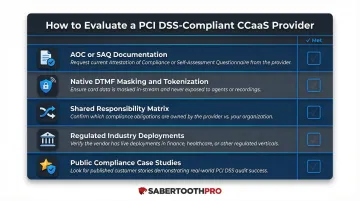
- AOC or SAQ on file — not a self-declared badge. Vendors were prioritized when they could produce documentation issued after a QSA assessment; an AOC carries significantly more third-party weight than a simple compliance claim.
- Offers DTMF masking, recording controls, and tokenization as native capabilities, not bolt-on integrations — reducing implementation complexity and audit surface.
- Publishes a shared responsibility matrix that clearly defines which controls remain the customer's obligation. Genesys Cloud CX and Five9 set the standard here.
- Has documented deployments in financial services, retail, insurance, and healthcare — verticals where PCI DSS is non-negotiable, not aspirational.
- Maintains public case studies in compliance-heavy sectors, confirming real-world performance rather than theoretical capability.
The Value of Vendor-Agnostic Guidance
Matching compliance requirements to the right CCaaS platform is harder than vendors make it look. An independent advisor — one without a preferred vendor to push — can cut through marketing claims and focus on what your cardholder data environment actually requires.
SabertoothPro holds its own PCI-DSS certification and works across a 300+ provider ecosystem that includes major CCaaS platforms. That position enables a few things a single-vendor rep cannot offer:
- Benchmark pricing against real contract data across competing platforms
- Compare AOC scopes side-by-side to identify coverage gaps before signing
- Validate that proposed scope-reduction features (DTMF masking, tokenization) align with your specific data flows
Conclusion
PCI DSS compliance in a CCaaS environment is not a checkbox exercise. It requires choosing a provider whose platform architecture actively removes payment card data from agent scope through native features—DTMF masking, tokenization, secure IVR offload—and whose compliance documentation supports your own audit obligations. Certification status is the floor, not the ceiling.
That distinction shapes how you should evaluate providers. Beyond the logo on a compliance certificate, focus on:
- Scope reduction — how effectively the platform removes your environment from PCI audit scope
- Scalability — whether the compliance architecture holds as transaction volumes grow
- Total cost — what compliance will actually cost over the full contract lifecycle, including annual assessments and remediation
A platform that cuts your audit scope by 70% may carry a higher sticker price but deliver real savings in assessment fees, remediation hours, and breach liability exposure.
Businesses in financial services, retail, insurance, or any sector handling payment data can reach SabertoothPro at +1 888-891-2331 for vendor-agnostic guidance on selecting a PCI DSS-compliant CCaaS solution that fits their operational and regulatory requirements.
Frequently Asked Questions
What does PCI DSS compliance mean for a CCaaS provider?
A PCI DSS-compliant CCaaS provider has undergone assessment to confirm its platform infrastructure meets PCI DSS requirements for protecting cardholder data. Vendors typically document this with an Attestation of Compliance (AOC) from a Qualified Security Assessor (QSA), or a completed Self-Assessment Questionnaire (SAQ).
Does using a PCI DSS-compliant CCaaS platform make my contact center automatically compliant?
No. CCaaS compliance operates under a shared responsibility model. The vendor secures the platform, but your business must still control how agents interact with payment data, configure recording policies correctly, and meet its own PCI DSS obligations. Your compliance scope depends on how you use the platform.
What is DTMF masking and why does it matter for PCI DSS compliance?
DTMF (Dual-Tone Multi-Frequency) masking suppresses the audio tones generated when a customer enters card digits via phone keypad. This prevents both the agent and the call recording from capturing the card number, effectively removing the agent environment from PCI DSS audit scope.
Which industries are most commonly required to use PCI DSS-compliant CCaaS?
Any business that accepts, transmits, or stores payment card data via its contact center must comply. The most common sectors are retail, financial services, insurance, healthcare billing, utilities, and e-commerce. Contact centers in these verticals face mandatory PCI DSS audits.
What is the difference between a PCI DSS AOC and an SAQ for a CCaaS vendor?
An AOC (Attestation of Compliance) is issued after a formal assessment by a Qualified Security Assessor (QSA) and applies to larger or more complex environments. An SAQ (Self-Assessment Questionnaire) is a self-reported validation used by vendors with lower-risk processing profiles. Buyers should ask which applies to their specific deployment.
How do I verify that a CCaaS provider's PCI DSS compliance covers my use case?
Request the vendor's current AOC or SAQ documentation and confirm the assessment scope matches your deployment type (such as cloud-hosted, voice, or digital channels). Then review the vendor's shared responsibility matrix to see which controls are yours to manage versus theirs.