This guide walks IT managers, network architects, and business decision-makers through the operational mechanics of MPLS to SD-WAN migration—the step-by-step process that most vendors discuss in outcome terms but rarely explain at the execution level.
Key Takeaways
- MPLS to SD-WAN migration runs in phases: assess, select a vendor, run hybrid, then decommission MPLS
- Audit your MPLS environment first — circuits, contracts, baselines, and app dependencies all shape your plan
- Choose your SD-WAN architecture based on business goals—cloud connectivity, cost reduction, or remote site performance
- Run a pilot at 1-2 sites to validate performance and failover before network-wide rollout
- MPLS contracts run 12-36 months with auto-renewal traps: map exit dates before locking in your migration timeline
What Is MPLS to SD-WAN Migration—and Why Businesses Are Making the Switch
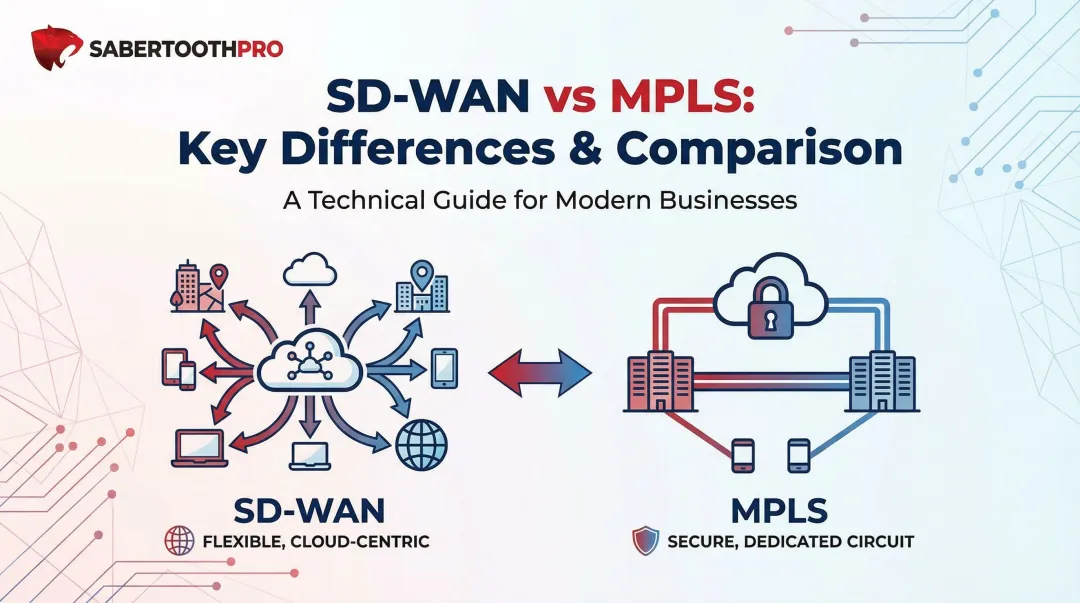
MPLS (Multiprotocol Label Switching) is a carrier-managed WAN technology that routes traffic through private, predetermined paths using label-switched routes. It delivers reliable, consistent performance with guaranteed Quality of Service (QoS), but at a premium price with rigid provisioning timelines and limited flexibility for cloud-first architectures.
SD-WAN (Software-Defined Wide Area Network) is a software-managed overlay that uses any combination of transport types—broadband, LTE, MPLS, or fiber—to dynamically route traffic based on real-time conditions and application policies. Rather than locking into a single carrier's private network, SD-WAN steers traffic across multiple underlay connections to keep performance high, costs controlled, and uptime consistent across every location.
The migration is accelerating because modern enterprises run on cloud applications. SaaS platforms, UCaaS systems, and cloud storage don't live in your data center—they live on the public internet.
Legacy hub-and-spoke MPLS architectures force cloud-bound traffic to "trombone" or "hairpin" through centralized data centers before reaching the internet, adding 50–150ms of latency that users feel in every video call and SaaS page load.
SD-WAN solves this by enabling direct internet breakout at the branch level, allowing local sites to connect directly to cloud services without backhauling traffic. That shift explains why adoption is moving fast: the SD-WAN market is projected to grow from $9.17 billion in 2025 to $35.39 billion by 2030, a 31.2% compound annual growth rate fueled by cloud adoption and the demand for scalable, lower-cost networking.
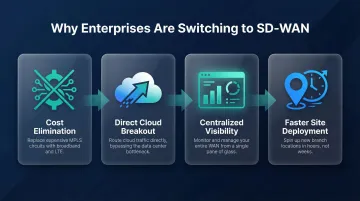
Why enterprises are making the switch:
- Eliminate costly MPLS circuits at branch locations where broadband performs equally well
- Enable direct cloud breakout to cut latency for Microsoft 365, Salesforce, and similar SaaS tools
- Gain centralized visibility and policy control across all sites from a single dashboard
- Scale new locations in days rather than the weeks MPLS provisioning typically requires
The Step-by-Step MPLS to SD-WAN Migration Process
Migration should be treated as a phased project, not a forklift replacement. Running both networks in parallel during the transition is standard practice and reduces risk. Most mid-sized organizations complete a phased rollout in 6 to 18 months, though timelines vary based on the number of sites and existing MPLS contract obligations.
Step 1: Audit Your Current MPLS Network
Document every MPLS circuit: location, bandwidth, carrier, monthly cost, and contract end date. This inventory forms the foundation of your migration plan and determines how quickly you can exit without penalty. MPLS contracts typically run 12 to 60 months and often include auto-renewal clauses that trigger 60-90 days before expiration — missing that window locks you into another term at legacy rates.
Early Termination Fees (ETFs) are real. Carriers like Verizon charge 35% of base monthly charges for the remaining contract term, while others charge up to 50%. Audit your contracts in Step 1—not as an afterthought—to avoid paying for both MPLS and SD-WAN simultaneously longer than necessary.
Map application dependencies and traffic flows next. Identify which applications are latency-sensitive (VoIP, video conferencing, real-time ERP transactions), which rely on QoS guarantees, and which sites carry the highest traffic volume. Applications requiring sub-150ms latency or strict jitter controls need explicit SD-WAN policies configured before MPLS is removed.
Step 2: Define Goals and Select Your SD-WAN Solution
Clarify your migration objectives before selecting a platform. Are you primarily reducing WAN costs, improving cloud performance, enabling direct internet breakout, or simplifying branch management? Different SD-WAN vendors optimize for different outcomes:
- Cost reduction: Broadband-backed SD-WAN saves up to 72% compared to MPLS, though without SLA guarantees
- Performance consistency: DIA-backed SD-WAN saves approximately 25% while maintaining carrier-grade SLAs
- Cloud optimization: Platforms with native cloud on-ramps (AWS Direct Connect, Azure ExpressRoute, Google Cloud Interconnect) reduce cloud application latency
- Security integration: Some vendors offer integrated NGFW, ZTNA, and SASE capabilities; others require third-party security solutions
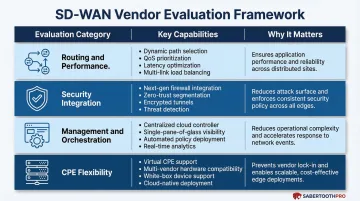
Evaluate SD-WAN vendors against your specific requirements:
| Evaluation Category | Key Capabilities | Why It Matters |
|---|---|---|
| Routing & Performance | Application-aware routing, dynamic path selection, Forward Error Correction (FEC), packet duplication | Ensures VoIP/UCaaS quality during underlay brownouts |
| Security Integration | NGFW, ZTNA, SWG, MEF 88 compliance | Protects direct internet breakouts from edge threats |
| Management & Orchestration | Centralized controller, northbound APIs, zero-touch provisioning | Reduces operational overhead and enables automation |
| CPE Flexibility | Support for existing router upgrades vs. proprietary appliances | Dictates upfront CapEx and deployment speed |
A vendor-agnostic advisor can run this comparison across carriers without a stake in the outcome. SabertoothPro works across 300+ SD-WAN and connectivity partners, matching platform selection to your application profile, site count, and budget — not a preferred vendor's roadmap.
Step 3: Design the Migration Architecture and Run a Pilot
During the transition period, SD-WAN appliances sit alongside existing MPLS CPE — broadband or LTE carries primary traffic while MPLS runs as backup. This hybrid setup ensures no reliability degradation during cutover. It's temporary by design, though some organizations retain it permanently for specific links (data center interconnects, latency-critical regulated sites).
Select 1-2 representative pilot sites — ideally mid-complexity branches with a mix of applications — and deploy SD-WAN there first. Track these KPIs to validate readiness before expanding:
- Latency: One-way delay should stay below 150ms for transparent interactivity (ITU-T G.114 standard)
- Jitter: Inter-packet delay variation, measured as one-way IPDV per MEF 105
- Packet loss: One-way packet loss ratio, targeting <0.1% for voice applications
- Application response times: Compare pre-migration and post-migration performance for business-critical applications
Pilots surface routing surprises — asymmetric paths, DNS resolution failures, firewall policy mismatches — before they affect the entire network. Organizations that skip this phase to accelerate timelines routinely face higher rollback rates and longer outage windows.
Step 4: Execute the Phased Site Migration
Once the pilot confirms your KPIs are met, roll out SD-WAN site by site in priority order. Most organizations start with lower-complexity or geographically clustered locations, progressively shifting traffic from MPLS while monitoring application performance at each site before advancing.
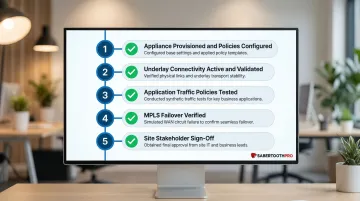
Use a per-site cutover checklist to maintain consistency across the rollout:
- SD-WAN appliance provisioned and policies configured
- Underlay connectivity (broadband/fiber/LTE) active and validated
- Application traffic policies tested against pilot baseline
- Failover to MPLS backup verified under failure conditions
- Sign-off from site stakeholders confirming operational readiness
Rushing this step is the most common cause of rollback events. Each site should stabilize for 1-2 weeks before proceeding to the next cluster. For organizations with 5-10 sites, this phase takes 2-4 months. For 100+ site deployments, expect 6-12 months depending on installer coordination and underlay availability.
Step 5: Optimize Performance and Decommission MPLS
After all sites run stably on SD-WAN, compare application latency, uptime, and user experience metrics against your pre-migration baseline. SD-WAN platforms use Bidirectional Forwarding Detection (BFD) to continuously monitor data plane tunnels — sending Hello packets every 1 second to measure packet loss, latency, and jitter.
This continuous monitoring feeds dynamic routing decisions based on real-time SLA classes, which is something MPLS simply can't match.
Terminate MPLS circuits in alignment with the contract end dates you catalogued in Step 1. Work with your carrier or advisor to avoid auto-renewal. Some organizations retain a reduced MPLS footprint for specific use cases:
- Data center interconnects: MPLS remains preferred for high-availability clusters requiring Layer 2 connectivity and sub-10ms latency
- Regulated environments: Healthcare, finance, or government sites where compliance mandates private circuit separation
- Remote locations: Sites with insufficient broadband quality where MPLS provides the only guaranteed SLA
Most enterprises settle on a 20% MPLS, 80% SD-WAN split as a permanent hybrid architecture rather than full replacement.
Key Factors That Affect Your MPLS to SD-WAN Migration
Five variables consistently drive migration timelines and complexity. Get these wrong, and even a well-funded project stalls.
Contract Terms and Termination Penalties
MPLS contract terms often dictate migration schedules more than technical readiness. Review contracts 12-18 months before your planned cutover to align decommissioning with natural expiration dates and avoid early termination fees (ETFs).
Site Count and Geographic Distribution
Scale changes everything. A 5-site migration can wrap up in 3-4 months. A 200-site national rollout requires coordinated installer scheduling, regional underlay provider negotiations, and phased project management—typically spanning 12-18 months.
Underlay Transport Availability
SD-WAN performance is only as good as the underlying internet connections at each site. Urban locations typically have multiple fiber and broadband options. Rural sites may rely on LTE or satellite (37.13% of South Dakota users depend on Starlink LEO for minimum broadband speeds). Sites without quality underlay need a specific plan—either retaining MPLS or deploying bonded connections.
Security Architecture Requirements
MPLS provides implicit security through network isolation—traffic travels on private circuits. SD-WAN with direct internet breakout requires explicit security policies. Regulated industries face specific mandates:
- NIST SP 800-207 (Zero Trust): No implicit trust zones; all connections must be authenticated and encrypted
- PCI DSS v4.0: Enhanced network segmentation to protect payment data
- CMMC (DoD): FIPS-validated encryption for Controlled Unclassified Information
- HIPAA: Encryption and monitoring requirements for electronic health records in transit
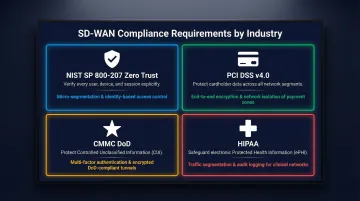
SD-WAN default settings won't satisfy these requirements. Encryption, segmentation, and monitoring must be explicitly configured before go-live.
Application Sensitivity and QoS
MPLS guarantees consistent performance via predetermined Label-Switched Paths and strict SLAs. SD-WAN compensates for internet variability by using multiple links and dynamically shifting traffic to faster paths based on real-time metrics.
Latency-sensitive applications—voice, video conferencing, real-time ERP transactions—need explicit QoS policies to ensure priority routing and sufficient bandwidth during congestion events.
Common Mistakes in MPLS to SD-WAN Migration—and How to Avoid Them
Contract timing is where migrations quietly derail. Many organizations discover mid-project they have 18-24 months of MPLS remaining—paying for both networks simultaneously because decommissioning triggers early termination fees. Audit every MPLS contract before scoping your SD-WAN rollout, not after you've already committed to a cutover date.
Security policy gaps are the second major failure point. MPLS kept traffic off the public internet through private circuits by default. SD-WAN with direct internet breakout has no such inherent protection—you need explicit policy covering:
- Firewall rules scoped to SD-WAN traffic flows
- ZTNA or SASE integration for user and application access control
- TLS inspection (MEF 88's Application Flow Security mandates Middle-Box Functions to decrypt, inspect, and re-encrypt traffic)
Skipping this step creates both compliance exposure and live data risk.
Bypassing the pilot to hit a deadline is the fastest path to a rollback. Teams that jump straight to network-wide deployment consistently report higher rollback rates and longer resolution windows. Rushed cutovers without pilot validation lead to "six-figure mistakes"—routing surprises, DNS failures, and security policy mismatches where new paths bypass inspection or break critical applications. Run the pilot. The cost of one structured test site is a fraction of an emergency rollback across 50 locations.
When a Full MPLS to SD-WAN Migration May Not Be the Right Move Yet
Retaining MPLS makes operational sense in specific scenarios:
- Broadband-limited locations where internet underlay quality can't meet minimum performance requirements for business operations
- Latency-sensitive workloads — financial trading platforms, medical imaging, or industrial control systems — that require the deterministic performance only private MPLS circuits deliver
- Unfavorable contract economics where remaining MPLS term lengths make early termination financially prohibitive
Hybrid WAN is a valid long-term architecture for many organizations — not just a transitional state. Running SD-WAN as primary with MPLS as QoS failover captures the cost advantages of internet transport while keeping private circuit reliability in place for mission-critical traffic. Before committing to a full cutover, map your highest-risk application workloads against available underlay quality at each site — that gap analysis will tell you whether full migration is viable now or a phased hybrid approach makes more sense.
Conclusion
Successful MPLS to SD-WAN migration is a structured, phased effort that starts with a thorough audit, moves through deliberate pilot validation, and concludes with careful decommissioning aligned to contract terms. Organizations that skip steps — rushing pilots, ignoring security reconfiguration, or failing to audit contracts — trade short-term speed for long-term instability, rollbacks, and unexpected costs.
Done right, the migration pays off in concrete ways: faster cloud application performance, reduced WAN spend, and a network that scales without renegotiating carrier contracts every time the business grows. Getting there requires that decisions stay grounded in those outcomes, not vendor pressure or procurement convenience.
Working with a vendor-agnostic advisor keeps both vendor selection and execution on track. SabertoothPro's lifecycle management approach covers network assessment through deployment and ongoing optimization, drawing on a 300+ partner ecosystem to match each business with the right fit — not the most convenient one. If you're evaluating SD-WAN options, that's the right place to start.
Frequently Asked Questions
How long does an MPLS to SD-WAN migration typically take?
Migration timelines vary by the number of sites and contract obligations. Most mid-sized organizations complete a phased rollout in 6 to 18 months, with pilot phases taking 4-6 weeks. Smaller deployments can move faster if MPLS contracts permit early exit without prohibitive termination fees.
Can you run MPLS and SD-WAN at the same time during migration?
Yes, running both in parallel during migration is standard practice. SD-WAN handles primary traffic while MPLS provides backup during the transition. This hybrid period is temporary by design, though some organizations retain it long-term for latency-critical applications or high-availability data center links.
What happens to network security during the MPLS to SD-WAN migration?
SD-WAN introduces direct internet breakout, removing the implicit security of MPLS's private network isolation. Organizations must deploy integrated security—firewall, ZTNA, or SASE—alongside SD-WAN to maintain protection. This is especially critical in regulated industries like healthcare and finance where compliance mandates explicit encryption and segmentation.
How do MPLS contract termination terms affect the migration timeline?
MPLS contracts typically run 12 to 36 months with auto-renewal clauses and early termination fees of 35% to 50% of remaining contract value. Audit these terms upfront to avoid paying for both networks simultaneously during the transition.
What is the difference between SD-WAN and MPLS performance?
MPLS offers consistent, guaranteed QoS over a private network with strict SLAs and predetermined paths. SD-WAN dynamically routes traffic across multiple transport types (broadband, LTE, fiber) and can match or exceed MPLS performance for most applications through intelligent path selection. Performance depends on underlay quality and real-time monitoring.
Do you need to replace all routers and CPE hardware when migrating to SD-WAN?
Most SD-WAN deployments require new edge appliances at each site, though existing underlay infrastructure (routers, switches) can often stay in place. Some routers support SD-WAN software upgrades, but requirements vary by vendor and appliance type.