SD-WAN vendor selection affects uptime, security posture, compliance readiness, and total cost of WAN operations across every business location. The average cost of downtime for a large enterprise exceeds $14,000 per minute, with 20–40% of those costs stemming from activities related to identifying affected users and locations. The SD-WAN market is projected to grow from $5.3 billion in 2023 to more than $8 billion by 2026, with 81% of the 5,000 largest global enterprises expected to deploy SD-WAN by 2026. This growth reflects urgent business need, not technology hype.
Key Takeaways
- SD-WAN routes traffic intelligently across broadband, LTE, and MPLS based on real-time performance conditions
- Evaluate vendors across six dimensions: performance, security, cloud integration, scalability, management, and total cost
- Choosing based solely on price or brand creates integration gaps and rising costs at scale
- SabertoothPro benchmarks 300+ providers through a vendor-agnostic process to match capabilities with your actual needs
- Treat post-deployment performance reviews as part of the selection process, not an afterthought
What is SD-WAN?
SD-WAN is a software-driven approach to managing wide area networks that decouples the network control plane from the hardware. This enables IT teams to dynamically route traffic across multiple transport connections based on application priority, performance thresholds, and security policies. Rather than relying on expensive, hardware-dependent MPLS circuits with rigid routing, SD-WAN introduces flexibility by allowing businesses to use broadband, LTE/5G, and MPLS together under a single policy-driven overlay.
Traditional WAN architectures lock businesses into costly MPLS circuits where traffic follows predetermined paths regardless of real-time conditions. When an MPLS link degrades or fails, traditional WAN requires manual intervention or lengthy failover processes. SD-WAN monitors all available links continuously and redirects traffic within milliseconds when performance drops below defined thresholds.
The cost difference is significant: a typical 1 Gbps MPLS circuit runs $1,439 per month in North America, while SD-WAN using Dedicated Internet Access circuits plus managed service costs $1,066 per month — roughly 25% savings without sacrificing performance.
Core Components of SD-WAN
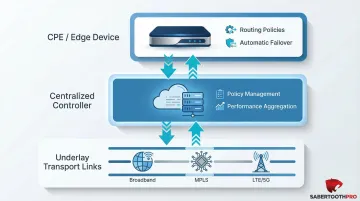
Three foundational elements determine the reliability and performance of any SD-WAN solution:
- CPE/Edge Device: Physical or virtual appliance at each site that enforces routing policies, monitors link health, and executes failover decisions. Processing power and built-in security features determine what the SD-WAN can do at each location.
- Centralized Controller: Cloud-hosted or on-premises platform that pushes policy changes across all sites, aggregates performance data, and determines which applications use which links. One change here applies everywhere.
- Underlay Transport Links: The broadband, MPLS, and LTE/5G circuits carrying actual traffic. SD-WAN doesn't replace these connections — it optimizes how traffic uses them, letting businesses combine lower-cost broadband with LTE backup while retaining MPLS only where latency demands it.
Deployment models vary in how much internal IT ownership they require:
- Cloud-managed: Vendor hosts and maintains the controller — minimal internal overhead, faster deployment
- Self-managed: Your team hosts and operates the controller infrastructure — maximum control, higher staffing demands
- Co-managed: Vendor NOC handles day-to-day monitoring while internal staff retains configuration authority
For lean IT teams, cloud-managed is usually the right starting point. For organizations with strict data sovereignty requirements or existing NOC capacity, self-managed or co-managed models offer more control.
Key Benefits of SD-WAN for Business
- Application performance: VoIP, UCaaS, and SaaS tools run more reliably — Cisco SD-WAN deployments reduced application latency by 45%
- Lower WAN costs: Supplements or replaces expensive MPLS circuits with broadband and LTE
- Faster branch provisioning: Zero-touch deployment eliminates manual configuration at new sites
- Unified visibility: Single pane of glass for network health, application performance, and policy enforcement across all locations
Industry-specific applications demonstrate SD-WAN's versatility. In healthcare, a rural Texas hospital deployed SD-WAN with built-in failover and gained 19.3 additional hours of uptime in August 2025, preventing 18.9 hours of major disruptions including dropped telehealth calls and broken web sessions. For retail and QSR franchises, a large quick-serve food retailer used Versa Secure SD-WAN to reduce order failure rates from 10-15 per day to 1-3 per day. In logistics, Coach Atlantic deployed Cradlepoint ruggedized routers across 250+ vehicles to improve Wi-Fi uptime and stability for passengers and drivers across mobile sites.
What to Consider When Selecting an SD-WAN Vendor
SD-WAN vendor selection is highly context-dependent. What works for a five-site healthcare network has different requirements than a 200-location retail franchise. The following six factors translate technical specifications into business-relevant selection criteria.
Evaluating vendors in isolation leads to integration gaps. Every selection must account for how a solution fits the organization's existing cloud, security, and communications stack.
Network Performance and Reliability
A dropped WAN link during a busy shift is not a theoretical risk — it's a recurring operational cost. Vendors must demonstrate real-world SLA guarantees, automatic failover capabilities, and dynamic path selection across multiple transport links.
Key questions to ask:
- How does the vendor handle sub-second failover when a link degrades?
- Does the platform support active-active link bonding or only active-passive failover?
- What are the documented failover times in production environments?
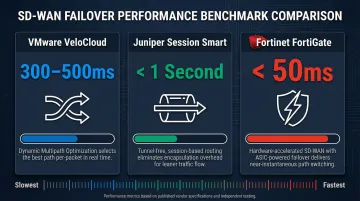
Performance benchmarks vary significantly by vendor. VMware VeloCloud detects WAN link failures in 300 to 500 milliseconds and immediately reroutes traffic to an active link. Juniper Session Smart Router executes failovers in less than a second using its tunnel-free Secure Vector Routing protocol. Fortinet FortiGate can achieve failover times under 50ms depending on network configuration.
KPIs this influences:
- Application uptime percentages
- Mean time to recovery (MTTR) during link failures
- Voice/video quality scores (MOS)
- Latency and jitter measurements for VoIP and video conferencing
Security Architecture and Compliance Support
Security must be built into the SD-WAN fabric, not bolted on afterward. The vendor should offer integrated next-generation firewall (NGFW), secure web gateway, zero-trust network access (ZTNA), or full SASE convergence. Security-light platforms force organizations to purchase separate overlapping tools — driving up both cost and complexity.
Deploying an integrated Secure SD-WAN solution delivered a 300% return on investment over three years, increased security and network team productivity by 50%, and improved network performance by 65% compared to disparate legacy systems.
Compliance dimensions matter for regulated industries:
- HIPAA: The HHS Security Rule requires technical security measures to guard against unauthorized access to ePHI transmitted over electronic networks
- PCI-DSS: Network segmentation isolates the cardholder data environment (CDE), reducing scope and risk of PCI DSS assessments
- CMMC: DoD CMMC Level 2 requires FIPS-validated encryption algorithms for remote access sessions protecting Controlled Unclassified Information (CUI) in transit
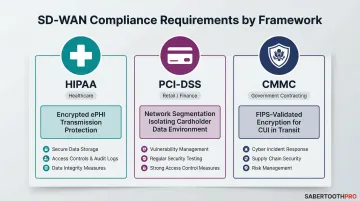
Vendors supporting these frameworks must demonstrate encrypted traffic segmentation, audit logging, and policy-based access controls. For businesses in healthcare, finance, government contracting, and legal sectors, this capability is non-negotiable.
Track these metrics:
- Compliance audit pass rates
- Security incident detection and response times
- Network segmentation effectiveness
- Encryption coverage across all traffic flows
Cloud and SaaS Application Integration
Modern businesses are cloud-first. Nearly half of enterprise WAN traffic now goes to external cloud or SaaS providers, with the average enterprise tracing 48% of its WAN traffic to external destinations. SD-WAN must optimize traffic destined for cloud platforms including AWS, Azure, Microsoft 365, Salesforce, and UCaaS tools.
The vendor's cloud integration should cover:
- Cloud on-ramp features that create direct connections to major cloud providers
- Direct internet breakout at the branch that routes cloud traffic locally rather than backhauling through a central data center
- Integration with cloud gateways and CDN platforms
Microsoft's connectivity principles warn that backhauling traffic to a central head office creates network hairpins that greatly lengthen the network path, increasing latency and reducing Office 365 performance. Vendors that force all traffic through centralized inspection points eliminate the performance advantage of SD-WAN for cloud applications.
Measure impact through:
- SaaS application response times
- Call quality on cloud-hosted UCaaS platforms
- Video conferencing packet loss rates
- Frequency of application-level performance complaints
Scalability and Deployment Flexibility
A vendor that fits well at five locations may create operational friction at fifty. Zero-touch provisioning (ZTP) support, site onboarding speed without on-site IT resources, and a licensing model that scales affordably as branch count grows all determine whether the platform can keep pace with the business.
The efficiency gains from mature ZTP workflows are measurable:
| Vendor | Deployment Efficiency Gain |
|---|---|
| Fortinet Secure SD-WAN | 75% time savings per new deployment |
| Cisco SD-WAN ZTP | 30–60 minutes saved per device vs. manual CLI configuration |
| Hughes (pharmacy rollout) | 2,000+ stores in six months, averaging 137 sites weekly at under 10 minutes per cutover |
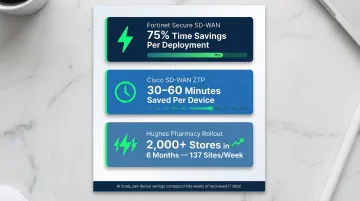
At scale, per-device time savings compound into weeks of recovered labor — and that efficiency requires centralized policy templates and vendor support capable of coordinating multi-site rollouts.
Business metrics affected:
- Average time to provision a new site
- IT labor hours required per deployment
- Total cost delta between current site count and projected growth over 24–36 months
Centralized Visibility and Management
Network complexity grows with every site added. Without a single-pane-of-glass management platform, IT teams lose visibility into performance degradation, policy drift, and security incidents across distributed locations.
The vendor's dashboard should provide:
- Real-time application-level analytics showing which applications consume bandwidth and how they perform
- Historical trending that reveals patterns and enables capacity planning
- Alert thresholds with customizable notifications for latency, packet loss, and jitter
- Role-based access for multi-team environments where network, security, and application teams need different views
KPIs this influences:
- Mean time to detect (MTTD) network issues
- IT troubleshooting hours per incident
- Ability to demonstrate network health during audits or SLA reviews
Total Cost of Ownership and Vendor Support Quality
The initial quote rarely captures total cost. Hardware amortization, per-site licensing fees, support tier costs, bandwidth overages, and upgrade pricing all factor into the three-to-five-year picture. Organizations reduce WAN costs by 38% over five years with SD-WAN when accounting for connectivity, IT staff time, and lost user productivity due to outages.
Underestimated cost categories include:
- Implementation and professional services fees (typically 10–20% of first-year costs)
- Circuit installation charges ($500 to $2,000 per site)
- Hardware purchases (roughly $1,000 per site for self-managed deployments)
- Annual support renewals and feature upgrades
Vendors with strong 24/7 NOC-backed support free up internal IT teams from routine monitoring. For lean IT organizations, proactive monitoring and vendor-managed incident response are worth the premium.
KPIs this influences:
- Three-year total WAN cost
- Support ticket resolution SLAs
- Availability of proactive monitoring versus reactive-only support
Red Flags to Watch Out for During SD-WAN Vendor Evaluation
Vendor lock-in disguised as proprietary optimization: Some vendors use closed hardware ecosystems or non-standard protocols that make future migrations prohibitively expensive. Ask vendors directly about hardware portability, open API availability, and what the exit process looks like if the relationship ends.
Cisco Catalyst SD-WAN's tiered, bandwidth-dependent licensing is a well-documented example of how total cost becomes difficult to forecast as organizations scale.
Demo environment versus production reality gap: Request proof-of-concept deployments in environments that resemble the actual business—multi-site, mixed transport, real SaaS workloads—rather than accepting lab demos as sufficient validation. G2 verified user reviews note that while Cisco Catalyst SD-WAN offers powerful management, it features a steep learning curve for managing policies in production environments. Third-party reviews and analyst ratings verify whether vendor performance claims hold up in customer deployments.
SD-WAN that doesn't fit the broader IT stack: Even a technically sound SD-WAN solution becomes a liability if it can't connect to the tools already in use. A vendor without native integrations will require middleware, workarounds, or redundant tooling — driving up both complexity and cost.
Before committing, confirm how the solution connects to:
- Existing firewalls and next-gen security appliances
- SIEM platforms for centralized log and threat visibility
- Identity management systems (SSO, LDAP, Active Directory)
- Cloud infrastructure and UCaaS environments
How SabertoothPro Can Help
Going directly to a single SD-WAN vendor means getting a quote shaped by that vendor's sales incentives — not your actual requirements. SabertoothPro works differently. As a vendor-agnostic IT advisory partner with a 300+ channel provider ecosystem, it benchmarks options across all major SD-WAN vendors and matches solutions to your specific performance needs, compliance obligations, and budget.
The advisory process is built around real-world pricing benchmarks drawn from continuously updated industry contract data. That means negotiating on your behalf with accurate market context — not vendor-provided estimates. From discovery through deployment, monitoring, and ongoing optimization, clients aren't left to self-manage a complex platform once the contract is signed.
What backs that up in practice:
- Carrier-certified status ensuring direct access to preferred pricing and technical support
- Globalgig-integrated connectivity for multi-carrier access and maximum uptime
- HIPAA-compliant solution design for healthcare and regulated industries
- SOC 2 Type II, PCI-DSS, and CMMC compliance support for security-conscious organizations
- National installer network for field deployment across distributed locations
- No minimum commitment requirements, allowing SabertoothPro to act as an independent technology fiduciary
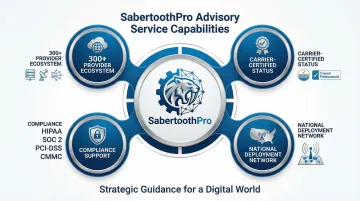
The result: a shortlist of vendors that fits your environment — with pricing already negotiated — rather than a sales pitch from a single provider with limited visibility into what else is available.
Conclusion
The right SD-WAN vendor is the one whose architecture, security posture, scalability model, and support structure align with your specific operational priorities — not just the most recognized name or the lowest initial price. Use the six criteria outlined in this article—performance and reliability, security and compliance, cloud integration, scalability, centralized management, and total cost of ownership—as the basis for building an evaluation scorecard.
SD-WAN is not a set-and-forget infrastructure investment. Network demands shift as businesses adopt new cloud applications, expand locations, and confront new security threats.
Build periodic performance reviews and vendor accountability checkpoints into your contracts from day one. The organizations that do this consistently extract far more value from their SD-WAN investment than those who only revisit the decision when something breaks.
Frequently Asked Questions
What is the difference between SD-WAN and traditional MPLS?
MPLS is a private, hardware-dependent WAN with guaranteed performance but high cost and limited flexibility. SD-WAN uses software to route traffic dynamically across multiple transport types including broadband and LTE, offering comparable or better application performance at lower cost with greater scalability.
How many SD-WAN vendors should a business evaluate before deciding?
Businesses should shortlist three to five vendors after an initial RFP process. Working with a vendor-agnostic advisor can streamline this by pre-qualifying vendors against the organization's specific requirements before formal evaluation begins.
How long does SD-WAN deployment typically take?
Single-site deployments can be completed in days with zero-touch provisioning. Multi-site enterprise rollouts range from several weeks to a few months depending on hardware logistics, carrier coordination, and change management complexity.
Is SD-WAN secure enough for regulated industries like healthcare and finance?
Enterprise-grade SD-WAN platforms support encrypted traffic, network segmentation, and compliance controls for HIPAA, PCI-DSS, and CMMC. Security depth varies significantly by vendor, so regulated organizations should evaluate platforms with documented certifications and built-in NGFW or SASE capabilities.
Can SD-WAN support remote workers and cloud-only business environments?
Yes. Modern SD-WAN platforms support remote workers through ZTNA or VPN integration and are built for cloud-first environments with direct SaaS breakout and cloud on-ramp features that eliminate unnecessary backhaul to a central data center.
What is the typical total cost of SD-WAN compared to an MPLS-only network?
SD-WAN typically reduces WAN costs by replacing dedicated MPLS circuits with lower-cost broadband and LTE. For an accurate comparison, request a three-to-five-year TCO analysis covering hardware, licensing, support, and professional services, not just monthly circuit fees.