Introduction
IT teams in 2026 face a convergence challenge: managing distributed workforces, cloud-first architectures, and mounting cyberthreats—all at once. Organizations struggle with fragmented vendor stacks, inconsistent security policies across locations, and ballooning network costs as MPLS circuits strain under cloud traffic.
SD-WAN has become the connective tissue of a unified SASE strategy. Pick the wrong provider and the fragmentation gets worse, not better:
- Policy gaps open between networking and security layers
- Latency compounds when point-of-presence architectures don't align
- Licensing costs balloon across disconnected multi-vendor stacks
This guide cuts through the vendor noise to rank the top SD-WAN providers on what actually matters for SASE readiness: how well their architecture converges networking and security, how far their global PoP coverage reaches, and whether they scale from SMB to enterprise without breaking the budget.
Key Takeaways
- SD-WAN is the network foundation for unified SASE, combining application-aware routing with security service edge functions like ZTNA, SWG, and CASB
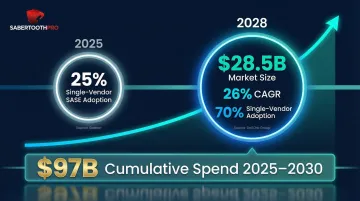
- Gartner projects 70% of SD-WAN purchases will be part of single-vendor SASE platforms by 2028, up from 25% in 2025
- Top providers: Cato Networks, Fortinet, Palo Alto Networks Prisma SASE, Cloudflare One, Cisco Catalyst SD-WAN
- Selection criteria: natively integrated SSE (built-in, not added on), global PoP coverage, licensing transparency, compliance certifications
- The right platform depends on your existing infrastructure, compliance requirements, and where your business is headed—vendor-agnostic evaluation gives you a cleaner read on fit
What Is SD-WAN's Role in a Unified SASE Architecture?
SD-WAN is the intelligent networking layer that routes application traffic across multiple WAN transports (broadband, LTE, MPLS) using policy-based controls. Gartner's SASE model requires SD-WAN as the network foundation, connecting it to SSE (Security Service Edge) components to form a complete converged architecture:
- SWG (Secure Web Gateway) — filters web traffic and enforces acceptable use policies
- CASB (Cloud Access Security Broker) — monitors and controls cloud application access
- ZTNA (Zero Trust Network Access) — grants least-privilege access based on identity and context
- FWaaS (Firewall as a Service) — delivers cloud-native firewall capabilities at the network edge
Unified SASE means both SD-WAN and SSE functions are delivered through a single vendor platform on a shared control plane. This eliminates policy gaps and management overhead. Networking and security teams no longer operate separate consoles, identity stores, and licensing models — a fragmentation that quietly inflates both cost and risk.
The market numbers reflect this shift. Gartner estimates the SASE market will reach $28.5 billion by 2028 at a 26% CAGR, with Dell'Oro Group forecasting cumulative SASE spending of $97 billion from 2025–2030. For organizations evaluating providers in 2026, the practical question is which vendors actually deliver on convergence — and which are repackaging separate products under a single brand.
Top SD-WAN Providers for Unified SASE in 2026
Providers were evaluated on native SSE integration depth (not co-branding), cloud-delivered architecture, global PoP coverage, hybrid work and multi-cloud support, and licensing transparency.
Cato Networks
Cato is a cloud-native SASE platform that built SD-WAN and SSE as a single converged service from the ground up—one of the few true single-vendor SASE options available today. Its appeal is strongest for mid-market organizations seeking operational simplicity without sacrificing security depth. Cato was recognized as a Leader in the 2025 Gartner Magic Quadrant for SASE Platforms.
What makes Cato stand out: its global private backbone with 85+ PoPs eliminates the tradeoff between security and performance. All security functions—ZTNA, FWaaS, SWG, CASB, DLP, RBI—run in-line in the same cloud platform. No separate appliances, no integration projects, no policy translation between networking and security teams.
| Feature | Details |
|---|---|
| Key SASE Components | SD-WAN, ZTNA, SWG, CASB, FWaaS, DLP, RBI, EPP/EDR/XDR integration—all native |
| Deployment Model | 100% cloud-delivered; physical socket appliance at branch, no dedicated security hardware |
| Best Fit | Mid-market to enterprise organizations prioritizing operational simplicity and single-vendor SASE |
Fortinet (FortiSASE + FortiSD-WAN)
Fortinet is a security-first vendor that tightly integrated its industry-leading firewall and SD-WAN capabilities into a converged FortiSASE offering. Its presence is strong in mid-market and regulated industries where compliance certifications matter as much as feature depth.
Fortinet's differentiator: FortiOS runs identically across hardware appliances, virtual instances, and cloud—giving consistent security policy across on-prem data centers and remote users. Broad compliance certifications including FIPS 140-2/3, Common Criteria, PCI-DSS, and SOC 2 Type II aligned with HIPAA make it attractive for healthcare and finance verticals. Fortinet is a Leader in the 2025 Gartner Magic Quadrant for SASE Platforms.
| Feature | Details |
|---|---|
| Key SASE Components | SD-WAN (FortiGate), ZTNA, SWG, CASB, Cloud-delivered NGFW |
| Deployment Model | Hybrid: on-prem FortiGate appliances + FortiSASE cloud service; unified FortiOS management |
| Best Fit | SMB to mid-market; regulated industries (healthcare, finance, government) requiring deep compliance coverage |
Palo Alto Networks (Prisma SASE)
Prisma SASE converges Prisma Access (SSE) with Prisma SD-WAN—delivering a full SASE stack from a single enterprise-grade vendor. Palo Alto is a consistent Gartner Magic Quadrant leader, named a SASE leader for the third consecutive time in 2025.
Key differentiators:
- AI-powered security with AIOps for proactive network operations
- ZTNA 2.0 extending zero trust to all app types—including SaaS—with continuous trust verification
- Autonomous Digital Experience Management (ADEM) for end-to-end visibility via Real User Monitoring and synthetic testing, enabling IT teams to troubleshoot performance issues across the full SASE fabric
| Feature | Details |
|---|---|
| Key SASE Components | Prisma SD-WAN, ZTNA 2.0, SWG, CASB, FWaaS, DLP, ADEM |
| Deployment Model | Cloud-delivered Prisma Access + hardware/virtual SD-WAN nodes; centralized Strata Cloud Manager |
| Best Fit | Mid-market to large enterprise; security-first organizations requiring advanced threat prevention and AI-driven operations |
Cloudflare One (Magic WAN)
Cloudflare One is a SASE platform built on Cloudflare's global anycast network spanning 335 cities in 125+ countries. It offers SD-WAN via Magic WAN and a full SSE stack including Zero Trust Network Access, SWG, Email Security, and Remote Browser Isolation.
Cloudflare's differentiator: its network-as-a-service model means no dedicated SASE PoPs—traffic routes through Cloudflare's existing internet edge, minimizing latency globally. Developer-friendly API-first architecture makes it attractive for cloud-native and hybrid enterprises that want programmatic control over networking and security policies. Cloudflare was named a Visionary in the 2025 Gartner Magic Quadrant for SASE Platforms.
| Feature | Details |
|---|---|
| Key SASE Components | Magic WAN (SD-WAN), ZTNA, SWG, CASB, Email Security, RBI, DDoS protection |
| Deployment Model | 100% cloud-delivered; no proprietary hardware required; CNI and GRE/IPsec tunnel connectivity |
| Best Fit | Cloud-native organizations, SMBs scaling fast, distributed enterprises needing global performance at competitive pricing |
Cisco Catalyst SD-WAN + Cisco+ Secure SASE
Cisco is the incumbent network leader with the broadest ecosystem integration in this space. Its Catalyst SD-WAN (formerly Viptela), combined with Cisco+ Secure SASE (powered by Umbrella SSE and Duo ZTNA), is built for organizations already invested in Cisco infrastructure.
Differentiators: deep integration with existing Cisco switching, routing, and Meraki environments; ThousandEyes network intelligence natively integrated for end-to-end visibility across internet paths; strong multicloud on-ramp support for AWS, Azure, and GCP. Cisco is a five-time Leader in the 2024 Gartner Magic Quadrant for SD-WAN.
| Feature | Details |
|---|---|
| Key SASE Components | Catalyst SD-WAN, Cisco Umbrella (SWG/CASB/DNS), Duo ZTNA, ThousandEyes, Meraki integration |
| Deployment Model | On-prem/cloud hybrid; Cisco vManage (now Cisco SD-WAN Manager) + cloud-delivered SSE; Meraki auto-VPN option for SMB |
| Best Fit | Organizations with existing Cisco infrastructure; enterprises requiring multi-cloud visibility and complex hybrid WAN environments |
How We Chose the Best SD-WAN Providers for Unified SASE
Our evaluation focused on SASE convergence depth — not co-branding. The question most buyers skip: do SSE and SD-WAN functions actually share a common control plane?
Vendors marketing "SASE" often deliver siloed products requiring separate licensing, separate management consoles, and significant integration work. Real convergence means a single identity store, a unified policy engine, and one operational model — not three dashboards duct-taped together.
Additional weighted criteria:
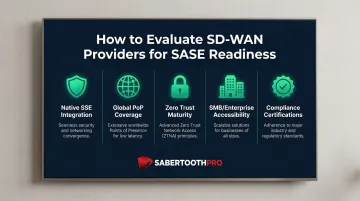
- Global PoP/anycast coverage for latency-sensitive workloads
- Zero Trust maturity, particularly ZTNA coverage for all traffic types including legacy apps
- SMB and mid-market accessibility in pricing model and deployment complexity
- Compliance certification alignment with regulated US industries—SOC 2 Type II, FedRAMP (for government), HIPAA readiness, PCI-DSS, ISO 27001
When vetting vendor claims, ask these directly:
- Do SD-WAN and SSE policies share one management plane?
- Can a single admin modify routing and firewall rules in the same console?
- Does user identity propagate consistently across all security inspection points?
Conclusion
The best SD-WAN provider for unified SASE in 2026 genuinely converges networking and security under a single operational model. When pressure-testing vendor claims, focus on a few key criteria:
- SD-WAN and SSE policies share one management plane and one identity store
- AI/automation investments show a credible, funded roadmap — not just a slide deck
- PoP expansion plans align with your geographic footprint
- Current feature parity is verified, not just marketed
These factors matter more than any single vendor's checklist today.
SabertoothPro works as an independent advisor across 300+ technology partners — including SASE providers like Cloudflare — so recommendations reflect real-world pricing data, not vendor incentives. That means businesses get an unbiased comparison, contract benchmarks pulled from actual deployments, and a deployment plan built around their infrastructure and compliance requirements. Reach out to see which unified SASE platform fits your environment and scaling plans.
Frequently Asked Questions
What is the difference between SD-WAN and SASE?
SD-WAN is the networking layer that provides intelligent WAN routing and application optimization across multiple transports. SASE is a broader framework combining SD-WAN with cloud-delivered security services like ZTNA, SWG, and CASB. SASE requires SD-WAN as its foundation but adds identity-driven security on top.
Is SD-WAN required to implement SASE?
SASE can run over basic internet connectivity, but SD-WAN is essential for real-world performance. It handles intelligent traffic steering, failover, and application-aware routing — capabilities that most leading SASE vendors now include as a core component.
Which SD-WAN providers offer the most complete single-vendor SASE in 2026?
Cato Networks and Palo Alto Networks Prisma SASE are most frequently cited as true single-vendor SASE platforms where SD-WAN and SSE share a unified control plane. Fortinet and Cisco offer tightly integrated but architecturally hybrid approaches with on-prem and cloud components.
How much does SD-WAN cost for a small or mid-sized business?
Basic SD-WAN deployments typically cost $100-$300 per site per month, while premium solutions with advanced security run $500-$1,000+ per site. Costs vary significantly by provider, number of sites, and bundled security features. Working with a vendor-agnostic advisor reveals significant pricing differences across the same vendors.
Can SD-WAN replace MPLS entirely?
SD-WAN can replace MPLS for most workloads by combining broadband, LTE/5G, and internet links with intelligent failover. Organizations typically see 50-84% cost reductions when shifting from pure MPLS to SD-WAN. Some latency-sensitive or compliance-driven use cases may retain a hybrid MPLS+SD-WAN approach during transition.
What compliance certifications should I look for in a SASE provider?
Organizations in healthcare, finance, or government should verify SOC 2 Type II, FedRAMP (for government), HIPAA readiness, PCI-DSS support, and ISO 27001 certifications. Certifications matter, but overall security posture alignment should drive the evaluation, not feature lists alone. Also confirm whether the vendor signs Business Associate Agreements for HIPAA compliance.