This guide delivers a practical, checklist-driven framework for evaluating IT vendor partners across the factors that actually determine success: technical fit, compliance credentials, scalability, support quality, total cost of ownership, and proven track record. Whether you're selecting a UCaaS provider, cloud infrastructure partner, or full-stack technology advisor, this framework helps you move from gut-feel to evidence-based decisions that protect your business for years to come.
Key Takeaways
- Technical fit, compliance certifications, and support quality drive operational outcomes more than price alone
- Verify industry-specific certifications (SOC 2 Type II, HIPAA, PCI-DSS, CMMC) before signing contracts in regulated sectors
- Evaluate scalability upfront; vendors that can't grow with you become a bottleneck, not a partner
- SLAs with defined response times and breach remedies are what separate a strategic partner from a commodity vendor
- Working with a vendor-agnostic advisor like SabertoothPro provides unbiased access to 300+ vetted technology providers without vendor-driven sales pressure
What Is an IT Vendor Partner?
An IT vendor partner is more than a supplier fulfilling purchase orders. It's a technology provider whose solutions and ongoing support align with your operational goals — not just your immediate purchasing needs. Unlike vendors who simply deliver products and disappear, strategic IT partners take a consultative role—designing solutions for your specific environment, supporting implementation, and adapting technology as your business evolves.
That relationship structure determines real outcomes. Here's how the two models differ:
- Transactional vendors handle one-time or product-specific deployments — you buy connectivity, they provision circuits, done.
- Strategic IT partners embed themselves in your technology roadmap, accounting for compliance obligations, growth trajectory, and integration requirements before recommending anything.
As businesses manage an average of 335 applications across connectivity, cloud, security, communications, and IoT, how you structure vendor selection directly determines whether your stack holds together or fractures under load. The more vendors you coordinate, the higher the risk of fragmented systems, inconsistent SLAs, and duplicated spend.
Why the Wrong IT Vendor Costs More Than You Think
The financial impact of poor vendor selection extends far beyond contract value. IT project failures driven by vendor mismatch carry massive financial consequences: 84% of IT integrations fail or experience significant issues. When you add the cost of downtime, compliance violations, and vendor lock-in penalties, the total exposure adds up fast.
Downtime Costs Are Higher Than Most Businesses Realize
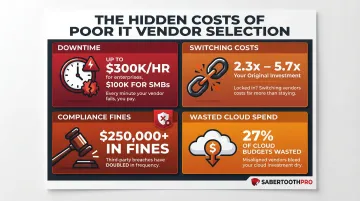
According to ITIC's 2024 survey, the average cost of a single hour of downtime exceeds $300,000 for over 90% of mid-size and large enterprises. For SMBs with 20 to 100 employees, 57% report that an hour of downtime costs up to $100,000. Poor vendor support that delays issue resolution directly multiplies this cost.
Vendor Lock-In Multiplies Switching Costs
Switching vendors after a poor selection isn't a simple contract termination. Vendor lock-in creates switching costs ranging from 2.3x to 5.7x the original implementation investment. Early termination fees, data migration, and retraining expenses compound rapidly — trapping businesses in underperforming relationships for years.
Compliance Gaps Invite Regulatory Fines
Vendors without proper certifications expose businesses in regulated industries to audit failures and fines. The 2025 Verizon Data Breach Investigations Report found that third-party breaches doubled year-over-year, rising from 15% to 30% of all breaches. Business associates are directly liable for HIPAA violations—HHS OCR fined one organization $250,000 in 2024 for compliance failures.
Vendor Sprawl Drives Hidden Waste
Managing multiple disconnected vendors without a unified strategy creates financial bloat. Organizations report that 27% of cloud spend is wasted due to uncoordinated purchasing. In cybersecurity, businesses average 10 cloud security tools, which increases costs and introduces vulnerabilities. Fragmented invoicing, inconsistent SLAs, and duplicated spend are the direct results of ad-hoc vendor selection.
The four cost categories break down like this:
- Downtime: Up to $300,000 per hour for enterprises; up to $100,000 for SMBs
- Switching costs: 2.3x–5.7x the original implementation investment to exit a bad contract
- Compliance fines: Third-party breach liability doubled in 2025; HHS fined one org $250,000
- Wasted cloud spend: 27% of cloud budgets lost to uncoordinated vendor purchasing
IT Vendor Selection Checklist: 6 Key Factors to Evaluate
These six factors give you a repeatable framework for moving vendor evaluation from gut feel to objective scoring. Each one connects a specific technical requirement to a business outcome — so you're not just picking a vendor, you're building a defensible case for the right one.
Technical Capabilities and Solution Fit
Assessing whether a vendor's technology matches your specific business needs is the foundational step. A vendor with impressive capabilities in one environment may be completely wrong for yours. IDC research shows that 65% of failed integrations stem from poor data quality, mismatched identifiers, or privacy gaps—problems that surface when technical fit isn't properly evaluated upfront.
Critical Questions to Ask:
- Does the vendor support integration with your existing technology stack (ERP, CRM, communication platforms)?
- Do they have proven deployments in your industry vertical with similar compliance and scale requirements?
- What is their product roadmap for the next 2-3 years, and does it align with your business growth trajectory?
- Can they demonstrate interoperability with your current systems without extensive custom development?
Use frameworks like Gartner's IT Vendor Selection Tool to transform technology requirements into side-by-side competitive analysis. IDC's RFP and Vendor Selection Scoring Model provides repeatable evaluation criteria across both RFP and demo phases to prevent ad-hoc, inconsistent scoring.
Security, Compliance, and Certifications
Once you've confirmed technical fit, compliance becomes the next filter — and it's a hard one. For regulated industries like healthcare, finance, and government contracting, missing certifications create legal exposure that no indemnification clause fully covers.
Key Certifications by Industry Context:
| Certification | Applies To | What It Signals |
|---|---|---|
| SOC 2 Type II | Any organization handling customer data | Controls are designed and operating effectively over time to protect security, availability, and confidentiality |
| HIPAA (Business Associate) | Healthcare providers, health plans, and their vendors | Vendor will appropriately safeguard protected health information (PHI) through written Business Associate Agreements |
| PCI-DSS | Any entity storing, processing, or transmitting cardholder data | Baseline technical and operational requirements to protect payment account data |
| CMMC Level 2 | Defense contractors handling Controlled Unclassified Information (CUI) | Minimum cybersecurity standards required for DoD contract eligibility |
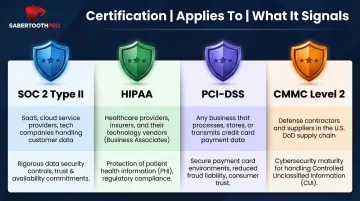
Business associates are directly liable for HIPAA violations. HHS OCR settled with one business associate for $10,000 following a breach affecting 15 million individuals. PCI-DSS violations result in fines levied by card networks and acquiring banks. CMMC non-compliance disqualifies contractors from DoD awards entirely.
Scalability and Future-Proofing
Compliance locks you in on risk — scalability determines whether the vendor can grow with you. Evaluate this before signing, not after your headcount doubles or you open a second location.
Scalability Evaluation Checklist:
- Expansion to new locations: no per-site penalties or geographic restrictions
- Usage flexibility: scale up or down without early termination fees or minimum user floors
- Published product roadmap aligned with AI, automation, and edge computing trends
- Contract provisions for adding services or adjusting capacity mid-term
IDC reports that SMBs are moving rapidly from technology experimentation to strategic adoption, particularly with AI and cloud technologies. By 2026, businesses will rely heavily on GenAI tools and cloud marketplaces. One in four businesses expects to reduce technology spending by up to 25% in the next 12 to 24 months, making scalable, usage-based consumption models critical.
Support Model, SLAs, and Responsiveness
Two vendors can look nearly identical on a spec sheet. Support is usually what separates them. Slow response times, unclear escalation paths, or offshore-only coverage can turn a routine outage into extended downtime — and enterprise downtime routinely runs into six figures per hour.
SLA Checklist:
- Contractual response times for P1 (critical), P2 (high), P3 (medium), and P4 (low) incidents
- Resolution targets defined — not just initial response acknowledgment
- 24/7 support included in base pricing, or billed separately as an add-on
- Named technical account manager vs. routing through general support queues
- Financial or service credits defined for SLA misses
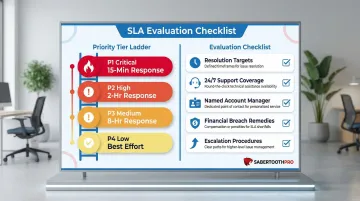
Enterprise-grade providers typically offer 15-minute response times for critical incidents, 2 hours for high-impact issues, and 4-8 hours for lower-priority requests. Forrester notes a growing shift from traditional SLA metrics to Experience-Level Agreements (XLAs) that focus on outcomes like ease of use and responsiveness rather than just technical uptime.
Total Cost of Ownership and Contract Flexibility
The quoted price is rarely the final price. Installation fees, per-site charges, data egress fees, overage penalties, and auto-renewal escalators all feed into Total Cost of Ownership (TCO) — and vendors rarely volunteer that math upfront.
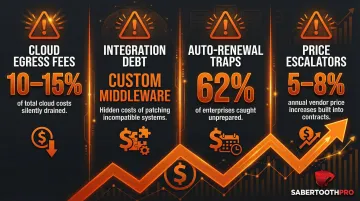
Hidden Cost Drivers:
- Cloud egress fees: Gartner estimates egress fees can make up 10% to 15% of total cloud costs, acting as a vendor lock-in mechanism
- Integration debt: Custom middleware or specialized connectors add significant upfront and ongoing costs when out-of-the-box integrations are inadequate
- Auto-renewal traps: 62% of enterprises have been caught by auto-renewal clauses in the past year, resulting in unintended renewals at higher rates
- Price escalators: The average SaaS contract includes a 5-8% annual price increase compounding year over year
Contract Flexibility Checklist:
- Are there minimum term commitments, or can you operate month-to-month?
- What are the early termination penalties if the vendor underperforms?
- Are pricing escalators capped or open-ended?
- Is data portability contractually guaranteed, or will migration costs create lock-in?
In 2023, buyers showed increased preference for avoiding multi-year agreements to maintain maximum flexibility. Benchmark-driven pricing evaluation—comparing vendor quotes against real-world market data—ensures you're not overpaying relative to industry norms.
Vendor Track Record and Industry References
Past performance in your specific industry is the most reliable predictor of future results. Case studies and client references give you evidence — marketing claims give you none.
How to Vet Track Record:
- Request references from similar clients: Ask for contacts at organizations with comparable size, industry, and compliance requirements
- Review publicly available certifications: Verify partner accreditations and compliance credentials through third-party registries
- Research outage history: Evaluate the vendor's historical uptime and incident response performance
- Check for contract disputes: Search public records or industry forums for patterns of service failures or legal issues
Deloitte research on ERP selection shows vendor ecosystem and culture currently receive 10% weight during evaluation — and recommends increasing that to 15%. Don't treat reference checks as a formality. They're often where selection decisions are won or lost.
How SabertoothPro Can Help You Choose the Right IT Partner
Evaluating IT vendors across all six factors simultaneously is resource-intensive for SMBs without dedicated procurement teams. SabertoothPro acts as an independent IT advisor, conducting evaluation work on behalf of clients using real-world pricing benchmarks and a 300+ partner ecosystem. Recommendations are unbiased and tailored to your business, not driven by vendor commission incentives.
SabertoothPro's Key Differentiators:
- Carrier-certified across UCaaS, CCaaS, SD-WAN, SASE, Cloud, Colocation, and IoT categories
- Compliance-aligned solutions covering HIPAA, SOC 2 Type II, PCI-DSS, and CMMC standards
- No minimum commitments, operating as an independent technology fiduciary focused on client outcomes
- Benchmark-driven negotiation using current real-world pricing data to secure fair market rates
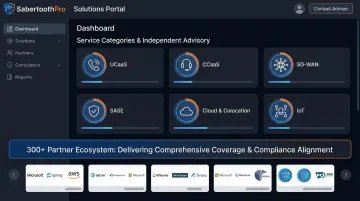
SabertoothPro provides lifecycle management from discovery through deployment, monitoring, and optimization. That means after a vendor is selected, SabertoothPro stays involved to track performance, flag issues, and adjust the solution as your business requirements change.
Conclusion
Choosing the right IT vendor is a strategic commitment that shapes your operational efficiency, compliance standing, and growth capacity for years. A structured checklist approach keeps vendor evaluations objective across the factors that matter most:
- Technical fit and integration compatibility
- Security credentials and compliance certifications
- Scalability to support future growth
- Support quality and response guarantees
- Total cost of ownership, not just sticker price
- Track record with businesses like yours
Vendor relationships should be reviewed periodically as business needs evolve. Working with an independent IT advisor — like Sabertooth Tech Group, which operates as a vendor-agnostic technology fiduciary across a 300+ provider ecosystem — ensures objectivity at every stage of selection and renewal, shielding your business from sales pressure and hidden contract terms that erode value over time.
Frequently Asked Questions
What is the difference between an IT vendor and an IT partner?
A vendor typically fulfills transactional product or service orders, while an IT partner takes a consultative role—aligning technology to business goals, providing ongoing support, and adapting solutions as needs change. Partners invest in your outcomes, not just your orders.
What certifications should I look for when choosing an IT vendor?
Look for SOC 2 Type II for data security, HIPAA compliance for healthcare, PCI-DSS for payment data, and CMMC for government contractors. Relevant certifications depend on your industry and the type of data your business handles.
How do I evaluate an IT vendor's security credentials?
Request documentation of active certifications, ask about penetration testing frequency, and verify whether compliance extends to sub-contractors in the vendor's supply chain. Third-party audits and publicly available certification registries provide independent verification of anything a vendor self-reports.
What questions should I ask an IT vendor before signing a contract?
Focus on five areas: SLA guarantees and breach remedies, total cost of ownership including hidden fees, contract flexibility and exit clauses, references from similar clients, and the vendor's technology roadmap.
How can I avoid vendor lock-in when selecting an IT partner?
Prioritize vendors with flexible or month-to-month contract options, ensure data portability is contractually guaranteed, and work with a vendor-agnostic advisor who can model alternatives objectively. Avoid long-term commitments until the vendor proves performance.
How long does the IT vendor selection process typically take?
Timelines vary by scope—a single-service evaluation may take 2-4 weeks, while a full IT stack assessment can take 1-3 months. Using a structured checklist and an experienced advisor can significantly compress the timeline by eliminating guesswork and focusing evaluation on the factors that matter most.