
Most institutions still run communication systems built for a different era. This article explains five practical, measurable benefits of Unified Communications as a Service (UCaaS) that go beyond marketing promises—grounded in what banks and financial services firms actually track: compliance readiness, cost control, and workforce productivity.
TL;DR
- UCaaS consolidates voice, video, messaging, and collaboration into one cloud platform—eliminating fragmented legacy systems
- Compliant-ready platforms embed PCI-DSS, SOC 2, and call recording controls without adding IT overhead
- Institutions reduce costs 30-60% during migration by eliminating per-branch hardware and maintenance contracts
- Branch staff, remote advisors, and back-office teams operate from one connected environment—no tool-switching, no silos
- Every quarter on legacy systems widens the gap between your institution and competitors already running on UCaaS
What Is UCaaS?
UCaaS is a cloud-delivered platform that consolidates business communications into a single system accessible from any device or location. For financial services firms, it replaces traditional PBX phone systems across bank branches, corporate offices, and remote teams. Unlike consumer tools, enterprise UCaaS includes the security, uptime, and compliance controls that regulated industries require.
A typical deployment brings together:
- Voice calls and direct extensions
- Video conferencing for internal and client meetings
- Instant messaging and presence indicators
- Secure file sharing across teams and locations
The practical impact goes well beyond dial tone. UCaaS determines how quickly a loan officer can reach underwriting, how reliably a branch serves customers during a system outage, and how easily compliance teams pull call records during an audit. For financial institutions managing distributed teams and strict regulatory requirements, that operational reliability is where the real value lies.
The 5 Key Benefits of UCaaS for Banking & Finance
The five benefits below focus on operational and compliance outcomes that financial institutions actually measure—not abstract technology features. Each maps to risks and inefficiencies specific to banking and finance, not generic business use cases.
Benefit 1: Built-In Compliance and Security Controls
UCaaS platforms designed for regulated industries embed compliance capabilities directly into the communication layer. Encrypted call recording, role-based access controls, and automatic data retention policies are built in—not bolted on through separate tools.
How This Works Operationally:
- Recorded calls are stored with encryption and retrieved for regulatory audits without manual intervention
- Access to sensitive communications is restricted by user role, preventing unauthorized listening or deletion
- Features like call masking prevent sensitive data (such as payment card numbers) from being exposed during phone interactions
- Automatic retention policies align with SEC Rule 17a-4 and FINRA Rule 4511 requirements
Financial institutions face overlapping compliance mandates—PCI-DSS for payment data, SOC 2 for cloud security, and FINRA/SEC recordkeeping rules for communications. According to IBM's 2024 Cost of a Data Breach Report, companies in the financial industry spend an average of $6.08 million dealing with data breaches, which is 22% higher than the global average.
UCaaS platforms with built-in controls reduce the manual effort of managing compliance requirements separately. A single gap in call recording or data handling can trigger regulatory fines, client lawsuits, or loss of operating licenses.
That risk isn't theoretical. In August 2024, the SEC charged 26 broker-dealers and investment advisers for off-channel communication failures, resulting in combined civil penalties of $392.75 million.
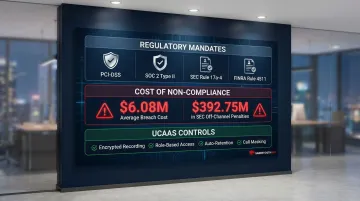
SabertoothPro's UCaaS solutions are evaluated against providers carrying PCI-DSS and SOC 2 Type II certifications, making compliance verification straightforward during vendor assessments.
KPIs Impacted:
- Audit response time
- Compliance incident rate
- Number of unrecorded or unretained communications
- Cost of compliance tooling per year
When This Advantage Matters Most:
This benefit delivers highest impact during regulatory audits, after data breach investigations, when onboarding new remote advisors, or when expanding into new states or markets with different compliance requirements.
Benefit 2: Significant Cost Reduction and Predictable Spending
UCaaS replaces per-branch PBX hardware, maintenance contracts, and multiple vendor relationships with a single subscription model—converting large, unpredictable capital expenditures into a flat, per-user monthly cost.
Real-World Usage:
A bank with 20 branch locations no longer needs separate phone system hardware at each site, a dedicated IT resource to manage each system, or separate contracts for voice, conferencing, and messaging tools. All of this consolidates under one provider and one invoice.
Traditional PBX systems require specialized hardware, licenses, and regular upkeep from skilled telecom workers, alongside expensive upgrades for new boards or software. According to Total Economic Impact studies, organizations reduce capital expenditures by 30% to 60% during migration to UCaaS.
| Cost Category | Traditional On-Premise PBX | Enterprise UCaaS |
|---|---|---|
| System Acquisition | Large upfront hardware purchase (servers, controllers) | No PBX hardware; cloud subscription |
| User Licensing | Per-extension licenses; hardware modules needed for upgrades | Per-user cloud subscriptions |
| Maintenance & IT Labor | High manual provisioning and on-site troubleshooting | Reduced operational complexity via centralized dashboards |
| Scaling | Hardware dependent and expensive | Elastic, easy, and cost-effective |
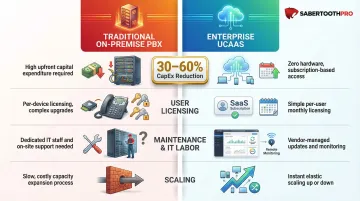
While subscription costs accumulate over time, the elimination of hardware depreciation, maintenance contracts, and manual provisioning allows most mid-sized organizations to reach cost parity by Year 2 or 3 and generate net positive ROI thereafter.
CFOs and finance operations leaders in banking favor UCaaS because the cost scales directly with headcount rather than infrastructure, making it far easier to forecast communications spend during expansions, acquisitions, or staffing changes.
KPIs Impacted:
- Total communications spend per employee
- IT maintenance hours per month
- Number of vendors managed
- Cost per branch for telephony infrastructure
When This Advantage Matters Most:
This benefit is most impactful during branch expansions, post-merger technology integration, or when a bank is consolidating from multiple regional phone vendors to a single national standard.
Benefit 3: Seamless Collaboration Across Branches and Remote Teams
UCaaS gives every employee—whether at corporate headquarters, a rural branch, or working from home—access to the same communication tools, with features like presence indicators, shared directories, and instant escalation from chat to voice or video.
Real-World Application:
A remote mortgage advisor can transfer a client call directly to an underwriter with one click, see whether a compliance officer is available before escalating, and join a team video call without switching to a separate app—all from a single UCaaS interface on any device.
Fragmented communication tools create delays, miscommunication, and audit trail gaps. Branch staff use desk phones, remote teams use personal devices, and collaboration happens across disconnected apps. UCaaS eliminates this by creating a single, logged communication environment that management can monitor.
According to a Forrester Total Economic Impact study on Zoom's unified communications platform, organizations add up to 52 weekly minutes of productivity per employee through integrated tools that reduce context switching.
Internal collaboration speed directly affects how quickly customers get answers on loan decisions, account issues, or investment queries—making internal UCaaS adoption a customer experience factor, not just an IT efficiency play.
The financial sector has heavily adopted hybrid work models. According to 2024 hybrid work research, professionals in the hybrid workforce have the highest engagement rates at 35%, compared to fully remote (33%) and in-office employees (27%). Six out of 10 employees in jobs where remote work is possible prefer a hybrid environment.

KPIs Impacted:
- Average internal response time
- Call transfer success rate
- Employee satisfaction with communication tools
- Number of communication platforms in use
When This Advantage Matters Most:
This benefit is highest-impact in banks undergoing rapid hiring of remote staff, institutions with branch networks across multiple time zones, or firms going through mergers where two different phone systems need to be integrated quickly.
Benefit 4: Faster, More Consistent Customer-Facing Responsiveness
UCaaS enables financial institutions to route customer calls intelligently—based on department, advisor availability, or customer account type—reducing hold times and ensuring clients always reach the right person on the first attempt.
Operational Impact:
Features like auto-attendant, skills-based routing, voicemail-to-email, and call analytics allow branch managers to monitor service levels in real time and adjust staffing or routing rules without waiting for IT support.
In financial services, communication failures have direct revenue and retention consequences. Missed calls from a client with a fraud alert, long hold times for a loan inquiry, or an unreturned voicemail from a high-net-worth client all drive churn.
According to the J.D. Power 2026 U.S. Retail Banking Satisfaction Study, 20% of retail bank customers have moved money away from their primary bank within the past three months, up from 17% the previous year.
Phone responsiveness is a critical factor. Industry studies show that nearly 80% of customers will hang up after being on hold for just one minute, and almost one-third of those who hang up will never call back.
The call center industry standard for a good First-Call Resolution (FCR) rate is 70% to 79%. For every 1% improvement in FCR, there is a corresponding 1% improvement in customer satisfaction.
KPIs Impacted:
- First-call resolution rate
- Average hold time
- Missed call rate
- Customer satisfaction score (CSAT) for phone interactions
Benefit 5: Business Continuity and Disaster Recovery
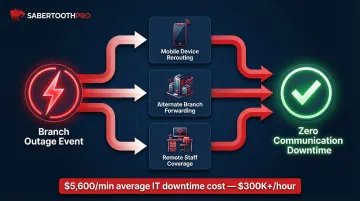
Because UCaaS is cloud-based, communication services are not tied to physical hardware at any single location. If a branch office loses power, faces a natural disaster, or experiences a network outage, calls can be automatically rerouted to mobile devices, other branches, or remote staff within seconds.
Operational Significance for Banking:
Financial institutions have strict uptime expectations from both regulators and customers. A cloud UCaaS platform with redundant carrier infrastructure and automatic failover removes communication downtime as a single point of failure during disruptions.
Banking regulators expect documented business continuity plans (BCPs) that cover communications infrastructure. UCaaS with documented uptime SLAs and automatic failover simplifies BCP compliance and reduces recovery time objectives (RTOs).
According to Gartner, the average cost of IT downtime is $5,600 per minute, which equates to over $300,000 per hour. For high-stakes sectors like financial services, these costs escalate rapidly due to lost revenue, idle labor, and service interruption penalties.
The 2023 Interagency Guidance on Third-Party Relationships from the Federal Reserve, FDIC, and OCC requires that contracts address the third party's responsibility for operational resilience. This includes maintaining current BCPs that specify recovery time and recovery point objectives.
KPIs Impacted:
- Mean time to recovery (MTTR) for communication outages
- Percentage of calls successfully rerouted during an outage
- BCP audit pass rate
What Happens When Financial Institutions Ignore UCaaS
Staying on legacy telephony creates compounding operational risks:
- Branch silos create service delays and miscommunication across locations
- No centralized call recording leaves the institution exposed during compliance audits
- Aging PBX maintenance drains IT budget that could fund customer-facing improvements
- Slow response to regulatory inquiries invites fines and reputational damage
In cases where communications cannot be produced during an audit, fines and reputational consequences follow regardless of whether a violation actually occurred.
That compliance exposure doesn't exist in isolation — it compounds a broader competitive disadvantage. As fintech competitors and digitally-native banks scale with agile communication tools, traditional institutions relying on legacy systems face slower internal coordination and higher per-interaction costs. They also struggle to retain advisors who expect modern workplace tools.
Despite the shift to the cloud, many regional banks remain tethered to depreciating PBXs, with less than 40% of businesses having completed their migration. Maintaining these systems is becoming more difficult and expensive as vendors end support. For example, Avaya will end manufacturer support for specific vintage releases of its G430 and G450 Gateways starting January 1, 2026.
How to Get the Most Value from UCaaS in Banking
UCaaS delivers maximum operational and compliance value when treated as a strategic communications foundation, not a routine cost-reduction exercise. Getting there requires three foundational decisions upfront:
- Select a provider with documented certifications for financial services (PCI-DSS, SOC 2 Type II)
- Integrate UCaaS with existing CRM and core banking platforms
- Establish governance over who can access, record, and retrieve communications
Working with a vendor-agnostic advisor like SabertoothPro helps financial institutions cut through that complexity. SabertoothPro evaluates solutions across 300+ providers and compares pricing against real-world contracts, so banks avoid overpaying for features they don't need — or choosing platforms that can't meet regulated-industry compliance requirements.
Three Operational Practices That Determine Long-Term Success:
- Review call analytics monthly — routing inefficiencies and missed call patterns surface quickly with consistent oversight
- Run annual compliance audits covering data retention policies and access logs
- Train branch managers on reporting features so decisions are based on real communication data, not assumptions
Frequently Asked Questions
What is UCaaS and how does it differ from a traditional bank phone system?
UCaaS delivers voice, video, messaging, and collaboration tools through the cloud on a subscription basis, replacing physical PBX hardware at each branch. This means no on-site equipment to maintain, instant updates, and access from any device or location.
Is UCaaS compliant with banking regulations like PCI-DSS and SOC 2?
Enterprise-grade UCaaS platforms built for financial services include compliance-ready features such as encrypted call recording, role-based access, and data retention policies. Buyers should verify that their provider holds current PCI-DSS and SOC 2 Type II certifications before deployment.
How does UCaaS reduce costs for financial institutions with multiple branches?
UCaaS eliminates per-branch hardware, reduces IT maintenance overhead, and consolidates voice, video, and messaging into a single vendor contract. This converts unpredictable capital costs into a predictable per-user monthly expense.
Can UCaaS support remote financial advisors and hybrid branch teams?
Yes. UCaaS is designed for distributed workforces—advisors, loan officers, and back-office staff can access the same communication tools from any device, with presence indicators and call transfer features that make location irrelevant to service quality.
What security features should a bank look for when evaluating UCaaS providers?
Key requirements include end-to-end encryption, automatic call recording with secure storage, role-based access controls, multi-factor authentication, and documented SLAs for uptime and incident response. Always ask for third-party certification evidence, not just vendor self-reporting.
How long does it typically take a financial institution to migrate to UCaaS?
Most financial institutions complete a phased rollout in 60–120 days, depending on the number of locations and integration complexity. Partnering with a UCaaS advisor who handles carrier coordination, number porting, and staff training keeps deployments on schedule.