Introduction
Managing your own data center drains budgets and stretches IT teams thin. U.S. commercial electricity rates jumped 8.3% year-over-year to 14.17 cents per kilowatt-hour in January 2026, making power costs a constant pressure point.
Meanwhile, 40% of server hardware in production is more than three years old, creating performance bottlenecks and technical debt that won't wait. Add 24/7 staffing requirements, redundant systems, and compliance certifications to that picture, and small and mid-sized businesses need a better option.
Standard colocation solves the physical facility problem by providing rack space, power, and connectivity. But it still places the full operational burden on your team. Managed colocation goes further, pairing enterprise-grade infrastructure with provider-handled operations: monitoring, patching, network management, and security operations.
This guide is for IT managers, business owners, and decision-makers at growing companies evaluating infrastructure options, particularly those in regulated industries with compliance obligations like HIPAA, PCI-DSS, or SOC 2.
TLDR:
- Combines physical data center space with operational services: monitoring, remote hands, and network management
- You retain hardware ownership and data control while the provider handles day-to-day operations
- Delivers enterprise-grade reliability without the cost of building a data center or hiring specialized staff
- More cost-predictable than cloud for high-utilization workloads and compliance-sensitive applications
What Is Managed Colocation and How Does It Work?
Managed colocation is a service model where your business houses its own servers and networking hardware in a third-party data center, while the provider takes on defined operational and management tasks. You retain hardware ownership and full data control.
The provider handles the day-to-day operational burden: monitoring infrastructure health, performing physical maintenance, managing network configurations, and responding to incidents around the clock.
Standard vs. Managed Colocation
In standard (unmanaged) colocation, you rent physical space, power, cooling, and bandwidth. Your IT team manages all hardware, software, networking, and security entirely on its own. If a server needs a reboot at 2 AM, you dispatch your staff or handle it remotely. If a network port fails, you troubleshoot and remediate it yourself.
Managed colocation layers operational services on top of that physical infrastructure. The provider's data center engineers become an extension of your team, handling tasks that would otherwise require dedicated internal headcount.
The "Managed" Spectrum
Managed services scope varies widely by provider and contract tier:
- Entry level: Remote hands support for physical tasks (cable swaps, reboots) and monitoring with alerting for critical thresholds
- Mid tier: OS patching and updates, backup management, and basic network configuration support
- Fully managed: Complete network management, firewall administration, intrusion detection and response, disaster recovery orchestration, and compliance reporting
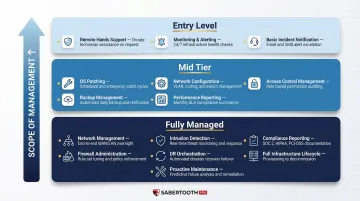
Define scope carefully during procurement. What one provider considers "managed" might be another's entry-level tier.
Managed Colocation vs. Managed Hosting
The key distinction: hardware ownership.
| Managed Hosting | Managed Colocation | |
|---|---|---|
| Hardware owner | Provider | You |
| What you pay for | Access to provider infrastructure + management | Your data center space + management |
| Best for | No existing hardware; prefer OpEx model | Existing hardware investments; CapEx already spent |
| Compliance fit | Shared infrastructure; may not meet all mandates | Dedicated hardware supports stricter audit requirements |
This distinction matters most for businesses with existing hardware investments, active depreciation schedules, or compliance requirements that mandate dedicated physical infrastructure. This is especially relevant for regulated industries where data sovereignty or audit requirements prohibit sharing physical resources.
Key Features of Managed Colocation Services
Physical Data Center Infrastructure
Enterprise-grade colocation facilities provide infrastructure that would cost millions to replicate in-house:
- Tier III or Tier IV-rated facilities: Tier III data centers are concurrently maintainable with redundant components, requiring no shutdowns when equipment needs maintenance or replacement. Tier IV facilities add fault tolerance—when equipment fails or distribution paths are interrupted, IT operations continue unaffected.
- Redundant power systems: Uninterruptible power supplies (UPS), backup generators with automatic failover, multiple utility feeds
- Precision cooling: Hot aisle/cold aisle containment, variable-speed cooling systems, humidity control
- Multi-carrier fiber connectivity: Direct access to multiple network carriers, redundant internet pathways, low-latency peering
That infrastructure gets shared across all tenants — which is why access costs a fraction of what a private build would run.
Remote Hands and On-Site Technical Support
Managed colocation providers maintain 24/7/365 data center technicians who perform physical tasks on your behalf:
- Server racking and cabling
- Hardware reboots and power cycling
- Component swaps (drives, RAM, power supplies)
- Physical troubleshooting and diagnostics
- Cable testing and port verification
Your team stays focused on higher-value work — no emergency drives to the data center at 2 a.m.
Managed Network Services
Network management is one of the most operationally intensive components and a major reason businesses choose managed over standard colocation:
- Monitors bandwidth consumption and handles capacity planning and circuit provisioning before bottlenecks develop
- Manages redundant paths with automatic failover between carriers and real-time route optimization
- Defends against DDoS attacks through traffic scrubbing, rate limiting, and active detection
- Maintains firewall rule sets, enforces policies, and aggregates security logs
- Connects multi-site environments via SD-WAN with application-aware routing and centralized control
Security Operations and Compliance Support
Physical security controls the first line of defense:
- Biometric access controls (fingerprint, iris scan, facial recognition)
- CCTV surveillance with recording retention
- On-site security personnel 24/7
- Mantrap entry systems and escort policies
Cybersecurity management covers the logical layer:
- Intrusion detection and prevention systems (IDS/IPS)
- Log aggregation and correlation
- Vulnerability scanning and patch management
- Security incident response
Providers also maintain compliance certifications that directly reduce audit burden for regulated industries:
- SOC 2 Type II: Evaluates whether controls are designed and functioning as intended over time, covering security, availability, and confidentiality
- PCI-DSS: Requirement 9 mandates restricting physical access to cardholder data, which certified facilities satisfy through documented access controls
- HIPAA-ready environments: Facilities implement policies and procedures to limit physical access to electronic information systems, meeting HIPAA Security Rule requirements for facility access and control
Monitoring, Patching, and Managed Operations
No other feature separates managed from standard colocation more clearly. Providers handle continuous operations so your team doesn't have to:
- Monitors server health, network connectivity, power and cooling, and storage thresholds around the clock with real-time alerting
- Applies OS patches and emergency security updates on schedule, including application updates where the contract covers them
- Automates backup scheduling, offsite replication, and retention enforcement — and tests restores so you know recovery actually works
- Orchestrates failover, tracks RTO and RPO targets, and runs DR tests to validate recovery readiness

Key Benefits of Managed Colocation for Businesses
Cost Efficiency Compared to On-Premise Data Centers
Power costs are the top expense increase reported by 42% of data center operators, followed by capacity expansion costs (32%), IT hardware costs (28%), and staffing costs (23%). Managed colocation eliminates capital expenditure for building or upgrading dedicated data center space, hardware refresh cycles, and facility maintenance.
You convert unpredictable infrastructure costs to predictable monthly operating expenses. No more surprise equipment failures, emergency HVAC repairs, or unplanned electrical upgrades.
Access to Enterprise-Grade Infrastructure at SMB-Friendly Economics
Because managed colocation facilities serve many customers simultaneously, infrastructure costs are distributed. A business gets redundant power systems, high-capacity cooling, carrier-grade connectivity, and physical security that would cost millions to replicate internally—for a fraction of the price.
Tier III facilities deliver 99.982% availability, meaning approximately 1.6 hours of allowable annual downtime. Tier IV facilities achieve 99.995% availability, with just 26 minutes of allowable downtime per year.
Operational Expertise Without the Hiring Cost
Managed colocation gives you access to certified data center engineers, network specialists, and security operations personnel without adding headcount. For SMBs and mid-market businesses with lean IT teams, this eliminates one of the most persistent staffing gaps in infrastructure management.
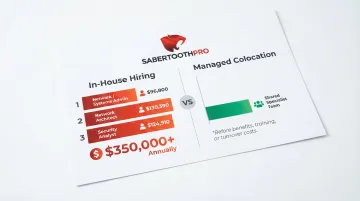
Median salaries for specialized staff illustrate the hiring burden:
- Network and computer systems administrators: $96,800 annually
- Computer network architects: $130,390 annually
- Information security analysts: $124,910 annually
Hiring just three full-time specialists costs over $350,000 per year before benefits, training, or turnover. Managed colocation providers employ teams of specialists whose costs are shared across all customers.
Improved Uptime and SLA-Backed Reliability
Managed colocation providers guarantee uptime through contractual service level agreements. Two common benchmarks from major providers:
- Equinix: 99.999% availability for redundant power — less than five minutes of unavailability over 12 months
- CyrusOne: 99.99% infrastructure availability with service credits for any breach
Redundant systems at the facility level mean a single hardware or connectivity failure doesn't take down operations. UPS systems bridge gaps during power transitions, and backup generators kick in automatically.
Multiple carrier connections add another layer of protection — if one provider goes down, network availability holds.
Stronger Compliance and Security Posture
Providers maintain facility-level certifications and supply audit documentation, compliance reports, and access logs that regulated businesses need. Three frameworks that directly benefit from this arrangement:
Providers maintain facility-level certifications and supply audit documentation, compliance reports, and access logs that regulated businesses need. Three frameworks that directly benefit from this arrangement:
- SOC 2 Type II: Evaluates whether controls function as intended over time, including documentation of physical access restrictions to protected assets
- PCI-DSS: Requires limiting and monitoring physical access to systems in the cardholder data environment — something the facility handles on your behalf
- HIPAA: Requires covered entities to enter business associate agreements (BAAs) with cloud service providers, making the provider both contractually and directly liable for compliance
This shifts a significant portion of compliance burden from your IT team to the provider—covering physical controls, environmental controls, and in most managed agreements, network security controls as well.
Managed Colocation vs. Standard Colocation vs. Cloud
| Dimension | Managed Colocation | Standard Colocation | Public Cloud |
|---|---|---|---|
| Hardware Ownership | Customer owns hardware | Customer owns hardware | Provider owns hardware |
| Management Responsibility | Provider handles operations | Customer handles everything | Provider handles infrastructure, customer handles applications |
| Cost Model | Hybrid: CapEx for hardware, OpEx for space + services | Hybrid: CapEx for hardware, OpEx for space | Pure OpEx: pay-per-use |
| Scalability | Moderate: requires hardware procurement | Moderate: requires hardware procurement | High: instant resource scaling |
| Compliance Control | Full control over dedicated hardware | Full control over dedicated hardware | Shared responsibility model |
| Best-Fit Workload Type | Predictable, high-utilization, compliance-heavy | Workloads with strong in-house IT support | Variable, unpredictable, rapidly scaling |
When Managed Colocation Beats Standard Colocation
Standard colocation is appropriate for businesses with strong in-house IT teams and the capacity to self-manage 24/7. Managed colocation fits better when:
- Internal IT resources are limited or focused on strategic projects rather than operational tasks
- 24/7 coverage is required but staffing costs are prohibitive
- Compliance demands exceed internal capabilities (audit preparation, documentation, controls testing)
In practice, a mid-sized healthcare organization replacing one on-call IT hire with a managed colocation contract often breaks even within the first year — before factoring in faster incident response.
When Managed Colocation Beats the Cloud
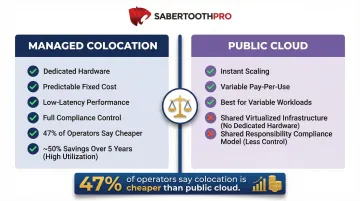
The staffing and compliance case for managed colo over standard colo is clear. Against the cloud, the argument shifts to cost predictability and performance. Cloud excels for variable or rapidly scaling workloads — managed colocation wins for:
- 60% of operators cite data security and 44% cite regulatory compliance as reasons for keeping mission-critical workloads off public cloud — dedicated hardware eliminates the shared-tenant risk entirely
- Workloads requiring consistent, low-latency compute — dedicated resources don't contend with neighboring tenants
- Legacy applications that are expensive or impractical to refactor for cloud-native deployment
- High-utilization environments where private infrastructure costs roughly half of public cloud over a five-year period
Which Businesses Benefit Most from Managed Colocation?
SMBs and Mid-Market Companies Outgrowing On-Premise Infrastructure
A growing business that has maxed out its server room capacity often lacks the budget to build a proper data center but owns hardware it doesn't want to abandon. Managed colocation offers a path to enterprise-grade facilities without migrating to the cloud or replacing existing hardware.
Moving existing equipment to a certified facility delivers immediate, concrete gains:
- Redundant power and cooling without capital construction costs
- Professional monitoring and management from day one
- Improved uptime without rearchitecting a single application
- A fixed infrastructure footprint that scales on demand
Regulated Industries with Data Sovereignty and Compliance Requirements
Healthcare organizations subject to HIPAA, financial services firms under PCI-DSS, legal firms, and government contractors often cannot place sensitive workloads in multi-tenant public cloud environments. Managed colocation in a certified facility provides the compliance documentation and dedicated hardware separation these businesses require.
Financial institutions running high-frequency trading, risk management, and derivatives pricing need single-digit millisecond latency — something public cloud rarely guarantees. According to Data Center Dynamics, proximity to exchange connectivity is a core driver of colocation adoption in financial services.
Businesses with Predictable, High-Utilization Workloads
For applications with consistent, high resource utilization, the economics of dedicated hardware in a managed colocation facility often outperform per-hour cloud pricing significantly. Databases, ERP systems, rendering farms, and analytics platforms that run continuously benefit from the fixed-cost model.
A 100-server environment running 24/7 at high CPU utilization can cost 50–60% less in managed colocation over a three-year period compared to equivalent reserved cloud instances.
What to Look for in a Managed Colocation Provider
Evaluate Facility Certifications and Compliance Capabilities
Verify the provider maintains current certifications relevant to your industry:
- Tier III or Tier IV data center ratings: Tier Certification of Constructed Facility (TCCF) ensures facilities are constructed as designed and capable of meeting defined performance requirements
- SOC 2 Type II audit reports: Reports on controls at a service organization relevant to security, availability, processing integrity, confidentiality, or privacy
- PCI-DSS compliance: Attestation of Compliance (AOC) documents the service provider's compliance status
- HIPAA-ready environment documentation: Covered entities using cloud service providers must enter business associate agreements (BAAs), making the provider directly liable for HIPAA compliance under the agreement
- Contractual SLAs: Confirm uptime guarantees, remote hands response times, and incident escalation procedures are documented before signing
Assess the Scope and Flexibility of Managed Services
Not all managed colocation contracts are the same. Clearly define which services are included versus available as add-ons.
Key questions to ask:
- What is your response SLA for remote hands requests?
- Do you provide compliance reporting, and in what format?
- What is your escalation process for critical incidents?
- Which monitoring metrics are included in base service?
- How are OS patching and security updates handled?
- What backup and disaster recovery options are available?
How SabertoothPro Helps Businesses Navigate Managed Colocation Decisions
SabertoothPro is a vendor-agnostic IT advisory partner with a 300+ provider ecosystem spanning data center and colocation partners nationwide. We evaluate options across multiple providers to match your specific compliance, performance, and budget requirements—without a preferred vendor to push.
Our advisory approach prioritizes your needs over any single provider's product line. We benchmark pricing across our network, verify certifications and SLAs, and negotiate contracts on your behalf. The result: procurement-level transparency and leverage without the overhead of an in-house team.

Frequently Asked Questions
What is the difference between managed colocation and standard colocation?
Standard colocation provides physical space, power, cooling, and connectivity while you manage everything operationally. Managed colocation adds provider-handled services — monitoring, remote hands, network management, and security operations — on top of that physical infrastructure.
Is managed colocation the same as the cloud?
No. In managed colocation, you own dedicated physical hardware housed in a third-party facility. Cloud services use shared, virtualized infrastructure owned by the provider — no customer hardware involved.
What is typically included in a managed colocation service?
Common inclusions are 24/7 facility monitoring, remote hands support, network management, physical security, and compliance reporting. Scope varies by provider, so ask specifically what is covered in the SLA versus what incurs additional fees before signing.
What types of businesses benefit most from managed colocation?
Regulated industries — healthcare, finance, legal, government — benefit most due to compliance requirements. SMBs with lean IT teams and companies running predictable, high-utilization workloads also gain significantly, since they get enterprise-grade reliability without the cost of building their own data centers.
How does managed colocation support compliance requirements like HIPAA or PCI-DSS?
Certified providers handle the physical security controls, environmental safeguards, and audit documentation required by HIPAA, PCI-DSS, and SOC 2 — shifting that compliance burden off your internal team. Your auditors get facility-level evidence without your staff doing the legwork.
How much does managed colocation typically cost?
Most businesses pay between $500 and $2,500+ per cabinet per month, depending on power draw, bandwidth, and the managed services tier included. Getting quotes from multiple providers — or working with a vendor-agnostic advisor — is the fastest way to benchmark pricing against your actual requirements.