
This guide delivers a direct, side-by-side breakdown of Starlink Roam, T-Mobile AWAY, Amazon Leo, and 5G hotspots, plus a decision framework to match each option to your specific travel style.
TL;DR
- Starlink Roam covers nearly anywhere off-grid, with hardware costs running $199–$349 upfront
- T-Mobile AWAY works well for highway travel near towers — no equipment fees required
- Amazon Leo launches in 2026 as a potential lower-cost Starlink alternative—pricing and availability unconfirmed
- 5G hotspots cover weekend trips and light use; data caps make them poor fits for full-timers
- Full-time RVers often pair Starlink with a cellular hotspot for backup coverage across varied terrain
The State of RV Internet in 2026: Why Your Old Setup May Not Cut It
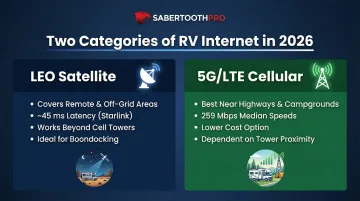
Internet demand in RVs now mirrors small office requirements. Remote workers need 1.2–3.8 Mbps for HD video conferencing and 15 Mbps for 4K streaming. Smart RV systems, cloud backups, and family entertainment pile on additional bandwidth pressure. The technology landscape has split into two primary categories:
| Category | Best For | Key Stat |
|---|---|---|
| LEO Satellite | Remote/off-grid coverage | ~45 ms latency (Starlink) |
| 5G/LTE Cellular | Speed near highways & campgrounds | 259 Mbps median (T-Mobile 5G) |
Legacy satellite (HughesNet, Viasat) and campground Wi-Fi alone no longer satisfy most 2026 RVers. Older GEO satellites average 683 ms latency, which makes Zoom calls nearly impossible, while shared campground Wi-Fi often caps at 4–20 Mbps per user during peak hours. Here's how the modern alternatives stack up.
Best RV Internet Options in 2026: A Head-to-Head Comparison
These options were evaluated on coverage range, real-world speed, transparent pricing, hardware requirements, and suitability for both part-time and full-time RV use.
Starlink Roam
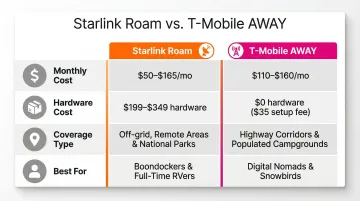
SpaceX's LEO satellite constellation delivers high-speed, low-latency internet across nearly all of North America. The Roam plan (formerly Starlink RV) is purpose-built for mobile, non-fixed use and supports the Starlink Mini ($199) and Standard ($349) hardware kits—no annual contract required, and service can be paused anytime.
What sets it apart: Only satellite option that works in motion with the Mini kit. Strong for boondockers, national park travelers, and anyone operating far outside cellular tower range. PCMag recorded 308 Mbps download speeds in Yellowstone National Park using Starlink Mini. Signal reliability through overcast weather is notably strong, and LEO latency enables video conferencing even in remote terrain.
| Monthly Plans & Pricing | Speed & Data | Best Use Case |
|---|---|---|
| Roam 100GB: $50/mo Roam Unlimited: $165/mo (deprioritized above 1TB) Hardware: $199–$349 one-time |
Download speeds up to 300 Mbps 100GB or unlimited data options No overage charges—speeds throttled after priority threshold on Unlimited plan |
Full-time RVers, boondockers, off-grid campers, and cross-country travelers who need connectivity regardless of cell tower proximity |
Pause feature update: Standby Mode now costs $5/mo (down from free), throttles speeds to 500 Kbps, and is no longer supported for in-motion use. Travelers need the $50/mo Roam plan for active transit.
T-Mobile AWAY
T-Mobile AWAY adapts T-Mobile's 5G Home Internet service for mobile use—the same gateway hardware, but not locked to a fixed address. RVers can use it anywhere T-Mobile's 5G/LTE network reaches, which covers over 330 million people across 2 million square miles.
What sets it apart: No upfront hardware cost saves RVers up to $300+ compared to satellite kits. Unlimited data plan available. Ideal for travelers who primarily follow interstate corridors and stay near populated areas or established campgrounds. Latency is lower than satellite in strong signal areas, which benefits real-time tasks like video calls and gaming.
| Monthly Plans & Pricing | Speed & Data | Best Use Case |
|---|---|---|
| 200GB plan: $110/mo with AutoPay Unlimited plan: $160/mo Plan can be paused twice yearly (up to 90 days each, $10/mo pause fee) Gateway included ($35 setup fee) |
Download speeds 150–259 Mbps in tested conditions 200GB capped or unlimited options Performance drops in remote canyons or rural areas away from towers |
Digital nomads, remote workers, and snowbirds who primarily travel along highways and stay within range of T-Mobile's 5G infrastructure |
Amazon Leo (Project Kuiper)
A new competitor is entering the LEO satellite market in 2026. Amazon's Project Kuiper is rolling out consumer internet service with a mobile/travel option across two hardware tiers: the Nano dish (~7"x7", comparable to Starlink Mini) and the Pro dish (targeting up to 400 Mbps). RVers should treat this as an emerging alternative worth monitoring.
Worth watching: The Nano dish is physically smaller than Starlink Mini, which may appeal to space-conscious RVers. Amazon's logistics infrastructure could enable faster hardware delivery and potentially lower subscription costs than Starlink. That said, neither pricing nor an exact launch date is officially confirmed as of early 2026.
| Monthly Plans & Pricing | Speed & Data | Best Use Case |
|---|---|---|
| Not yet announced—2026 market entrant Pricing to be confirmed at time of consumer rollout |
Nano targets up to 100 Mbps download Pro targets up to 400 Mbps Note: Amazon's stated targets—real-world RV performance data not yet available |
Early-adopter RVers watching for a Starlink alternative; best assessed once pricing and availability are confirmed mid-2026 |
5G Hotspot Plans (T-Mobile, Verizon, AT&T)
5G hotspot devices remain cost-effective, lightweight options for weekend warriors and light users. Dedicated hotspot devices (e.g., Inseego MiFi X PRO 5G) allow multiple devices to share data without draining a phone battery. Phone tethering is fine for occasional use but insufficient for multi-user or high-data environments.
T-Mobile Hotspot Plans
- Data tiers: 2GB, 5GB, 10GB, 30GB, 50GB
- Monthly pricing: $10–$50
- Why it stands out: Widest 5G coverage nationally—recommended carrier for RV use due to coverage breadth
Verizon Hotspot Plans
- Data tiers: 15GB, 50GB, 100GB, 150GB
- Monthly pricing: $10–$60 (requires existing Verizon mobile plan for best pricing)
- Why it stands out: Most affordable per-GB pricing, but narrower coverage footprint. Strong rural reliability utilizing low-band spectrum
AT&T Hotspot Plans
- Data tiers: 15GB, 20GB, 50GB, 100GB
- Monthly pricing: $35–$90
- Why it stands out: Second-largest U.S. coverage; prepaid data-only plans available; highest-tier plans are among the most expensive
Device recommendation: The Inseego MiFi X PRO 5G supports Wi-Fi 6 and up to 32 connected devices, making it a top choice for RV hotspot use.
How to Choose the Right RV Internet Based on Your Travel Style
The fundamental decision axis is coverage range vs. cost. Satellite wins on coverage everywhere, cellular wins on cost and low latency near towers. Neither is objectively "best" without knowing your travel pattern.
Off-Grid and Remote Explorers
For RVers who boondock in national forests, desert terrain, or rural backcountry with no cell signal: Starlink Roam is the only reliable option. Budget for the hardware cost upfront ($199–$349) and factor in the $50–$165/mo plan cost against what inconsistent cellular would cost in frustration.
Highway and Campground Travelers
For RVers who mostly follow interstates, stay in KOA-style parks, or travel through populated corridors: T-Mobile AWAY or a 5G hotspot plan is likely sufficient and significantly cheaper. No equipment fee for AWAY is a major advantage. For light weekend use, a T-Mobile or Verizon hotspot plan at $10–$20/mo provides good value.
Full-Time Remote Workers
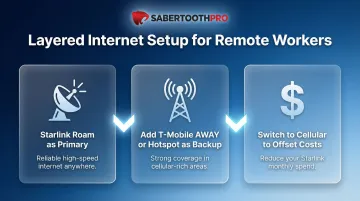
For digital nomads doing daily video calls, large file transfers, or running cloud-based operations from the road: the best setup is a layered approach:
- Use Starlink Roam as your primary connection for reliable high-speed access anywhere
- Add T-Mobile AWAY or a hotspot plan as backup when parked in cellular-strong areas
- Switch to cellular when signal is strong to offset Starlink monthly costs
Campground Operators and RV Fleets
Managing connectivity across multiple users, devices, or vehicles adds complexity that single-carrier plans aren't built for. A carrier-agnostic partner like SabertoothPro can optimize pooled data plans across carriers, reducing overage charges and providing centralized visibility — particularly useful when IoT devices, point-of-sale systems, or remote monitoring run alongside traveler internet.
Part-Time and Weekend RVers
For RVers who travel 1–2 weekends per month: a 5G hotspot plan or phone tethering is almost always sufficient. Starlink's pause feature ($5/mo Standby Mode) makes it viable even for seasonal users if they already own the hardware. T-Mobile AWAY also allows pausing up to twice per year — useful if you go dark for the winter.
How We Selected the Best RV Internet Options
Each option was evaluated across five criteria that matter on the road:
- Real-world coverage breadth — not just advertised maps, but verified performance in rural and remote areas
- Transparent pricing — no hidden contract lock-ins or buried overage fees
- Hardware portability and in-motion usability — whether the setup works while driving, not just parked
- Data plan flexibility — caps, throttling policies, and pause features
- Fit across RV user profiles — from weekend campers to full-time remote workers
Common mistakes RVers make:
- Over-relying on a single carrier with gaps in their route
- Paying for unlimited plans when capped plans would suffice
- Purchasing expensive satellite hardware for routes that are well within cellular range
Pricing and plan terms change frequently—always verify current offers directly with providers before purchasing. Starlink, T-Mobile, and Amazon have all updated plans multiple times in the past 12 months.
Conclusion
The right RV internet setup depends on four variables: your typical routes, data usage intensity, budget, and whether connectivity is recreational or business-critical. No single service wins across all of them.
Before investing in hardware, map your travel routes against carrier coverage. If you rely on connectivity for income or remote work, a two-service setup — satellite plus cellular — provides the redundancy worth paying for.
For RVers, campground operators, or businesses managing connected fleets on the road, SabertoothPro offers vendor-agnostic guidance across 300+ connectivity providers, helping identify the right combination of satellite, cellular, and IoT solutions with no minimums and no vendor lock-in. Reach out at 888-891-2331.
Frequently Asked Questions
How much does RV internet cost per month?
Monthly costs vary widely by service: 5G hotspot plans start around $10/mo for basic data, T-Mobile AWAY starts at $110/mo, and Starlink Roam runs $50/mo (100GB) or $165/mo (unlimited). Factor in Starlink's upfront hardware cost ($199–$349) when calculating what you'll actually spend.
What internet options are available for RVs?
Four main categories cover most RV travelers:
- LEO satellite — Starlink Roam, Amazon Leo
- 5G/LTE mobile gateways — T-Mobile AWAY
- Dedicated hotspot devices — T-Mobile, Verizon, AT&T plans
- Campground/public Wi-Fi — free supplemental option
What is the best internet service for an RV?
It depends on travel style: Starlink Roam for off-grid/remote travelers, T-Mobile AWAY for highway and campground-based travelers, and a hotspot plan for casual weekend use. Many full-timers use two services in combination.
What is the best hotspot for RV travel?
The T-Mobile Inseego MiFi X PRO 5G is a top choice thanks to Wi-Fi 6 support and 5G connectivity. Plan selection matters as much as the device itself, so compare data caps and coverage maps before committing.
How can I get unlimited internet in my RV?
The two main unlimited options are Starlink Roam Unlimited ($165/mo) and T-Mobile AWAY Unlimited ($160/mo). Most 5G hotspot plans cap at 15–150GB before speeds drop, so satellite is currently the closest thing to truly unthrottled data.