Introduction
When a GPS tracker goes dark in a dead zone, a cold chain sensor stops transmitting mid-route, or a fleet management system drops connectivity during a critical delivery, the fallout is real: lost cargo, compliance failures, damaged customer trust, and six-figure financial exposure.
Standard consumer or business SIM cards were never engineered for these conditions. They fail under extreme temperatures, constant vibration, and the coverage gaps that define real-world logistics routes.
This guide covers what you need to know to make the right call on IoT SIM connectivity for transport and supply chain:
- What IoT SIMs are and how they differ from standard SIM cards
- Why they're purpose-built for logistics environments
- The features that separate reliable solutions from costly mistakes
- How to choose the right provider without overpaying or over-speccing
Key Takeaways
- IoT SIMs are industrial-grade cellular connections built for embedded devices: multi-carrier access, extended temperature tolerance, and 10+ year lifecycles
- Transport operations use IoT SIMs for fleet tracking, cold chain monitoring, cargo security, and last-mile visibility where single-carrier SIMs fail
- Key features to prioritize: multi-carrier access, Private APN support, MFF2 ruggedized chips, LTE-M/NB-IoT protocols, and pooled data plans
- A vendor-agnostic advisor eliminates coverage blind spots, cuts data costs up to 25%, and scales fleet connectivity without surprise bills
What Is an IoT SIM — and How Does It Differ from a Standard SIM?
An IoT SIM is a cellular SIM card engineered for machine-to-machine (M2M) communication rather than human use. Unlike the SIM in your smartphone, IoT SIMs connect embedded devices—GPS trackers, telematics units, cold chain sensors, cargo cameras—to cellular networks to transmit data continuously, in frequent bursts across years of deployment.
Built for Harsh Environments, Not Your Pocket
The technical gap between consumer SIMs and industrial IoT SIMs is substantial:
| Feature | Consumer SIM | Industrial MFF2 IoT SIM |
|---|---|---|
| Form Factor | Removable (Mini, Micro, Nano) | Soldered MFF2 (5mm × 6mm) |
| Operating Temperature | -25°C to +85°C | -40°C to +105°C |
| Data Retention | Standard | 10 to 17 years |
| Write Endurance | 100,000 cycles | 500,000+ cycles |
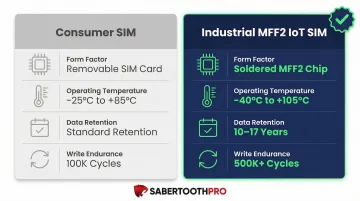
Industrial IoT SIMs are designed to withstand vibration, moisture ingress, and the thermal extremes of a truck cab in Arizona or a refrigerated container crossing the Canadian border. Slot a consumer SIM into that same environment and it typically fails within months—defeated by heat cycles and constant mechanical stress.
Multi-IMSI and eUICC: Beyond Standard Roaming
Standard consumer roaming relies on a single carrier's network and roaming agreements, which triggers unpredictable per-MB charges and "fair use" throttling when you cross state lines. Purpose-built IoT SIMs with multi-IMSI or eUICC (embedded Universal Integrated Circuit Card) technology hold profiles for multiple carriers and switch between them automatically based on signal strength.
Multi-IMSI architecture provides native-network access on each carrier—not a roaming guest session—maintaining consistent speeds and eliminating surcharges. When a truck crosses from Verizon-strong territory into an AT&T-dominant corridor, the SIM switches carriers without driver intervention or service interruption.
eUICC Remote Provisioning Eliminates Truck Rolls
The GSMA SGP.32 specification defines how IoT eSIMs can be remotely provisioned over-the-air (OTA). Instead of dispatching technicians to physically swap SIMs across a 500-vehicle fleet (at $150 to $1,000 per truck roll), you push carrier profile updates remotely from a central dashboard.
For fleets operating nationally or internationally, that turns a potential six-figure operational headache into a software update.
Why Transport, Logistics & Supply Chain Operations Depend on Specialized IoT Connectivity
Fleet Tracking and Telematics
Real-time GPS tracking, driver behavior monitoring, Electronic Logging Device (ELD) compliance, and route optimization all require persistent, low-latency cellular connectivity. The FMCSA ELD mandate requires electronic data transfer to safety officials via wireless web services, and connectivity failures disrupt compliance reporting and real-time fleet visibility.
The North American fleet management market is forecast to grow from 19.2 million active units in 2024 to 33.2 million by 2029—an 11.9% CAGR. Standard SIMs fail in rural corridors, highway dead zones, or multi-state routes where no single carrier covers every mile.
A connectivity lapse means lost visibility into asset location, driver hours, and ELD compliance data during roadside inspections.
Fleet telematics devices primarily use LTE Cat-1, Cat-1bis, or LTE-M (Cat-M1) protocols, with LTE-M supporting full handover between network cells—critical for mobile tracking at highway speeds.
Cold Chain and Perishable Cargo Monitoring
Refrigerated trucks and reefer containers rely on IoT sensors to transmit temperature, humidity, and door-open alerts continuously. A SIM dropout during transit means a temperature excursion goes undetected until delivery—triggering recalls, regulatory penalties, or total cargo loss.
The financial stakes are significant across every cold chain segment:
- Biopharma loses approximately $35 billion annually to temperature-controlled logistics failures
- Up to 50% of global vaccines are wasted due to cold chain breakdowns
- 30–40% of the US food supply is lost or wasted, with cold chain gaps driving a substantial share of perishable losses
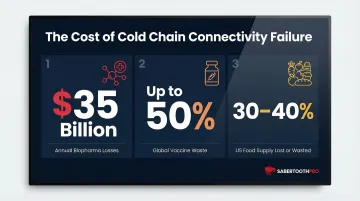
The FDA Food Safety Modernization Act (FSMA) requires shippers to develop written procedures ensuring food requiring temperature control is transported under adequate temperature management. Multi-carrier IoT SIMs ensure cold chain alerts reach dispatchers even when trucks enter rural areas or cross borders where single-carrier coverage fails.
Asset Tracking and Cargo Security
Battery-powered IoT trackers monitor trailers, shipping containers, pallets, and high-value cargo using LTE-M and NB-IoT protocols. These devices transmit infrequently but must stay reachable across:
- Remote staging yards and intermodal rail yards
- Active port facilities with dense RF environments
- Cross-border and international shipping routes
Cargo theft losses surged to nearly $725 million in 2023, a 60% increase from 2022, with 3,594 recorded supply chain crime events across the US and Canada. Multi-network SIM coverage ensures stolen cargo triggers immediate alerts even when thieves move assets to remote locations—where single-carrier SIMs go dark.
LTE-M and NB-IoT utilize Power Saving Mode (PSM) and extended Discontinuous Reception (eDRX) to enable battery lifetimes of 10 years or more—critical for cargo trackers that can't be recharged during multi-month deployments.
Last-Mile Delivery and Proof of Delivery
Mobile data terminals, handheld scanners, and in-vehicle tablets used by delivery drivers rely on reliable cellular data for route updates, electronic proof-of-delivery (ePOD) capture, and dispatch communication. The US last-mile delivery market is expected to grow from $37.7 billion in 2023 to $62.4 billion by 2030, a 7.5% CAGR.
LTE/5G IoT SIMs in these devices need consistent urban and suburban coverage across carrier networks. A single-carrier SIM creates coverage gaps that delay ePOD timestamps—turning missed confirmations into re-delivery disputes and failed SLA claims.
Warehouse and Yard IoT Automation
Connected dock door sensors, yard management systems, autonomous forklifts, and smart gates rely on cellular backup when Wi-Fi coverage is inconsistent across sprawling warehouse footprints. Gartner predicts over 75% of companies will adopt warehouse automation by 2027.
Private 5G/LTE networks deployed in warehouses and ports address Wi-Fi gaps, providing reliable, low-latency connectivity across 200+ acres. Associated British Ports deployed a Verizon Private 5G Network across 200-230 acres at the Port of Southampton to enable near-real-time analytics and vehicle tracking, replacing unreliable public 4G coverage.
Must-Have Features in an IoT SIM for Fleet and Supply Chain Management
Multi-Carrier Network Access with Automatic Failover
This is the single most important feature for transport use cases. A SIM that connects to the strongest available carrier—rather than being locked to one—eliminates dead zones along interstate corridors, at ports, and in rural distribution routes.
Carrier-certified Private APN access takes this further by providing a secure, managed tunnel that isolates fleet data from the public internet. SabertoothPro's carrier-certified Private APN solutions with multi-carrier access are purpose-built for this need in logistics environments, offering encrypted data transmission and VPN integration for end-to-end security.
Pooled Data Plans and Data Management
Large fleets with dozens or hundreds of IoT SIMs waste significant budget on individual per-device data allocations, where some devices over-consume and others sit idle. Pooled data plans share the total data budget across all SIMs, with usage automatically balanced.
Pooling data across facilities and right-sizing allocations has resulted in annual connectivity cost reductions of 28% to 35%. Instead of paying overage fees when a single device spikes, the pool absorbs the variance.
Typical single-carrier overage structures:
- Verizon 5G Account Share plans: $5 per GB overage
- AT&T Business Connect (Telemetry): $0.00001431 per KB ($14.31 per GB)
- AT&T Mobile Select Pooled: $0.000009536 per KB ($9.54 per GB)
Those rate differences compound fast across a 200-device fleet — which is exactly where pooled plans pay for themselves.
Industrial Form Factor and Durability Ratings
Hardware specifications to prioritize:
- MFF2 (soldered) form factor for permanent in-vehicle installations, eliminating physical SIM swap requirements
- Operating temperature range: -40°C to +85°C minimum for transport environments
- IP67/IP68 ingress protection for outdoor asset trackers exposed to rain, dust, and moisture
- MIL-STD-810G/H vibration and shock resistance to survive constant road vibration and heavy machinery environments
A SIM that works in a smartphone will fail within months when soldered into a trailer tracker exposed to road vibration and temperature swings from -20°F winter cold to 140°F summer heat inside a closed trailer.
Low-Power Protocol Support (LTE-M and NB-IoT)
Battery-powered asset trackers, cold chain sensors, and remote container monitors can't use standard LTE continuously—they rely on LTE-M (Cat-M1) or NB-IoT protocols that sharply cut power consumption while maintaining connectivity.
| Technology | Power Features | Typical Use Case |
|---|---|---|
| LTE-M (Cat-M1) | PSM, eDRX | Mobile asset tracking, fleet management (supports cell handover) |
| NB-IoT (Cat-NB1/NB2) | PSM, eDRX | Stationary sensors, smart meters (limited mobility) |
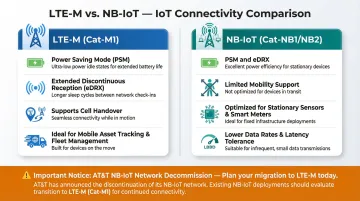
LTE-M is preferred for mobile asset tracking due to its support for cell handover, whereas NB-IoT is optimized for stationary devices. Note that AT&T announced plans to decommission its NB-IoT network in the US as early as Q1 2025, transitioning customers to LTE-M. Verizon and T-Mobile continue supporting both protocols.
Centralized SIM Management Platform
For large fleets, a web-based management platform is what separates scalable IoT operations from a support ticket backlog. Fleet managers need direct control — activate, deactivate, monitor usage, and troubleshoot individual SIMs without waiting on carrier support queues.
Essential platform features:
- Real-time data usage monitoring per device
- Customizable threshold alerts before overages hit
- Remote SIM activation/deactivation
- Device-level diagnostics and connectivity status
- Bulk management for hundreds or thousands of SIMs
For fleets managing 500+ devices, the ability to identify and disable a malfunctioning SIM consuming excess data—or remotely activate new devices during deployment—saves hours of carrier support calls.
How to Choose the Right IoT SIM Provider — And Avoid Costly Mistakes
Evaluate Coverage Maps Honestly, Not on Paper
Don't accept a carrier's self-reported coverage maps at face value. Actual in-field coverage—especially in rural freight corridors, industrial areas, and cross-border routes—can differ sharply from advertised maps.
Best practices:
- Request SIM trials on specific routes your fleet operates
- Verify multi-carrier capability with real-world testing in dead zones
- Ask for carrier-neutral options that provide access to more than one network
A single-carrier SIM that shows "excellent coverage" on a map may fail in practice when trucks enter warehouse districts with poor tower penetration or rural interstate stretches where that carrier has limited infrastructure.
Understand the Total Cost of Ownership, Not Just the Per-SIM Price
The upfront per-SIM cost is rarely the largest expense. Overage charges on individual data plans, the cost of managing multiple carrier contracts, and downtime costs from poor coverage compound quickly.
A vendor-agnostic advisor like SabertoothPro uses benchmark-driven pricing and pooled data plan optimization across a 300+ carrier partner ecosystem to reduce what you pay at the contract level. That means access to multi-carrier coverage without the markup layers that come with going directly to a single provider.
Assess Lifecycle Support and Remote Provisioning
Physically replacing SIMs in hundreds of deployed devices is operationally impractical. Prioritize providers offering:
- eUICC/eSIM remote profile switching — change carriers without a field service visit
- Over-the-air (OTA) provisioning for firmware and profile updates without physical access
- 10+ year lifecycle guarantees so network upgrades don't trigger costly truck rolls
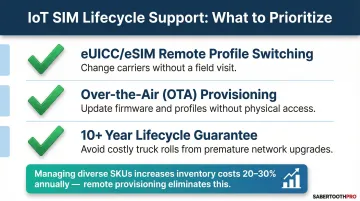
Managing diverse SKUs for different regions increases inventory carrying costs by 20-30% annually. Remote provisioning eliminates this by allowing a single SIM SKU to be deployed globally and configured remotely based on the device's operational region.
Frequently Asked Questions
What is an IoT SIM card, and how is it different from a regular SIM?
IoT SIMs are industrial-grade, machine-to-machine SIM cards engineered for embedded devices rather than smartphones. They're built to withstand extreme temperatures (-40°C to +105°C), vibration, and continuous low-data transmission over 10+ years of deployment. Consumer SIMs typically fail within months under the same conditions.
Do IoT SIM cards work across multiple carriers?
Standard SIMs are locked to one carrier. Purpose-built IoT SIMs with multi-IMSI or eUICC technology can switch between multiple carrier networks to maintain connectivity across routes and regions, providing native-network speeds without roaming surcharges.
What is a Private APN and why does it matter for transport fleets?
A Private APN (Access Point Name) creates a dedicated, encrypted data tunnel between fleet devices and a company's internal network. This isolates sensitive telematics and cargo data from the public internet, reducing exposure to cyberattacks and ensuring compliance with data security regulations.
Can IoT SIMs support cold chain and temperature monitoring in refrigerated trucks?
Yes. IoT SIMs are the connectivity backbone for cold chain sensors, enabling continuous temperature and humidity data transmission from reefer units to fleet management platforms. Multi-carrier SIMs ensure alerts reach dispatchers even in remote or rural areas where single-carrier coverage fails.
How do pooled data plans work for large IoT SIM deployments in logistics?
Pooled plans aggregate the total data allowance across all SIMs in a fleet. High-usage devices borrow from low-usage ones, eliminating wasted allocations on idle devices. This prevents per-device overages that inflate monthly costs by 28–35% compared to individual per-SIM plans.