
Introduction
U.S. businesses are grappling with a cybersecurity reality that's both expensive and fragmented. The average data breach now costs American companies $10.22 million—more than double the global average—while 43% of workers operate on hybrid schedules, scattering corporate data across home offices, coffee shops, and co-working spaces. Traditional perimeter security collapses when there's no perimeter left to defend.
SASE (Secure Access Service Edge) has become the architecture of choice for organizations tired of stitching together VPNs, firewalls, and cloud access tools that were never designed to work together. By converging networking and security into a single cloud-delivered framework, SASE replaces appliance sprawl with identity-driven enforcement that follows users wherever they work.
Choosing the right provider carries real business weight. Get it wrong and you're patching gaps as your workforce grows; get it right and security becomes a competitive advantage rather than a liability.
This guide evaluates the top 10 SASE providers in the U.S. market across four dimensions that matter most to decision-makers: architectural completeness, compliance readiness, distributed performance, and organizational fit — whether you're a cloud-first startup or a branch-heavy enterprise.
Key Takeaways
- SASE replaces legacy perimeter defenses with identity-based access control — unifying SD-WAN, ZTNA, SWG, CASB, and FWaaS into a single cloud-native platform
- Top 10 U.S. SASE providers for 2026: Cisco, Palo Alto Networks, Zscaler, Fortinet, Cato Networks, Check Point, Netskope, Cloudflare One, Versa Networks, HPE Aruba
- Choose based on your actual environment — security posture, branch footprint, cloud maturity, or compliance requirements — not brand recognition alone
- No universal "best" vendor exists; how a solution fits your current stack and scales with your operations matters more than any feature checklist
What Is SASE and Why Does It Matter for U.S. Businesses?
SASE is a cloud-native framework coined by Gartner in 2019 that unifies wide-area networking with comprehensive security services. Instead of managing separate appliances for each function, SASE delivers all of the following as integrated, cloud-delivered services enforced through identity-driven policies:
- SD-WAN — optimized wide-area network connectivity
- Firewalls — perimeter and application-layer threat control
- Secure Web Gateways (SWG) — web traffic filtering and inspection
- Cloud Access Security Brokers (CASB) — visibility and control over cloud app usage
- Zero Trust Network Access (ZTNA) — identity-verified access to internal resources
Adoption is accelerating. Gartner projects the SASE market will reach $28.5 billion by 2028, growing at 26% annually. U.S. organizations are leading this shift—particularly in healthcare, finance, and retail—where strict compliance requirements and distributed operations make traditional security models impractical.
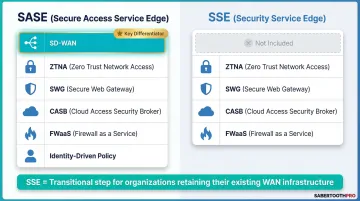
The difference between SASE and SSE (Security Service Edge) matters for procurement: SASE includes both networking (SD-WAN) and security, while SSE covers only security services. Organizations modernizing both network and security infrastructure need full SASE; those keeping existing WAN infrastructure may adopt SSE as a transitional step. Understanding where you fall on that spectrum is the first step toward choosing the right provider from the list below.
Top 10 SASE Service Providers in the USA (2026)
These providers were selected based on architectural completeness, U.S. market presence, compliance support, performance across distributed environments, and suitability across business sizes.
Cisco — Best Overall SASE Platform
Cisco's SASE offering combines Cisco Secure Access (the evolution of Umbrella) with Cisco SD-WAN into a unified enterprise-grade platform. It's one of the most widely deployed networking and security stacks among large U.S. organizations, benefiting from decades of enterprise trust and infrastructure investment.
Cisco delivers policy consistency across multi-site and multi-cloud environments without requiring separate configuration layers. Its mature partner ecosystem and managed services footprint make it a reliable anchor for complex, large-scale deployments where continuity and support depth matter as much as feature velocity.
| Attribute | Details |
|---|---|
| Best For | Large and global enterprises with complex, multi-site environments |
| Key Features | SD-WAN, DNS-layer security, CASB, ZTNA, DLP, AI-based threat detection, content filtering |
| Notable Strength | Broad enterprise support network with long-term upgrade continuity and managed services ecosystem |
Palo Alto Networks (Prisma Access) — Best for Advanced Threat Prevention
Prisma Access is Palo Alto Networks' cloud-delivered SASE platform, combining its Next-Generation Firewall with SD-WAN (via the CloudGenix acquisition), threat intelligence, ZTNA, SWG, CASB, and DLP. Named a Leader in the 2025 Gartner Magic Quadrant for SASE Platforms for the third consecutive time, it's built for security-first organizations.
Prisma Access leads on traffic inspection depth and threat visibility. AI-powered Autonomous Digital Experience Management (ADEM) automates threat detection and cuts mean time to resolution — a meaningful advantage for healthcare, finance, and government environments where security granularity directly affects audit outcomes.
| Attribute | Details |
|---|---|
| Best For | Security-led and regulated organizations (healthcare, finance, government) |
| Key Features | NGFW-as-a-Service, ZTNA, SWG, CASB, DLP, SD-WAN, AI-driven ADEM, IoT security |
| Notable Strength | Fine-grained policy control with high-fidelity traffic visibility and mature SOC workflow integration |
Zscaler — Best for Zero Trust Architecture
Zscaler operates one of the largest cloud security platforms globally, with Zscaler Internet Access (ZIA) and Zscaler Private Access (ZPA) forming a comprehensive SASE solution built on a cloud-native proxy architecture. The platform operates more than 160 globally distributed points of presence and was named a Leader in the 2025 Gartner Magic Quadrant for Security Service Edge.
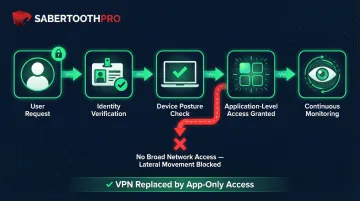
Zscaler enforces application-level access rather than broad network access. Users connect only to approved applications after identity and device verification, which minimizes lateral movement risk. That architecture makes it a natural fit for cloud-first, remote-heavy U.S. organizations actively replacing legacy VPN infrastructure.
| Attribute | Details |
|---|---|
| Best For | Cloud-first organizations and remote-heavy distributed teams |
| Key Features | ZTNA (ZPA), SWG (ZIA), CASB, FWaaS, DLP, inline threat inspection, browser isolation |
| Notable Strength | App-only access model with minimal VPN dependency and clean network segmentation outcomes |
Fortinet (FortiSASE) — Best for Unified Security Fabric
FortiSASE integrates Fortinet's established security ecosystem—including secure SD-WAN, cloud-based firewall, CASB, SWG, and universal ZTNA—into a unified managed SASE platform designed for hybrid workforces. Named a Leader in the 2025 Gartner Magic Quadrant for SASE Platforms, it's built for operational continuity.
FortiSASE's core strength is hardware-to-cloud continuity. Organizations already running Fortinet appliances can reuse existing rulebases and maintain coordinated enforcement from branch to cloud — avoiding the policy fragmentation that stalls most SASE migrations.
| Attribute | Details |
|---|---|
| Best For | Enterprises with existing Fortinet infrastructure or branch-heavy deployments |
| Key Features | Secure SD-WAN, cloud NGFW, CASB, SWG, universal ZTNA, DLP, endpoint integration |
| Notable Strength | Unified security fabric that extends from on-premises hardware through cloud workloads with consistent policy management |
Cato Networks — Best for Simplified Single-Vendor SASE
Founded in 2015, Cato Networks is a cloud-native SASE pioneer that delivers networking and security through a single globally distributed platform—eliminating the need for separate SD-WAN and security stacks. The company operates a private cloud-native network spanning 85+ points of presence worldwide and was named a Leader in the 2025 Gartner Magic Quadrant for SASE Platforms.
Cato's single-console operations and private global backbone reduce integration overhead and compress deployment cycles. Centralized management with fast policy propagation means mid-market organizations and lean IT teams can go from procurement to production without the multi-vendor coordination that drags out typical SASE rollouts.
| Attribute | Details |
|---|---|
| Best For | Mid-market organizations and IT teams seeking single-vendor simplicity |
| Key Features | Global private backbone, SD-WAN, SWG, CASB, FWaaS, IPS, DLP, malware detection |
| Notable Strength | Rapid site onboarding with minimal integration overhead and simplified lifecycle management |
Check Point SASE — Best for Compliance-Driven Enterprises
Check Point SASE combines comprehensive security features—including ZTNA, SWG, FWaaS, CASB, and a full-mesh private access model—with strong governance and audit readiness capabilities. Named a Leader in the 2025 Gartner Magic Quadrant for Hybrid Mesh Firewalls, it's built for regulated U.S. industries.
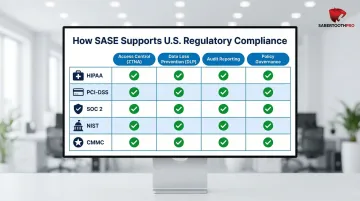
Check Point structures SASE with regulatory discipline at its core. Traceable rule change history, granular governance controls, and audit-ready reporting give finance, healthcare, and government teams the paper trail compliance frameworks require — without trading away enforcement depth to get it.
| Attribute | Details |
|---|---|
| Best For | Finance, healthcare, government, and other compliance-driven enterprises |
| Key Features | ZTNA, SWG, FWaaS, CASB, DLP, browser isolation, SaaS security mapping, unified cloud dashboard |
| Notable Strength | Audit-ready reporting clarity with traceable policy change history and granular governance controls |
Netskope — Best for SaaS and Cloud Data Protection
Netskope is a cloud-native SASE platform recognized as a Leader in the 2025 Gartner Magic Quadrant for Security Service Edge, with deep visibility into SaaS applications, CASB, SWG, ZTNA, NGFW, and an emphasis on data governance within cloud environments.
Netskope's inline proxy engine evaluates data movement and user behavior inside SaaS workflows — not just at the connection level. That distinction matters for enterprises handling sensitive data across platforms like Microsoft 365, Salesforce, or Google Workspace, where activity-level visibility drives both DLP enforcement and insider risk detection.
| Attribute | Details |
|---|---|
| Best For | SaaS-heavy enterprises requiring deep cloud data governance |
| Key Features | CASB, SWG, ZTNA (Netskope Private Access), NGFW, DLP, shadow IT discovery, SaaS activity visibility |
| Notable Strength | SaaS-level activity inspection with flexible data policy rules and insider risk signal context |
Cloudflare One — Best for Global Edge Performance
Cloudflare One is a zero-trust network-as-a-service platform built on Cloudflare's globally distributed edge—applying DNS filtering, SWG, network firewall, CASB, ZTNA, and browser isolation close to users to minimize latency across dispersed teams. The network spans 330+ cities in 120+ countries and Cloudflare was named a Visionary in the 2025 Gartner Magic Quadrant for SASE Platforms.
Cloudflare's edge-native architecture processes security inspection and routing decisions near the point of access rather than routing traffic through centralized backhaul. For U.S. organizations with international offices or multi-region operations, that translates to noticeably lower latency without compromising enforcement coverage.
| Attribute | Details |
|---|---|
| Best For | Distributed and international workforces prioritizing performance and edge security |
| Key Features | ZTNA, SWG, DNS filtering, CASB, FWaaS, browser isolation, API-first admin, DDoS protection |
| Notable Strength | Massive global edge distribution with low-latency routing and fast region expansion capabilities |
Versa Networks — Best for Customizable Enterprise Networking
Versa Networks delivers a flexible SASE platform supporting deep WAN customization alongside integrated security enforcement—including SD-WAN, ZTNA, SWG, CASB, and FWaaS—with multi-tenant architecture suited for complex enterprise and service provider environments.
Versa supports highly custom network topologies without sacrificing consistent security inspection across branches and cloud workloads. Advanced routing control and segmentation flexibility suit organizations with complex WAN estates and in-house network engineering teams who need more configurability than most single-vendor SASE platforms allow.
| Attribute | Details |
|---|---|
| Best For | Enterprises with complex WAN requirements or service provider deployments |
| Key Features | SD-WAN, ZTNA, SWG, CASB, FWaaS, multi-tenant architecture, advanced WAN segmentation, routing customization |
| Notable Strength | Deep routing customization and flexible topology design with service-provider deployment readiness |
HPE Aruba (Aruba EdgeConnect) — Best for Branch and Campus Integration
HPE Aruba's SASE offering integrates SD-WAN (Aruba EdgeConnect), secure access, and campus-to-branch policy consistency into a unified framework—designed for enterprises modernizing physical locations alongside cloud and remote access needs. Named a Leader in the 2024 Gartner Magic Quadrant for SD-WAN for seven consecutive years.
Aruba bridges wired and wireless infrastructure with cloud-delivered SASE enforcement. Organizations already running Aruba networking hardware can extend security policy from campus infrastructure to remote users without rebuilding their network architecture from the ground up.
| Attribute | Details |
|---|---|
| Best For | Aruba-centric branch and campus environments modernizing to cloud-delivered security |
| Key Features | SD-WAN (EdgeConnect), ZTNA, SWG, CASB, wired-wireless integration, branch policy consistency |
| Notable Strength | Smooth branch modernization with campus-to-cloud policy continuity and established enterprise networking stack |
How We Chose the Best SASE Providers
These providers were assessed on architectural completeness—does the platform natively include SD-WAN, ZTNA, SWG, CASB, and FWaaS?—as well as U.S. market presence, PoP density, compliance support for regulated industries, and deployment suitability across enterprise, mid-market, and distributed environments.
Common Selection Mistakes
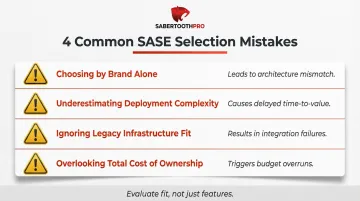
Businesses often choose SASE vendors based on brand name alone rather than architecture fit. Other frequent errors include:
- Underestimating deployment complexity and migration timelines
- Ignoring whether the vendor supports existing infrastructure (legacy systems, on-premises appliances)
- Failing to account for total cost of ownership versus feature volume
- Overlooking vendor lock-in risks without clear exit strategies
Gartner notes that "many vendor offerings are incomplete or immature," leaving organizations with platforms that can't meet actual operational requirements. Deployment timelines vary considerably: cloud-native platforms like Cato can onboard new sites in days, while deployments involving legacy infrastructure migration may take several months.
SabertoothPro's vendor-agnostic advisory model evaluates providers against your actual environment — infrastructure, compliance obligations, and budget — rather than vendor pitch decks. With access to 300+ technology partners across SD-WAN, SASE, cloud, and security, the team uses real-world contract benchmarks to validate pricing and prevent overbuying on features you won't use.
Conclusion
SASE is no longer optional for U.S. businesses managing distributed users, cloud workloads, and rising compliance demands. The right provider should be chosen based on architecture alignment, scalability, and long-term operational fit—not just brand recognition or analyst placements.
Before committing, evaluate each platform against criteria that reflect your actual environment:
- Ongoing performance metrics and SLA transparency
- Migration complexity and time-to-value estimates
- Vendor lock-in risk and contract flexibility
- Integration fit with your existing identity and infrastructure stack
The difference between a successful SASE deployment and a costly migration failure often comes down to matching your operational reality—not just your feature wishlist.
SabertoothPro provides vendor-agnostic SASE consulting and deployment support nationwide, helping organizations across healthcare, finance, retail, and logistics build secure, resilient network architectures without being steered by vendor incentives. Contact SabertoothPro at +1 888-891-2331 or visit the website to get started.
Frequently Asked Questions
Do major vendors like Palo Alto and Cisco offer SASE?
Yes, both Palo Alto Networks (via Prisma Access) and Cisco (via Cisco Secure Access and SD-WAN) offer full SASE platforms. Palo Alto is security-first with deep threat inspection, while Cisco is known for balanced networking and security at enterprise scale.
Is SASE worth it?
Yes — especially for organizations juggling hybrid workforces, multi-cloud environments, or compliance mandates. SASE consolidates networking and security tools into one platform, cutting infrastructure complexity and enforcing consistent policies regardless of where users connect.
What is the difference between SASE and SSE?
SASE includes both networking (SD-WAN) and security services in one architecture, while SSE (Security Service Edge) covers only the security layer—ZTNA, SWG, CASB, FWaaS—without SD-WAN. Organizations retaining existing WAN may adopt SSE as a transitional step.
Is SASE suitable for small and mid-sized businesses?
SASE is scalable and increasingly accessible to SMBs, especially through managed SASE offerings and vendors like Cato Networks that prioritize simplicity. Mid-sized organizations benefit from reduced infrastructure overhead and improved security without requiring large in-house IT teams.
How long does SASE implementation typically take?
Timelines vary: cloud-native platforms like Cato can onboard new sites in days, while enterprise deployments involving legacy infrastructure migration often run several months. Working with a SASE advisory partner typically cuts that timeline by reducing vendor selection cycles and pre-deployment planning.
What compliance frameworks does SASE help address?
SASE platforms with strong governance capabilities — such as Check Point and Palo Alto — support HIPAA, PCI-DSS, SOC 2, NIST, and CMMC. They do this by enforcing consistent access controls, generating audit-ready reports, and applying data loss prevention across every user session.