
Introduction
Legacy WAN was built for a world where traffic flowed to a data center — not to Salesforce, Microsoft 365, or AWS. As workforces spread across remote locations and SaaS applications took over daily operations, that architecture stopped working. The pressure on IT teams to keep up has only grown.
According to IDC's 2023 forecast, the SD-WAN infrastructure market is projected to reach $7.2 billion by 2026 — a 14.1% compound annual growth rate. Yet many IT and operations teams, especially at small to mid-sized businesses, still confuse Cloud SD-WAN with traditional WAN, VPN, or on-premise SD-WAN, leading to mismatched deployments and avoidable costs.
This guide clarifies what Cloud WAN is, how it works in practice, and where it delivers measurable value.
Key Takeaways
- Cloud SD-WAN manages WAN connections across multiple locations and transport types from a cloud-hosted control plane
- Direct cloud-optimized paths replace traditional backhauling to a central data center
- Core features include application-aware routing, centralized security policy enforcement, and zero-touch site deployment
- Works across broadband, LTE, MPLS, and 5G — ideal for multi-site businesses and hybrid workforces
- Cloud SD-WAN is a full network management architecture — policy, routing, security, and visibility unified under one control plane
What Is Cloud SD-WAN?
Cloud SD-WAN is a software-defined wide area network where orchestration, policy management, and monitoring run through cloud infrastructure — not on-premises hardware appliances. Cloud WAN refers to the broader cloud-based network architecture that Cloud SD-WAN manages and connects.
According to the Metro Ethernet Forum (MEF) 70 standard, SD-WAN is an application-aware, policy-driven overlay connectivity service that optimizes IP packet transport over multiple underlay networks such as MPLS, broadband, and LTE.
Why Cloud SD-WAN Exists
Traditional WAN was designed for traffic flowing from branch offices to a central data center. As applications moved to the cloud — SaaS tools like Microsoft 365, Salesforce, and cloud ERP systems — that hub-and-spoke model created costly backhaul and latency. Hairpinning forces all branch traffic through a central data center for security inspection before it ever reaches the internet. That detour introduces significant latency and packet loss that directly degrade user experience.
Cloud SD-WAN closes this architectural gap by enabling direct internet breakout, allowing trusted SaaS traffic to route directly from the branch edge to the cloud without unnecessary backhaul.
What Cloud SD-WAN Is Not
Cloud SD-WAN is not:
- A VPN — VPNs encrypt point-to-point tunnels but lack intelligent routing, application awareness, or centralized policy control
- An internet upgrade — Cloud SD-WAN is a full network fabric with orchestration, failover logic, and end-to-end visibility
- On-premise SD-WAN — traditional SD-WAN still requires locally managed hardware controllers; cloud-delivered does not
Cloud SD-WAN and SASE
Cloud SD-WAN is foundational to SASE (Secure Access Service Edge) architectures, which layer security services directly on top of the SD-WAN fabric. Cloud SD-WAN forms the network foundation that SASE and Zero Trust security models are built on.
Deployment Types
Cloud SD-WAN is typically deployed in one of three models:
- Fully cloud-managed: Control plane lives in the cloud; physical edge devices remain at branch locations for local traffic handling
- Cloud-native: Every component is cloud-hosted — no on-premise controller, no hardware dependency at the management layer
- Managed service (SDWaaS): A third-party provider owns configuration, monitoring, and ongoing optimization so your team doesn't have to
The right model depends on how much operational control your team wants to retain versus offload.
How Cloud SD-WAN Works
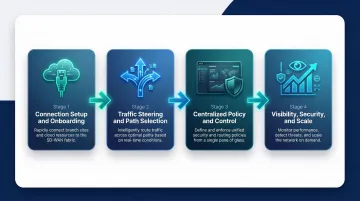
Cloud SD-WAN moves traffic through four distinct stages: onboarding, path selection, policy enforcement, and outcome delivery. Understanding each stage explains why the architecture outperforms traditional WAN — and why the gap widens as networks scale.
Connection Setup and Onboarding
Onboarding typically uses zero-touch provisioning (ZTP): edge devices at branch locations automatically connect to the cloud controller upon activation, pull down their configuration, and join the network fabric without requiring on-site IT personnel.
When an edge device powers on, it contacts a cloud-based provisioning server via DHCP, authenticates, and downloads its full configuration automatically. The device joins the SD-WAN overlay without a technician touching it. A 2022 Forrester TEI study found ZTP cut deployment time by 75% per site versus legacy WAN rollouts.
That eliminates the "truck-roll" bottleneck — the costly, time-consuming dispatch of IT staff to configure hardware on-site. For businesses managing 20 or 200 locations, the difference is measured in weeks and headcount.
Traffic Steering and Path Selection
Cloud SD-WAN continuously monitors all available transport paths — broadband, MPLS, LTE — and dynamically steers application traffic over the best-performing path based on real-time conditions like latency, jitter, and packet loss.
Application-aware routing drives those decisions. The system uses Deep Packet Inspection (DPI) to identify the traffic type — a VoIP call, a video conference, a large file backup — and routes each one differently. Latency-sensitive traffic gets the fastest available path. Bulk transfers take the most cost-efficient route.
Centralized Policy and Control
A single cloud-hosted dashboard pushes consistent policies across every site simultaneously. No per-device configuration required. Enforced policies include:
- QoS prioritization rules
- Firewall and access control settings
- Security posture and compliance baselines
When a policy changes — adding a firewall rule, for example — it propagates to every branch in seconds. That eliminates configuration drift, where individual sites quietly fall out of compliance over time.
Output — Visibility, Security, and Scale
The network produces end-to-end visibility across every connection, user, and application, plus integrated encryption of traffic in transit and the ability to scale bandwidth up or down without hardware changes.
Business outcomes include:
- Reduced downtime
- Better application performance for cloud tools
- Faster incident detection
- Flexibility to add new sites without IT infrastructure lead times
Key Benefits of Cloud SD-WAN
Cost Efficiency Over Traditional WAN
Cloud SD-WAN allows businesses to replace or reduce expensive MPLS circuits by aggregating lower-cost broadband and wireless connections. A 2020 Forrester TEI study commissioned by Dell Technologies modeled a 50% reduction in MPLS costs by shifting traffic to broadband.
The 2022 Fortinet Secure SD-WAN study reported a 300% ROI over three years with an eight-month payback period, driven by reduced communication costs and a 65% reduction in network disruptions.
Improved Application Performance for Cloud and SaaS Tools
Traffic takes optimized, direct-to-cloud paths instead of backhauling through a central data center. Latency drops for critical applications like UCaaS, video conferencing, and cloud ERP — which directly improves both employee productivity and customer-facing responsiveness.
SD-WAN also compensates for unreliable broadband links. Features like Forward Error Correction (FEC) and packet duplication detect and reconstruct lost data at the destination — no TCP retransmission required, and no noticeable degradation for end users.
Built-In Security Without Additional Hardware
Cloud SD-WAN incorporates encrypted tunnels, firewall policies, and access control as part of the fabric itself — not bolted on separately.
NIST SP 800-207 (Zero Trust Architecture) calls for encrypted, authenticated traffic with micro-segmentation to prevent lateral movement. SD-WAN natively delivers this via IPsec/DTLS tunnels and VRF-based network segmentation.
That matters especially for regulated industries. Businesses in healthcare, financial services, and government contracting can use SD-WAN's built-in controls to satisfy HIPAA, PCI-DSS, and CMMC requirements without layering on separate security hardware.
Operational Simplicity and Scalability
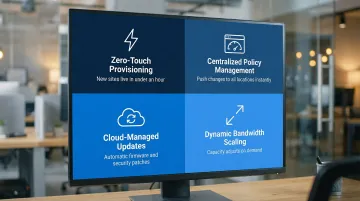
SD-WAN reduces the hands-on IT work that traditional WAN deployments demand. Key operational advantages include:
- Zero-touch provisioning — new branch sites come online without on-site engineers
- Centralized policy management — configuration changes push to all locations from a single dashboard
- Cloud-managed updates — firmware and security patches deploy automatically, with no maintenance windows
- Dynamic bandwidth scaling — capacity adjusts on demand, bypassing hardware procurement cycles
A branch that once took days to onboard can be live in under an hour.
Where Cloud SD-WAN Is Used
Cloud SD-WAN delivers the most value in operational environments where consistent, secure connectivity across many locations is critical:
- Multi-site retail chains
- Healthcare networks with multiple clinics or facilities
- Franchise systems
- Logistics hubs
- Distributed financial services offices
Optimal Conditions for Cloud SD-WAN
Cloud SD-WAN performs best in environments with:
- A mix of transport types (some locations have fiber, others only LTE or broadband)
- Heavy SaaS and cloud app usage
- Distributed or hybrid workforces
- Compliance requirements that demand consistent security policy enforcement
Real-World Examples
According to Żabka's Cisco SD-WAN deployment case study, the Polish retail chain deployed SD-WAN across 9,800+ stores. Automated ZTP allowed up to 300 installations per day, reducing IT technician time per store by 94% (from 4 hours to 15 minutes annually).
How to Choose the Right Cloud SD-WAN Vendor
With dozens of Cloud SD-WAN providers in the market, the right fit depends on several factors:
- Industry compliance needs — healthcare, finance, and government each carry distinct requirements
- Geographic footprint — coverage and latency vary significantly by provider
- Cloud environment integration — compatibility with existing AWS, Azure, or Google Cloud setups
- Budget model — OpEx vs. CapEx structures differ across vendors
SabertoothPro sources from a 300+ partner ecosystem spanning SD-WAN, SASE, and connectivity providers. That breadth means businesses get an unbiased recommendation rather than a pitch tied to a single platform.
Cloud SD-WAN vs. Traditional WAN and VPN
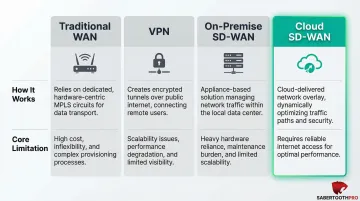
Not all WAN architectures handle modern cloud traffic the same way. Here's how the three most common approaches compare — and where Cloud SD-WAN pulls ahead.
| Architecture | How It Works | Core Limitation |
|---|---|---|
| Traditional WAN | Routes all traffic through a central data center hub | Backhaul creates latency and bottlenecks for cloud apps |
| VPN | Creates encrypted point-to-point tunnels | No intelligent routing, application-awareness, or centralized policy management |
| On-premise SD-WAN | Software-defined, but controllers are locally hosted | IT teams still manage hardware at each site or regional data center |
| Cloud SD-WAN | Fully cloud-managed with direct cloud access from any branch | No on-site controller hardware required |
Is SD-WAN Replacing VPN?
For site-to-site and multi-location business connectivity, Cloud SD-WAN typically replaces or supplements VPN because it provides broader coverage, dynamic path selection, and integrated security at scale. However, VPN remains appropriate for individual remote user access unless combined with a Zero Trust Network Access (ZTNA) solution.
According to TeleGeography's 2026 WAN Manager Survey, SD-WAN is now the standard network technology, deployed by 63% of enterprise respondents. The survey notes a definitive decline in MPLS reliance as enterprises shift toward broadband and SD-WAN to support cloud connectivity.
Businesses running on legacy MPLS or patched-together VPN setups are often paying more for less — a properly deployed Cloud SD-WAN solution typically delivers better performance at lower cost.
Frequently Asked Questions
What is cloud-based SD-WAN?
Cloud-based SD-WAN (also called SD-WAN-as-a-Service or SDWaaS) is a WAN architecture where the control and management plane is hosted in the cloud. Businesses manage multi-site network connectivity, routing policies, and security from a single cloud dashboard without on-premises controller hardware.
Which is a benefit of a cloud-based SD-WAN deployment?
Key benefits include centralized management, zero-touch site provisioning, dynamic traffic steering across multiple transport types, built-in security policy enforcement, and lower operational costs compared to MPLS-dependent or on-premise WAN setups.
How is SD-WAN different from WAN?
A traditional WAN is a fixed network infrastructure connecting locations, typically using expensive dedicated circuits like MPLS. SD-WAN is a software layer that abstracts and intelligently manages any combination of WAN connections — broadband, LTE, MPLS — with centralized control and dynamic routing.
Is SD-WAN better than VPN?
For multi-location enterprise connectivity, SD-WAN is generally superior to VPN. It adds application-aware routing, centralized policy management, failover across multiple links, and better performance at scale — capabilities that basic encrypted VPN tunnels don't provide.
Is Azure SD-WAN?
Azure is a public cloud platform, not an SD-WAN product. That said, Azure Virtual WAN is Microsoft's managed network service for WAN connectivity to Azure environments. It integrates with third-party SD-WAN solutions like Cisco, Versa, and Fortinet as part of a broader cloud WAN strategy.