
Introduction
For years, MPLS anchored enterprise WAN strategy with predictable latency and carrier-backed SLAs. But that stability came at a cost — both financially and architecturally. Now, with SD-WAN installation rates climbing from 18% in 2018 to 47% in 2022 and MPLS usage dropping from 82% to 51% in the same period, mid-sized businesses face a critical decision.
That decision touches more than IT budgets — it shapes how fast your distributed workforce reaches cloud applications, how quickly you can spin up new locations, and whether your network can keep up with the business. The average enterprise now routes 48% of WAN traffic to external cloud and SaaS providers, which makes MPLS's hub-and-spoke backhaul model increasingly hard to justify.
This comparison breaks down how each technology works, where each one wins, and the specific business conditions that make one a better fit than the other.
Key Takeaways
- SD-WAN routes traffic intelligently across broadband, LTE, or MPLS connections — MPLS locks you into dedicated private circuits with guaranteed QoS at a premium price
- SD-WAN wins on cost, deployment speed, and cloud app performance; MPLS wins on predictable latency and SLA-backed reliability
- Cloud-heavy, multi-site businesses benefit most from SD-WAN; highly regulated, latency-critical environments still need MPLS
- Hybrid architectures are common — 56% of enterprises combine both technologies to balance cost and reliability
- Your decision depends on traffic profile, compliance requirements, site count, and budget constraints
SD-WAN vs MPLS: Quick Comparison
Both technologies solve the same core problem — connecting distributed sites reliably — but Both technologies solve the same core problem: connecting distributed sites reliably. MPLS does this through carrier-managed private circuits with guaranteed performance. SD-WAN takes a different approach — policy-based routing logic that moves traffic dynamically across any available connection.
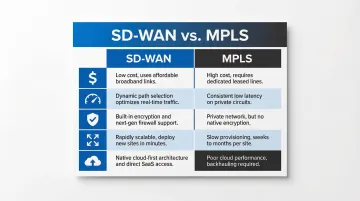
| Factor | SD-WAN | MPLS |
|---|---|---|
| Cost | Lower monthly costs using commodity broadband; median 100 Mbps broadband is 7.3x cheaper than MPLS; eliminates expensive long-term carrier contracts | Higher cost per Mbps; 3-5 year contracts typical; installation charges run $500-$2,000 per site; provisioning new circuits is slow and expensive |
| Performance | Dynamic path selection and automatic failover across multiple links; application-aware routing optimizes SaaS performance; quality depends on underlying internet circuits | SLA-backed guarantees: <45ms latency, <1ms jitter in North America; no internet congestion; highly predictable for voice and video |
| Security | Traffic travels over public internet; requires built-in IPsec encryption and integration with security tools (SASE, ZTNA); security layered at the edge | Inherently private network not exposed to internet threats; lacks native encryption; requires separate security appliances or VPN overlays |
| Scalability | New sites provisioned in days using zero-touch deployment; scales without carrier renegotiation; adds bandwidth instantly over broadband | Adding sites requires carrier provisioning taking 30-90 days; capacity upgrades historically took 6-12 weeks, rising to 50+ weeks during supply chain disruptions |
| Cloud Compatibility | Designed for direct cloud breakout to Microsoft 365, Salesforce, AWS, Azure; eliminates backhaul latency; optimized for hybrid and multi-cloud architectures | Cloud traffic typically backhauled to central data center, creating latency bottlenecks; not built for SaaS or cloud-heavy workloads |
What is SD-WAN?
SD-WAN (Software-Defined Wide Area Network) decouples network control from physical hardware. Software logic routes traffic across any combination of connections — broadband fiber, LTE, MPLS, or satellite — based on real-time conditions and application requirements.
Traditional WAN routers forward packets based on static routing tables. SD-WAN continuously monitors path quality across all available links, measuring latency, jitter, and packet loss. When Microsoft Teams traffic encounters congestion on the primary broadband circuit, SD-WAN automatically shifts it to LTE backup or an MPLS link within milliseconds.
Core Business Benefits
The operational advantages translate directly to measurable business outcomes:
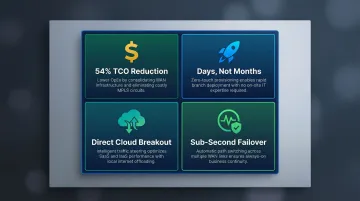
- Annual TCO drops up to 54% when replacing all-MPLS networks with hybrid DIA and broadband SD-WAN deployments
- Sites come online in days rather than months using zero-touch provisioning, eliminating manual router configuration
- Direct internet breakout removes the latency penalty of backhauling SaaS traffic through headquarters
- Sub-second path switching prevents downtime when primary circuits fail, protecting both uptime percentages and employee productivity
Key Technical Differentiators
Four capabilities separate SD-WAN from traditional WAN routing:
- Application-aware routing: Identifies traffic by application (Zoom, ERP, file transfers) and routes each flow based on policy and real-time path quality
- Dynamic path selection: Continuously evaluates all available links and selects the optimal path for each packet or flow
- Centralized policy management: IT teams configure routing rules, security policies, and QoS settings once and push them to hundreds of sites from a single console
- Built-in WAN optimization: Forward Error Correction (FEC) and packet duplication protect critical voice and video traffic from packet loss on broadband circuits
Deployment Models
SD-WAN implementations fall into three categories:
- Cloud-managed: A vendor-hosted controller manages all SD-WAN devices remotely; ideal for distributed organizations without centralized data centers
- On-premises controller: Enterprise deploys the SD-WAN controller in its own data center, maintaining full control over management infrastructure
- Hybrid: Combines cloud and on-premises management to balance control and operational simplicity
Businesses with strict data sovereignty requirements typically choose on-premises or hybrid models, while organizations prioritizing simplicity and rapid scaling lean toward cloud-managed. Choosing the wrong model creates compliance gaps or management overhead that negates the cost savings — SabertoothPro's vendor-agnostic advisors help match the right deployment to your infrastructure and regulatory requirements across 300+ technology partners.
Use Cases of SD-WAN
SD-WAN delivers the most value where businesses operate multiple distributed sites, rely heavily on cloud applications, or need to deploy new locations quickly:
- Multi-branch retail and QSR franchises: Burger King India deployed Fortinet Secure SD-WAN across 380+ restaurants, achieving 99.7% uptime for point-of-sale transactions while enabling centralized management across all locations
- Healthcare networks: Clinics and hospitals with multiple facilities benefit from reliable access to Electronic Health Records (EHR) and telehealth platforms without the cost of MPLS at every site
- Logistics companies: Distribution centers, warehouses, and field offices require consistent connectivity for inventory management and shipment tracking systems
- SaaS-heavy organizations: Companies running Microsoft 365, Salesforce, cloud ERP, and UCaaS platforms see immediate performance gains by eliminating backhaul and routing traffic directly to the internet
The QSR results aren't an outlier. One fast-food chain deployed Palo Alto Prisma SD-WAN across 90 branches in just 45 days, achieving a 50% increase in application performance and a significant drop in connectivity costs after migrating off MPLS.
What is MPLS?
MPLS (Multiprotocol Label Switching) is a private, carrier-managed WAN technology that forwards data packets across a dedicated network using predetermined label-switched paths. Unlike internet routing, which examines each packet's IP address at every hop, MPLS routers read a short label to determine the next hop, enabling faster forwarding and guaranteed bandwidth.
The carrier provisions a private MPLS backbone separate from the public internet, connecting your sites through a closed network topology. Traffic never touches the public internet unless explicitly configured to do so.
Core Operational Benefits
MPLS delivers three foundational advantages for businesses requiring predictable performance:
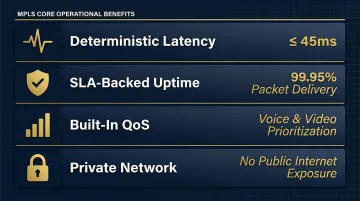
- Deterministic latency: Carriers guarantee specific round-trip times — Verizon's SLA ensures average latency ≤45ms and jitter ≤1ms between North American hub routers
- SLA-backed uptime: AT&T guarantees 99.95% packet delivery for real-time traffic classes, with penalties if performance falls below contracted thresholds
- Built-in traffic prioritization: MPLS natively supports Quality of Service (QoS), enabling carriers to prioritize voice and video traffic over email and file transfers without manual configuration
- Private network topology: Traffic stays off the public internet, reducing exposure to DDoS attacks and internet-based threats
MPLS Limitations in Modern Environments
Despite its reliability, MPLS faces structural challenges in cloud-first architectures:
- High cost per Mbps: Median 100 Mbps MPLS ports cost 7.3x more than equivalent broadband circuits
- Slow provisioning timelines: New MPLS circuits require site surveys, carrier coordination, and often physical infrastructure installation, leading to 30-90 day lead times
- Limited scalability: Adding bandwidth or new sites requires contract renegotiation and carrier provisioning; upgrades taking 6-12 weeks historically stretched to 50+ weeks during supply chain disruptions
- Cloud traffic bottleneck: Traditional MPLS architectures route all traffic — including internet-bound SaaS applications — back through a central hub before breaking out to the internet, injecting undesirable latency that degrades user experience
Where MPLS Still Makes Sense
Where MPLS Still Makes Sense
That cost and flexibility gap matters less when the alternative is unacceptable risk. 73% of Fortune 500 companies still run MPLS for at least some workloads — and for good reason in these scenarios:
- Banking and financial services: Transaction processing requires deterministic latency to meet compliance and operational SLAs; MPLS QoS guarantees deliver that consistency
- High-frequency trading: CME Group colocation facilities measure latency in microseconds (287 μs one-way) — variable broadband simply isn't an option
- Industrial OT and SCADA systems: Manufacturing and energy facilities need end-to-end delivery times of 100 μs to 50 ms and 99.999% availability for M2M automation
- Healthcare with multi-campus EHR synchronization: Real-time record access across hospital campuses benefits from MPLS's private network security and consistent performance
- Organizations mid-contract: Businesses with substantial MPLS commitments not yet at end-of-term often find a hybrid migration more practical than an immediate full replacement
SD-WAN vs MPLS: Which One Is Right for Your Business?
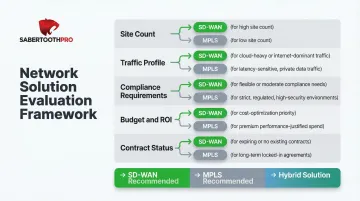
Choosing between SD-WAN and MPLS requires evaluating five core factors that define your network requirements:
1. Number and Geography of Locations
Businesses with 5+ branch locations typically benefit from SD-WAN's rapid deployment and lower per-site costs. Organizations with just 2-3 sites in carrier-dense metro areas may find MPLS pricing more manageable, particularly if circuits are already provisioned.
2. Cloud vs. Data Center Traffic Profile
If 40%+ of your traffic goes to Microsoft 365, Salesforce, AWS, or Azure, SD-WAN's direct internet breakout eliminates backhaul latency that MPLS can't avoid. Applications running primarily in private data centers with minimal cloud dependency don't require that optimization.
3. Regulatory and Compliance Requirements
- SD-WAN: Requires IPsec encryption and integration with SASE or ZTNA for Zero Trust security models
- MPLS: Private network topology satisfies compliance frameworks that mandate traffic isolation from the public internet
4. Budget and ROI Timeline
SD-WAN delivers ROI within 12-18 months for organizations cutting WAN costs by 20%+, and 31.8% of enterprises report savings above that threshold. If you're mid-contract on MPLS, deferring migration until expiration is often the practical call.
5. Current WAN Contract Status
- Month-to-month broadband arrangements allow immediate SD-WAN migration
- MPLS contracts with 12-18 months remaining suit a phased hybrid rollout
- Contracts with 2+ years left and early termination penalties usually favor hybrid architecture over full replacement
Situational Recommendations
Once you've mapped your environment against those five factors, the decision tends to fall into one of two camps — or a hybrid of both.
Choose SD-WAN if:
- Your business operates 5+ distributed sites requiring consistent connectivity
- Microsoft 365, cloud ERP, UCaaS, or SaaS platforms represent 40%+ of application traffic
- New site deployments happen quarterly or more frequently
- WAN costs consume a disproportionate share of IT budget relative to value delivered
- Application performance complaints arise from users at remote locations accessing cloud applications
Choose MPLS if:
- Your industry mandates strict latency SLAs (financial trading, industrial automation)
- Real-time applications cannot tolerate variable jitter (voice platforms, video conferencing in bandwidth-constrained environments)
- Compliance frameworks explicitly require private network isolation
- Legacy infrastructure tightly couples to MPLS QoS classes, making immediate migration impractical
The Hybrid Approach
For many organizations, the better question isn't which technology to pick — it's which traffic to route where.
A hybrid strategy routes latency-sensitive or compliance-critical traffic over MPLS while using SD-WAN over broadband for internet-bound and cloud traffic. This architecture reduces costs while maintaining reliability where it matters most.
56% of global enterprises adopted hybrid networking models as of 2023, integrating MPLS for core workloads and SD-WAN for branch agility.
Real-World Migration Examples
A rural Texas hospital struggled with daily internet outages that dropped telehealth calls and blocked access to Electronic Health Records. After migrating to SD-WAN with built-in failover, the hospital gained 19.3 hours of uptime in the first month, prevented 18.9 hours of major disruptions, and hit 100% uptime for critical patient care systems.
The scale-up story looks different, but the driver is similar. DHL Group replaced its legacy MPLS backbone across 3,300 sites in 220 countries with Cisco Catalyst SD-WAN — primarily to support Microsoft Office 365 without backhaul latency. The result: vastly reduced cost per Mbps, software-defined cloud interconnects, and zero service disruptions over the following 20 months.
Not sure which path fits your infrastructure? SabertoothPro's vendor-agnostic advisors evaluate your current environment across 300+ technology partners to match you with the right solution, with no carrier allegiance pulling the recommendation.
Conclusion
SD-WAN and MPLS serve different business realities. MPLS delivers guaranteed performance at a premium cost, making it indispensable for latency-critical and compliance-driven environments. SD-WAN prioritizes flexibility, cloud optimization, and cost efficiency, fitting organizations with distributed sites and heavy SaaS usage.
The right answer depends on your traffic needs, compliance obligations, and growth trajectory. A few quick signals:
- Choose MPLS if you run latency-sensitive workloads, operate under strict compliance mandates, or need guaranteed SLAs across locations
- Choose SD-WAN if you're scaling distributed sites, running cloud-first applications, or need to reduce WAN costs without sacrificing visibility
- Consider both if you have a hybrid environment — many organizations run SD-WAN over MPLS or use SD-WAN to supplement MPLS at select sites
Getting the architecture right has a direct bearing on cloud application performance, multi-site reliability, and long-term operational costs. Map your requirements against these criteria before committing to either path.
Frequently Asked Questions
Who are the leaders of SD-WAN in 2025?
The 2024 Gartner Magic Quadrant for SD-WAN identifies Cisco, Fortinet, Palo Alto Networks, Versa Networks, VMware (Broadcom), and HPE (Aruba) as Leaders. The "best" vendor depends on business size, security priorities, and whether you need single-vendor SASE integration or standalone SD-WAN.
What are the future trends for SASE in 2025?
By 2026, 60% of new SD-WAN purchases will be bundled into single-vendor SASE offerings. AI-driven traffic optimization and Zero Trust Network Access (ZTNA) integration are the dominant forces shaping enterprise WAN strategy.
Which secure web gateway is best for unified SASE?
Zscaler, Palo Alto, Cloudflare, and Netskope all integrate SWG natively into their SASE platforms. The right choice depends on your existing vendor stack — vendor-agnostic guidance helps avoid lock-in before you commit.
Is SD-WAN replacing MPLS entirely?
No. While TeleGeography forecasts global MPLS revenue will fall from $130 billion in 2025 to $57 billion in 2030, hybrid deployments remain common. MPLS still serves regulated industries where QoS guarantees are required for compliance or operational reliability.
Can SD-WAN and MPLS work together?
Yes. SD-WAN sits on top of an MPLS circuit alongside broadband links, routing traffic based on application priority. If the MPLS link fails, broadband takes over automatically — and critical apps still get guaranteed performance.