The business internet market in 2026 has evolved far beyond simple speed tiers. Today's selection process involves evaluating dedicated connections versus shared bandwidth, scrutinizing Service Level Agreements (SLAs) that guarantee uptime with financial remedies, weighing 5G backup options that automatically kick in during outages, and assessing multi-site scalability for businesses with distributed teams. Choosing the wrong provider based on advertised speeds alone can cost more in downtime losses than you'd save on monthly bills.
This guide breaks down the top 10 business ISPs in the USA, what makes them stand out, and what to look for before signing a contract.
Key Takeaways
- AT&T Business and Verizon Business lead on enterprise reliability and fiber performance — Spectrum Business suits smaller operations with no-contract flexibility
- Business internet means SLA guarantees, dedicated bandwidth, static IPs, and 24/7 priority support — speed is only part of the equation
- Fiber offers symmetrical speeds; cable provides broad availability; satellite and 5G fill rural or backup needs
- Pricing ranges from $50/month for basic cable to $1,000+/month for Dedicated Internet Access
- Evaluate SLAs, redundancy options, and scalability first—choosing on price alone creates costly downtime risk
What Makes Business Internet Different from Residential Service?
Business internet plans provide dedicated bandwidth that isn't shared with neighbors during peak hours. Unlike residential plans where speeds fluctuate when everyone streams video at 7 PM, business connections maintain consistent performance when operations depend on it.
Key differentiators exclusive to business plans include:
- Guaranteed uptime via Service Level Agreements (SLAs) — typically 99.9% or higher, with financial penalties if the provider misses the mark
- Faster issue resolution through dedicated business support lines, not shared consumer queues
- Static IP address options required for hosting servers, VPNs, security systems, and remote access
- Commercial use rights that residential contracts explicitly prohibit for business operations
Sizing Bandwidth to Team Size
| Team Size | Recommended Baseline | Notes |
|---|---|---|
| 1-5 employees | 50-100 Mbps | Scale up for video conferencing or cloud-heavy operations |
| 5-20 employees | 100-300 Mbps | Consider symmetrical fiber if uploading large files regularly |
| 20-50 employees | 300-500 Mbps | Dedicated Internet Access may be warranted for mission-critical apps |
| 50+ employees | 1 Gbps+ | Enterprise DIA recommended for high-transaction environments |
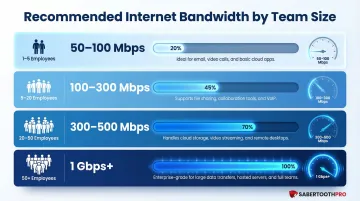
Cloud-heavy workflows and video conferencing shift the calculus — prioritize upload speeds as much as download. Microsoft Teams alone requires up to 4 Mbps in both directions for a stable call.
Top 10 Business Internet Service Providers in the USA (2026)
We evaluated providers based on reliability, speed offerings, SLA quality, geographic availability, customer satisfaction, and value for SMBs and enterprises. Here's what we found.
AT&T Business
AT&T Business ranked #1 in the J.D. Power 2025 Business Internet Satisfaction Study for large and medium enterprise segments. The provider offers fiber plans from 300 Mbps up to 5 Gbps symmetrical speeds, with built-in 5G backup on plans of 1 Gig or higher.
AT&T's Internet Backup feature automatically switches to 4G LTE/5G during outages—no manual intervention required. The integrated cybersecurity suite includes ActiveArmor (included with fiber plans) and Dynamic Defense for advanced network-embedded threat protection.
| Best For | Large enterprises, healthcare, multi-location businesses needing SLA-backed uptime |
| Speed & Connection Type | 300 Mbps–5 Gbps symmetrical fiber; Dedicated Internet Access also available |
| Starting Price / Contract | $40/month with wireless bundle, $60/month standalone; no annual contract on most fiber plans |
Verizon Business
Verizon Business ranked second in both large and medium business segments in the 2025 J.D. Power study. Verizon Fios delivers symmetrical fiber speeds from 300 Mbps up to 2 Gbps, with consistently high customer satisfaction ratings.
The 5G Business Internet option adds flexibility for businesses where fiber isn't available or as a failover connection, with speeds up to 400 Mbps and a 10-year price guarantee in select areas.
| Best For | SMBs in the Northeast, cloud-heavy teams, businesses needing reliable upload speeds |
| Speed & Connection Type | 300 Mbps–2 Gbps symmetrical fiber; 5G Business Internet for wireless deployments |
| Starting Price / Contract | $69/month; 2-year term typically required for best rates |
Comcast Business
Comcast Business is the most widely available business ISP in the U.S., serving 39 states with cable speeds up to 1.25–2 Gbps and dedicated Ethernet fiber up to 100 Gbps for enterprise needs.
Connection Pro provides automatic 4G LTE backup for up to 16 hours during outages. SecurityEdge offers cloud-based threat filtering to block threats before they reach local firewalls.
| Best For | Businesses in suburban/urban areas needing broad availability, retail, POS-dependent operations |
| Speed & Connection Type | 50 Mbps–2 Gbps cable; Dedicated Ethernet fiber up to 100 Gbps available |
| Starting Price / Contract | ~$60/month; best rates require 2-year contract with autopay |

Spectrum Business
Spectrum Business ranked #1 in the J.D. Power 2025 small business satisfaction segment, offering no-contract cable plans from 500 Mbps to 1 Gbps (up to 2 Gbps in select markets) across 41 states.
Month-to-month flexibility, unlimited data, and 25 included business email addresses make it ideal for startups, seasonal businesses, and growing SMBs that need to avoid long-term commitments.
| Best For | Small businesses, startups, seasonal operations needing flexibility without long-term commitments |
| Speed & Connection Type | 500 Mbps–1 Gbps cable (fiber in select markets); no contracts |
| Starting Price / Contract | $65/month; no annual contract—month-to-month |
Google Fiber Business
Google Fiber Business offers some of the fastest symmetrical fiber speeds available—up to 8 Gbps—at transparent pricing with no hidden fees and no contracts required. Customer satisfaction is high, but availability remains limited to select metro markets.
Verify serviceability before committing—coverage is the primary limitation.
| Best For | Tech startups, creative agencies, data-heavy SMBs in covered metro areas |
| Speed & Connection Type | Up to 8 Gbps symmetrical fiber; no contracts |
| Starting Price / Contract | $250/month for 2 Gig; limited availability—verify serviceability first |
Frontier Business
Frontier Business offers symmetrical fiber speeds up to 7 Gbps at competitive price points, serving 25 states. Free professional installation and a Wi-Fi 7 router are included with business fiber plans.
A strong value pick for budget-conscious SMBs within Frontier's footprint.
| Best For | Cost-conscious SMBs within Frontier's 25-state footprint needing high-speed symmetrical fiber |
| Speed & Connection Type | 500 Mbps–7 Gbps symmetrical fiber; free installation |
| Starting Price / Contract | $49.99/month for 500 Mbps on 24-month term with Auto Pay; verify post-promotional rate before signing |
Cox Business
Cox Business provides reliable cable internet plans alongside bundled voice and TV services, serving businesses across 18+ states. Cable plans reach up to 2 Gbps, with dedicated fiber available for enterprise needs.
Professional installation is included, and phone bundling makes it practical for operations that haven't moved fully to VoIP.
| Best For | SMBs needing bundled internet and voice services, multi-location businesses in Cox markets |
| Speed & Connection Type | Cable plans up to 2 Gbps; dedicated fiber available for enterprise needs |
| Starting Price / Contract | $65/month for 300 Mbps; early termination fees apply on contracts |
EarthLink Business
EarthLink Business offers both shared and dedicated fiber options, plus fixed wireless as a standalone or bundled solution for areas without fiber infrastructure. Plans include digital marketing tools like local directory listings and reputation manager trials.
Transparent tiered pricing makes it well-suited to small and micro-businesses.
| Best For | Small businesses needing budget-friendly fiber with marketing add-ons; fixed wireless where fiber is unavailable |
| Speed & Connection Type | Shared fiber up to 5 Gbps; Dedicated fiber up to 10 Gbps; Fixed wireless with 99.999% uptime SLA also available |
| Starting Price / Contract | Quote-based; call for fixed wireless quotes |
Starlink Business
Starlink Business has dramatically lowered its pricing, making satellite internet a viable option for rural businesses where fiber or cable infrastructure doesn't exist. With download speeds of 135–310 Mbps and latency between 25–60 ms (far lower than legacy GEO satellite's 500–700 ms), it now offers a 99.9% uptime SLA for Priority plans.
Factor in the $1,999 hardware cost and priority data thresholds when budgeting.
| Best For | Rural businesses, remote sites, agricultural operations, construction sites with no wired infrastructure |
| Speed & Connection Type | 135–310 Mbps satellite; equipment purchase required |
| Starting Price / Contract | $65/month Priority plan; $1,999 hardware cost |
T-Mobile 5G Business Internet
T-Mobile 5G Business Internet offers a flexible, cable-free connectivity option with wireless speeds typically ranging from 144–561 Mbps and fast deployment—no waiting for fiber installation.
It serves as a cost-effective primary internet solution for businesses in 5G coverage areas, or as a reliable failover for existing wired connections.
| Best For | Businesses needing quick deployment, temporary locations, retail, or wireless backup/failover |
| Speed & Connection Type | 5G wireless; speeds vary by coverage area |
| Starting Price / Contract | $30/month Small Business Grow plan, $50/month Business Advanced plan; run the coverage checker before committing |
How We Chose the Best Business Internet Service Providers
We assessed providers on six core criteria:
- Connection type and speed range — fiber, cable, satellite, and 5G options with symmetrical vs. asymmetrical speeds
- SLA quality and uptime guarantees — formal financial remedies for missed uptime commitments
- National availability and coverage footprint — how many states and metro areas each provider serves
- Customer satisfaction data — including J.D. Power rankings where available
- Pricing transparency — upfront costs, post-promotional rates, installation fees, equipment rental, static IP charges
- Business-critical features — static IPs, backup connectivity, security add-ons, priority support
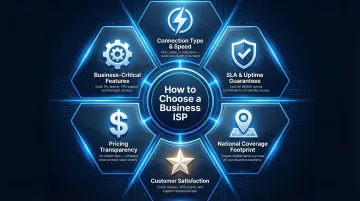
Those criteria matter because most businesses pick a provider based on one number: advertised download speed. That single metric misses the factors that cause the most friction after signing.
Common ISP Selection Mistakes
Businesses often choose providers based on advertised download speeds without verifying:
- SLA terms — shared cable broadband rarely includes formal uptime guarantees
- Upload speeds — cloud-heavy operations need symmetrical speeds, not just fast downloads
- Hidden fees compound fast — post-promotional rate increases, equipment rental, and early termination penalties routinely add 20–40% to the year-one quote
Working with a vendor-agnostic technology advisor like SabertoothPro—which operates across a 300+ carrier ecosystem with real-world pricing benchmarks—gives businesses live price comparisons across carriers, benchmark-driven contract negotiation, and an unbiased read on which connection type actually fits their workload before committing to a multi-year term.
Conclusion
The best business ISP depends entirely on operational needs, geographic location, team size, and whether your business has multi-site, backup, or industry-compliance requirements. Brand name and advertised rate are the least reliable factors in that decision.
Before signing anything, run through this short checklist:
- Request itemized quotes from at least 2–3 providers
- Review SLA terms carefully, not just headline uptime percentages
- Confirm post-promotional pricing before committing
Businesses with complex connectivity needs or multiple locations can work with a carrier-certified advisor like SabertoothPro for unbiased recommendations and benchmark-backed pricing across 300+ providers.
Frequently Asked Questions
How much should business internet cost per month?
Basic cable plans start around $50–$65/month, mid-tier fiber ranges from $100–$300/month, and Dedicated Internet Access (DIA) typically costs $1,000–$1,600/month for 1 Gbps. Total cost includes installation, equipment, static IPs, and backup add-ons—not just the monthly plan rate.
Which is the best internet for business?
AT&T Business and Verizon Business lead for enterprise reliability, Spectrum leads for small business flexibility, and Starlink/T-Mobile fill rural and wireless deployment needs. The right fit depends on your location, team size, and specific use case.
Which WiFi is best for business?
Most ISPs include a business-class router, which works for small offices. Larger or multi-floor environments typically need enterprise access points from vendors like Cisco Meraki, HPE Aruba, or Ubiquiti layered on top of the ISP's gateway.
What is the difference between business and residential internet?
Business plans include SLAs with uptime guarantees, dedicated or priority bandwidth, static IP options, 24/7 priority support, and commercial use rights that residential contracts prohibit. The core difference is guaranteed performance and legal accountability, not raw speed.
What internet speed does my business actually need?
A rough guide by team size:
- Under 10 employees: 50–100 Mbps
- 10–50 employees: 100–500 Mbps
- 50+ or cloud-heavy operations: 1 Gbps+
Upload speed matters as much as download for video calls and cloud apps.
Do I need a dedicated internet connection for my business?
Dedicated Internet Access (DIA) provides uncontended bandwidth guaranteed only for your business, making it essential for high-transaction environments like financial services, healthcare, or data centers. Shared fiber or cable is sufficient for most SMBs with standard cloud and communication workloads.