Introduction
Most businesses assume cellular coverage is "good enough" — until a fleet truck vanishes off the grid mid-route, a natural disaster knocks out towers for days, or remote field equipment stops transmitting sensor data. These aren't edge cases.
According to the ITU's 2025 Facts and Figures report, 96% of the world's population has access to mobile broadband, yet rural 4G coverage sits at only 84% — 15 percentage points behind urban areas. The FCC documented as far back as 2016 that 16% of all U.S. square miles had no LTE coverage or only subsidized coverage — a baseline that still shapes where cellular fails today.
Combining cellular and satellite internet isn't reserved for large enterprises or remote research stations. It's a decision increasingly relevant to trucking fleets losing GPS tracking on cross-country routes, agricultural operations with sensors in remote fields, construction sites in rural counties, and any business where connectivity gaps have direct operational consequences.
This article explains exactly when combining both networks makes sense — and when it doesn't.
Key Takeaways
- Cellular handles fast, low-latency coverage in populated areas; satellite covers where infrastructure ends
- Combine both when operations span remote areas, cross coverage boundaries, or require guaranteed uptime
- Key indicators: recurring dead zones, mobile workforce in rural areas, mission-critical applications that cannot tolerate downtime
- Don't combine if operations are fully urban, low-mobility, and the added cost isn't justified
- Act before a coverage gap triggers an outage, not after one already has
Why Cellular Alone Isn't Always Enough
Despite claims of broad cellular coverage, the reality on the ground tells a different story. While mobile broadband networks reach 96% of the global population, population coverage and land area coverage are not the same. Operations that move beyond populated corridors face significant connectivity gaps.
Specific Failure Modes of Cellular-Only Setups
Physical Infrastructure Limitations:
- Tower congestion during emergencies overwhelms capacity
- Weather events physically damage cell sites, cutting service for extended periods
- No coverage exists in rural farmland, offshore locations, or mountain terrain
- Hard coverage boundaries on long-haul trucking routes create predictable dead zones
Real-World Industry Impact:
Trucking & Logistics
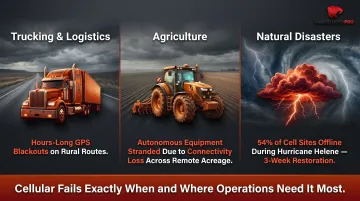
Commercial Carrier Journal reported in April 2025 that cloud-based truck safety systems fail to send real-time alerts when cellular connectivity drops. Hans Molin, CTO of Rand McNally, put it plainly: "It's surprising how often I drive on the big highways out in between the cities, and you'll lose coverage." Fleet managers routinely experience hours-long tracking blackouts when trucks cross rural corridors.
Agriculture
The FCC Precision Agriculture Task Force (2023) documented that autonomous tractors losing connectivity cannot alert operators of obstructions — the machine stays stranded until someone investigates on-site. The Task Force noted "millions of holes in cellular coverage" farmers need to reach "the last acre," and that "a tractor or a field of corn is not a 'serviceable' structure" under current federal broadband mapping.
Natural Disasters
During Hurricane Helene in 2024, 54% of cell sites in affected North Carolina counties went out of service, with restoration taking approximately three weeks. The FCC activated its Disaster Information Reporting System 7 times in 2024 alone, up from just 1 activation in 2016.
Each of these failure modes shares a common thread: cellular infrastructure goes down exactly when and where operations need it most. Satellite internet, while typically slower and higher-latency than cellular, operates independently of ground infrastructure — making it the coverage layer that holds when towers cannot.
When to Combine: The Right Scenarios for Pairing Cellular and Satellite Internet
The decision to combine depends entirely on operational context. Four conditions consistently signal when a dual-path approach becomes necessary:
Based on Geographic Reach and Coverage Gaps
Businesses whose assets, personnel, or operations routinely move into areas with limited or no cellular signal need satellite as a persistent fallback, not just an emergency option. This includes:
- Remote farmland where precision agriculture equipment operates
- Offshore vessels conducting marine operations
- Mountain terrain for energy, mining, or forestry work
- Long-haul trucking routes through rural corridors
Example: A logistics fleet loses GPS tracking on a cross-country route through cellular dead zones. The gap might last hours, during which the company has zero visibility into shipment location, driver status, or ETA accuracy. For time-sensitive freight or high-value cargo, this visibility gap creates unacceptable risk.
The same problem plays out in agriculture: an operator deploying IoT soil sensors across 2,000 acres loses data from remote field equipment the moment cellular coverage ends. Without satellite backup, critical growing-season readings disappear entirely.
Based on Uptime Requirements and Business Continuity
When a business application cannot tolerate even minutes of downtime, satellite serves as an always-on backup that activates automatically when cellular drops. This failover use case applies to:
- Point-of-sale systems in retail locations
- Telemedicine platforms delivering remote patient care
- Remote monitoring dashboards for critical infrastructure
- Financial transaction processing systems
The Ponemon Institute reported in 2016 that IT downtime costs averaged $9,000 per minute, with critical applications bleeding $1 million or more per hour in lost revenue. For businesses with compliance requirements — HIPAA for healthcare, PCI-DSS for payment processing — connectivity loss can mean interrupted service delivery or audit failures.
Regulatory frameworks make this explicit: the HIPAA Security Rule mandates Emergency Mode Operation Plans and Emergency Access Procedures to keep electronic protected health information accessible even when standard systems fail. Connectivity is infrastructure — not optional.
Based on Mobile and Distributed Operations
Vehicles, vessels, and field teams that move continuously across wide geographic areas create a moving connectivity problem. Neither a single cellular carrier nor satellite alone solves this effectively. This includes:
- Trucking fleets crossing state lines and rural routes
- Construction crews rotating between urban job sites and remote build locations
- Energy utility workers servicing infrastructure in remote areas
- Maritime vessels moving between coastal and offshore zones
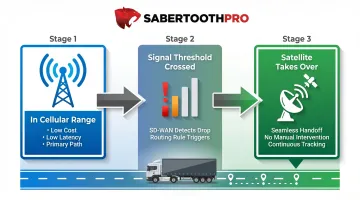
In practice, cellular handles the majority of data transmission at lower cost and latency. Satellite takes over automatically when the asset exits cellular range, ensuring no gap in location tracking, communication, or data sync. The switch happens based on signal quality and predefined thresholds — with no manual intervention required.
Based on Disaster Preparedness and Emergency Scenarios
Cellular towers are among the first infrastructure to fail during natural disasters and are slow to restore. Businesses in disaster-prone regions or those serving critical services need satellite as a resilient parallel path, not just a theoretical backup.
During Hurricane Helene, 48.7% of cell sites in impacted North Carolina areas were out of service as of October 1, 2024. NBC News reported "severe to total communications blackouts" in western North Carolina. Restoration took weeks, not hours or days.
Industries affected by this requirement:
- Utilities managing power grid operations during storms
- Healthcare facilities providing emergency medical services
- Government contractors with continuity-of-operations mandates
- Energy sector maintaining pipeline monitoring and control systems
Signs Your Business Needs Both Cellular and Satellite Right Now
The most common observable signal is recurring connectivity blackouts or "dead spots" in your operational workflow:
- A fleet truck loses check-in for hours at a stretch
- Farm equipment goes offline in remote fields
- A construction site loses cloud access in a rural county
- Mobile POS systems drop during outdoor events in underserved areas
If your business experiences data loss, missed alerts, delayed transactions, or communication failures traceable to cellular coverage gaps — not device issues or software bugs — you're already in territory where combining both makes sense.
Don't wait for an outage to force the conversation. Businesses planning to expand into new geographic markets, grow fleet size, or deploy remote IoT sensors should assess their connectivity architecture proactively. This matters most for trucking, agriculture, healthcare, and logistics teams where downtime has direct operational and financial consequences.
A vendor-agnostic connectivity assessment can identify specific coverage gaps and right-size the solution before a failure forces the decision. SabertoothPro draws on a 300+ provider ecosystem with multi-carrier access and private APN capabilities to benchmark quoted pricing and SLAs against real-world industry standards — so clients get competitive rates without any single-vendor bias.
When Combining Cellular and Satellite Isn't the Right Move
Businesses operating entirely within well-covered urban or suburban areas — retail locations, office-based teams, metropolitan operations — don't have the coverage gap that satellite solves. Layering satellite on top of solid cellular infrastructure adds cost with no meaningful return.
Avoid dual-network architecture as a reflexive "best practice" without first assessing actual coverage needs. Satellite service (especially LEO-based) adds:
- Hardware costs (terminals starting at $1,999)
- Monthly plan costs ($65 to $2,150+ depending on data volume)
- Configuration complexity requiring SD-WAN or intelligent routing setup
If a business's connectivity gaps can be solved by switching carriers or upgrading to a stronger cellular plan, that should be the first step.
Latency-sensitive applications like real-time video conferencing or high-frequency financial trading may perform worse on satellite-only connections. According to Ookla's 2025 Global Satellite Broadband Performance Report, LEO satellite latency averages 45 ms, while GEO satellites average 639 ms to 711 ms. For latency-dependent workloads, satellite should be a fallback path — not the primary one.
What Goes Wrong When Businesses Rely on One Network Too Long
Reactive decisions cost far more than proactive planning. Consider these cause-and-effect scenarios:
Logistics: A company loses asset tracking for a critical shipment crossing rural Montana. The truck is off-grid for six hours, the customer cancels the delivery window, and emergency rerouting runs three times the normal freight cost — plus contract penalties.
Healthcare: A telemedicine clinic drops a remote patient session due to a cellular outage. The consultation can't be rescheduled for 48 hours. The patient seeks care elsewhere, and the clinic loses the billing opportunity while facing potential HIPAA continuity audit findings.
Agriculture: A farming operation loses sensor data during a critical growing period. Without soil moisture readings, irrigation timing slips — reducing crop yield by 12% and costing $40,000 in lost revenue for the season.
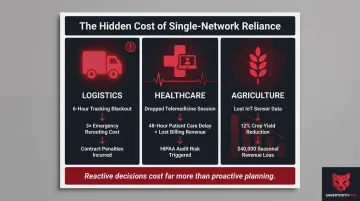
When a single network fails, the damage doesn't stop at the outage itself. Downstream costs stack fast:
- Emergency satellite hardware procurement, often at premium pricing
- Carrier contract penalties for mid-term changes
- Lost SLA performance affecting customer relationships
- Revenue loss from missed transactions or service delivery failures
According to a 2014 Gartner benchmark (via ProfoundLogic), the average IT downtime cost was $5,600 per minute — or $300,000 per hour. That figure has only climbed: a 2022 survey found that 44% of firms report hourly downtime costs between $1 million and $5 million, inclusive of legal fees, fines, and penalties.
How to Build a Reliable Cellular-Satellite Strategy
Start with a Coverage Audit
Map where your operations actually go versus where your current carrier provides reliable service. Identify specific routes, sites, or regions where cellular is unreliable before selecting satellite partners or hardware. This prevents paying for global satellite coverage when your actual dead zones are limited to three specific rural counties.
Configure Intelligent Routing (SD-WAN)
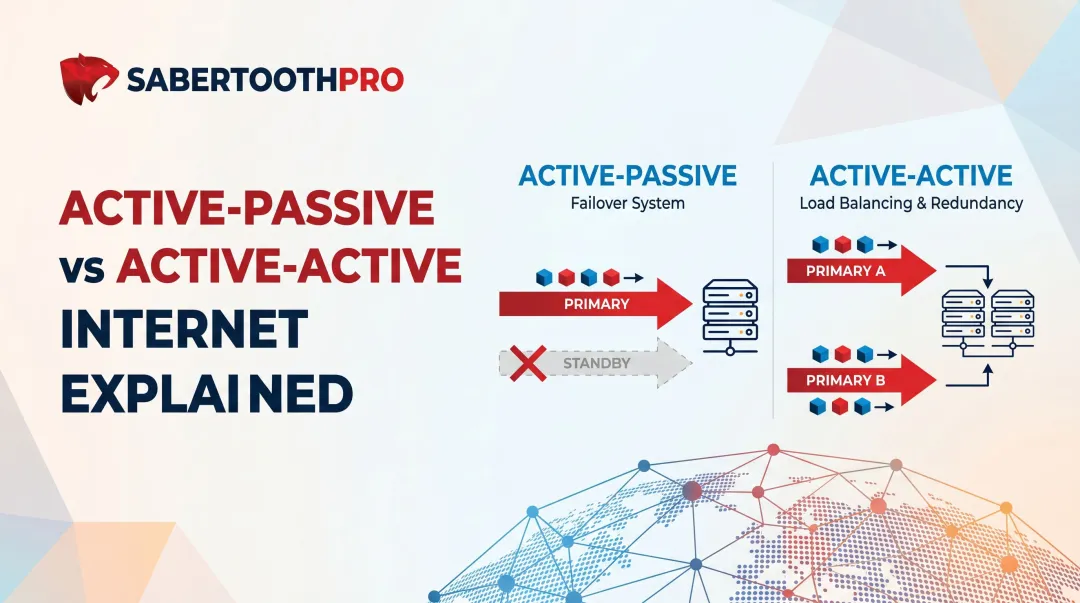
Simply having two connections isn't enough. The network needs to automatically failover or load-balance between cellular and satellite based on:
- Signal quality thresholds
- Latency measurements
- Predefined application rules (for example, POS traffic always routes via lowest-latency path)
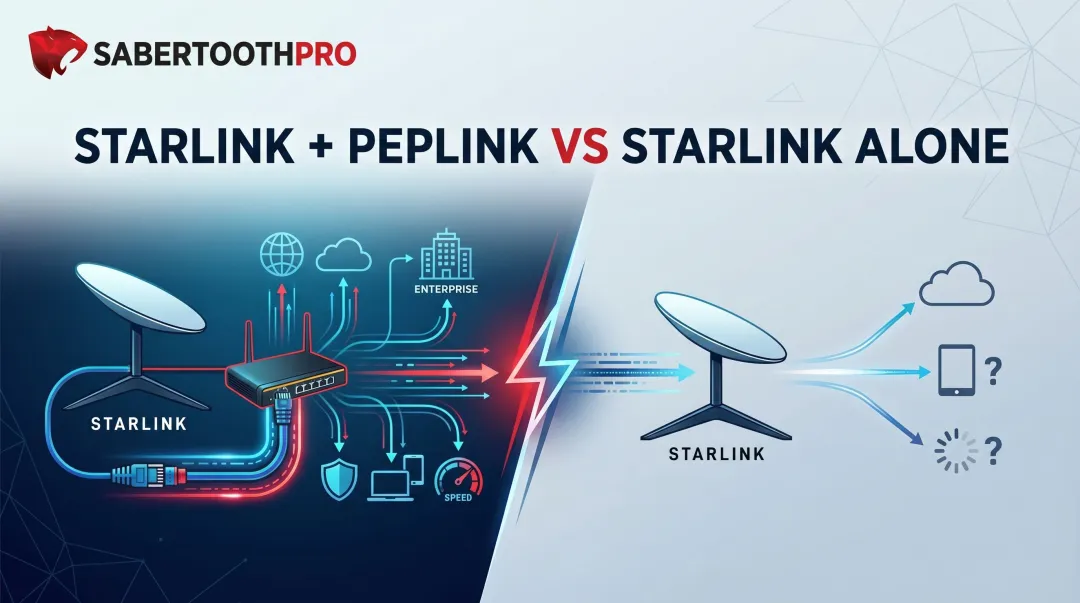
SD-WAN platforms enable this. For example, Ericsson Cradlepoint documents that LEO satellite devices connect via Ethernet to the primary router, enabling Multi-WAN functionality. The SD-WAN intelligently steers traffic on a per-application basis across satellite, cellular, and wired links, with automatic failover, failback, and link bonding capabilities.
Choose Hardware and Satellite Providers Based on Use Case
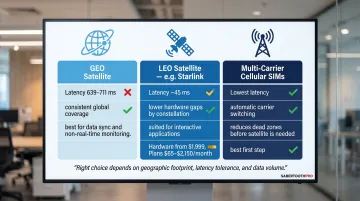
Once routing logic is in place, hardware and provider selection determines how well the architecture actually performs. The right combination depends on your latency tolerance, geographic footprint, and data volume.
GEO satellites:
- Consistent coverage
- Higher latency (639–711 ms average per Ookla)
- Best for applications tolerant of delay (data sync, email, non-real-time monitoring)
LEO constellations (such as Starlink):
- Lower latency (45 ms average per Ookla)
- May have gaps in coverage depending on constellation maturity
- Better for interactive applications requiring faster response times
Multi-carrier cellular SIMs with private APNs:
- Can dramatically reduce dead zones before satellite is even needed
- Enable automatic carrier switching based on signal strength
- Often the first step before adding satellite
According to Starlink's published business pricing, costs range from $65/month (50 GB) to $540/month (2 TB) for Local Priority plans, and $250/month (50 GB) to $2,150/month (2 TB) for Global Priority plans. Hardware starts at $1,999 for the business terminal.
Work with a Vendor-Agnostic Partner
Most businesses don't have in-house IT capacity to evaluate 300+ connectivity options across cellular carriers, satellite providers, and SD-WAN platforms. A vendor-agnostic partner narrows that field and designs the right dual-network architecture without bias toward any single provider.
SabertoothPro works across a 300+ provider ecosystem with carrier-certified multi-carrier access and private APN capabilities. Clients get competitive bids benchmarked against real-world pricing data, with solutions mapped to their specific uptime requirements and compliance obligations.
Conclusion
The decision to combine cellular and satellite internet comes down to one question: does your connectivity architecture match where your business actually operates? Combine when your operations cross coverage boundaries, when downtime carries a direct cost, or when you're expanding into areas no single network reliably serves.
Waiting for an outage to force the decision is the most expensive timing mistake a business can make. Assess your coverage gaps now, design for failover before you need it, and negotiate carrier contracts based on real operational data — not vendor promises.
Frequently Asked Questions
Will satellite replace cellular?
Satellite and cellular serve complementary roles. Cellular offers speed and low latency in populated areas, while satellite provides coverage where ground infrastructure doesn't reach. The industry trend is toward integration, not replacement, with emerging standards like 3GPP Release 17 enabling devices to seamlessly roam between both networks.
Can I turn my cell phone into a satellite phone?
Select newer smartphones support direct-to-satellite messaging for emergencies, such as Apple's Emergency SOS via Satellite. However, full two-way voice and data over satellite requires dedicated hardware or satellite-enabled SIM solutions. For business-grade dual connectivity, dedicated IoT modules or satellite routers are the practical choice.
What is the difference between cellular and satellite internet for businesses?
Cellular relies on ground-based towers, delivering low latency and high speeds in covered areas. Satellite connects via orbiting satellites and works virtually anywhere, though LEO options have closed the latency gap significantly (45 ms vs. 639+ ms for GEO). For most businesses, the deciding factors are coverage range and cost per GB of data.
What industries benefit most from combining cellular and satellite internet?
Trucking and logistics, agriculture, construction, energy and utilities, maritime, and healthcare in rural areas are primary candidates. Any industry where operations regularly move beyond cellular tower range or where network downtime has regulatory or safety consequences benefits from dual-network connectivity.
How much does combining cellular and satellite internet typically cost?
Costs depend on satellite provider (LEO vs. GEO), hardware, data volumes, and fleet size. Business plans range from $65 to $2,150+ per month, with pooled data plans reducing per-unit costs for larger deployments.
Can small businesses afford a dual cellular-satellite network setup?
LEO satellite services and multi-carrier IoT SIM plans have brought dual-network setups within reach for most small businesses. For operations with even a few remote assets or field teams, a failover satellite plan typically costs less than a single connectivity outage. Vendor-agnostic sourcing helps identify the most cost-effective configuration.