
Introduction
Internet outages are expensive. ITIC's 2024 survey of over 1,000 firms found that 90% of mid-size and large enterprises face hourly downtime costs exceeding $300,000, while Datto research pegs the average cost for SMBs at $8,000 per hour. A single multi-hour outage can erase weeks of profit.
Having a backup connection matters less than having the right backup architecture for your site. A hot-standby SD-WAN setup that works perfectly for a busy QSR franchise processing hundreds of card transactions per hour is overkill for a low-traffic branch office. A cold-standby ISP backup that takes five minutes to activate leaves a healthcare clinic exposed during telehealth sessions.
This guide maps core failover internet architectures to the site types they serve best, giving IT decision-makers a practical reference to right-size redundancy without over-investing.
Key Takeaways
- Failover architecture maintains business continuity by auto-switching to backup connectivity when the primary link fails
- Options range from cold standby (manual, slow recovery) to active-active SD-WAN (instant, multi-path switching)
- High-stakes sites — healthcare, data centers, financial — require hot standby or active-active architectures
- Remote and branch locations typically rely on LTE/5G or satellite as their failover layer
- Selection depends on RTO tolerance, compliance mandates (HIPAA, PCI-DSS), physical infrastructure, and budget
- Assessing options across multiple carriers prevents both over-spending and gaps in protection
What Is Failover Internet Architecture (and Why Site Type Matters)
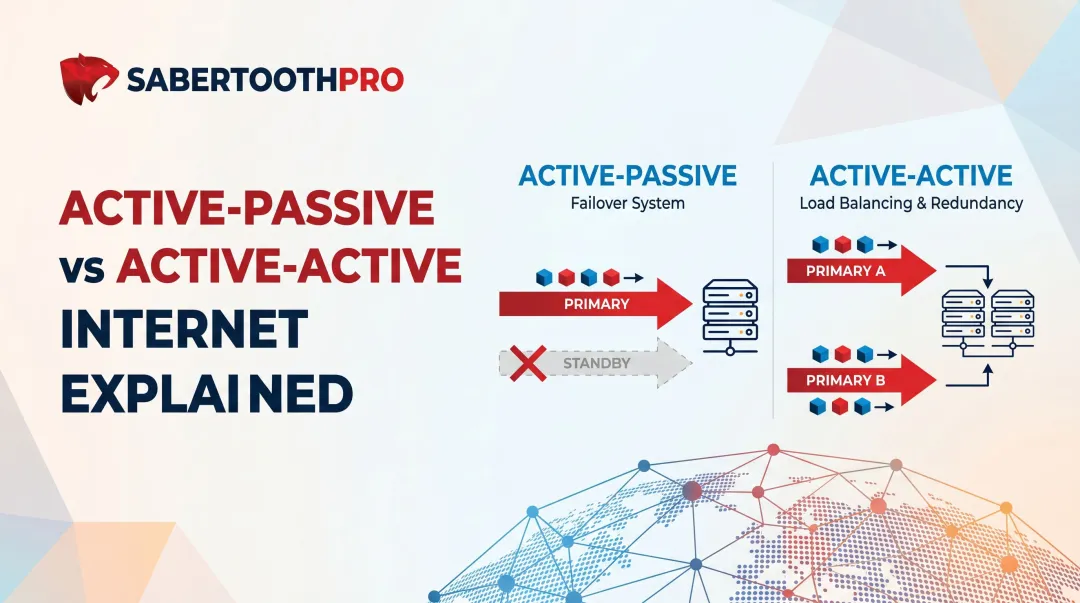
Failover internet architecture deploys a secondary (or multiple backup) internet connection that automatically activates when the primary link fails, maintaining operations without manual intervention.
Unlike server-level failover, internet connectivity failover involves physical diversity: different ISPs, different last-mile technologies (fiber, cable, DSL, LTE/5G, satellite), and different routing logic.
The architecture choice depends entirely on what's physically available at a given site. You can't deploy dual-fiber redundancy where fiber doesn't reach.
RTO and RPO Define Your Architecture Tier
Two concepts drive architecture selection:
- Recovery Time Objective (RTO): NIST SP 800-34 defines RTO as "the maximum amount of time that a system resource can remain unavailable before there is an unacceptable impact." For payment processing or VoIP, RTO is measured in seconds; for batch reporting, it's measured in hours.
- Recovery Point Objective (RPO): The point in time to which data must be recovered after an outage. Internet failover doesn't create data loss the way storage outages do, but session continuity (VoIP calls, video conferences, open transactions) becomes the equivalent recovery concern.
Every site type covered below maps to a specific RTO tier — and that tier determines which architecture options are worth considering.
Core Failover Internet Architecture Options
Dual-ISP / Cold Standby
The secondary connection sits idle until the primary fails. Activation requires either manual switching or a basic router failover rule.
Warm Standby / BGP Failover
The backup link is maintained in a partially active state, receiving routing updates so it can take over within seconds, typically implemented via BGP or policy-based failover routers.
RFC 4271 sets default BGP timers at 90-second Hold Time and 30-second Keepalive — meaning untuned deployments can take 60–90 seconds to detect peer loss. Production environments use BFD (Bidirectional Forwarding Detection) to cut detection time to 1–3 seconds.
Hot Standby / Active-Passive with Automatic Failover
Both primary and backup connections are live and health-checked continuously. A load balancer or failover router detects degradation (not just full outage) and switches traffic with sub-second impact.
Active-Active / SD-WAN with Intelligent Traffic Steering
Multiple connections (fiber + LTE + broadband) run simultaneously. SD-WAN dynamically distributes traffic based on real-time link quality and application priority.
VMware SD-WAN healthcare documentation confirms "sub-second failover maintains stable VDI sessions and real-time traffic for voice, video, and telehealth." That performance is driving rapid adoption: the SD-WAN infrastructure market grew 25% in 2022 and is projected to reach $7.5 billion by 2027 — a sign that multi-path, application-aware failover is becoming the enterprise standard, not the exception.
LTE/5G and Satellite as Failover Mediums
Cellular-based failover via fixed LTE routers or carrier-certified Private APNs is practical or the only option for:
- Remote sites without wired broadband access
- Geographically constrained locations with limited ISP choice
- Mobile or temporary deployments
Starlink Business now offers 40–220 Mbps download, 8–25 Mbps upload, 25–50ms latency, and a 99.9% uptime SLA backed by a 20% service credit. LEO satellite is now viable for commercial failover—or even primary connectivity—in extreme remote scenarios.
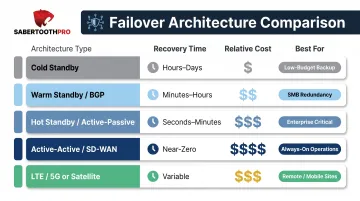
Architecture Comparison at a Glance
| Architecture | Recovery Time | Relative Cost | Best For |
|---|---|---|---|
| Dual-ISP / Cold Standby | 1–5 minutes | Lowest | Non-transactional sites with high RTO tolerance |
| Warm Standby / BGP Failover | Seconds (with BFD) | Moderate | Branch offices with moderate uptime needs |
| Hot Standby / Active-Passive | Sub-second to 2 sec | Higher | Payment processing, cloud VoIP, EHR access |
| Active-Active / SD-WAN | Near-zero | Highest | Multi-site enterprise, mission-critical facilities |
| LTE/5G or Satellite | Seconds (auto-switch) | Varies | Remote sites, mobile deployments, rural locations |
Best Failover Internet Architecture by Site Type
The architecture options above are not one-size-fits-all. The table below maps each site type to its recommended architecture based on operational risk, transaction volume, available infrastructure, and compliance exposure.
Retail / QSR / Franchise Locations
Point-of-sale systems, payment processing, loyalty platforms, and digital menu boards require continuous connectivity. The Federal Reserve's 2025 Diary of Consumer Payment Choice reports 78% of in-person transactions are now non-cash (credit, debit, mobile), with cash at just 22%. An outage during peak hours translates directly to lost revenue and customer walk-outs.
Recommended architecture: Active-Passive Hot Standby or entry-level SD-WAN with LTE failover SIM.
For multi-location franchise operators, centralized SD-WAN management with per-site LTE failover is preferred. It allows corporate IT to:
- Monitor link health across all locations from a single dashboard
- Enforce consistent failover policies
- Eliminate the need for on-site technical staff to manage failover events
A restaurant with $2.5 million in annual sales operating 5,808 hours/year generates approximately $430 per hour in average sales. At 1% downtime (58 hours/year), direct lost sales total approximately $12,470 per year—before accounting for brand damage and customer churn.
Healthcare and Medical Offices
HIPAA-regulated data, EHR access, telehealth sessions, and medical device connectivity cannot be interrupted without patient care risk and regulatory exposure.
Two federal regulations define the minimum bar. 45 CFR 164.306(a)(1) requires covered entities to "ensure the confidentiality, integrity, and availability of all electronic protected health information." 45 CFR 164.308(a)(7) separately mandates contingency planning — including disaster recovery and emergency mode operation plans.
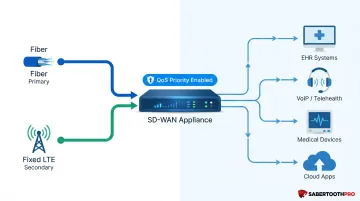
Recommended architecture: Active-Active SD-WAN with diverse last-mile technologies (fiber primary + fixed LTE secondary) and encrypted traffic paths.
Why this matters for healthcare: Failover architecture must account for VoIP/unified communications continuity. If a physician's IP phone fails over to a consumer ISP without QoS prioritization, call quality degrades even if connectivity is technically maintained. A properly configured SD-WAN with application-aware QoS prevents this scenario.
ONC data from 2021 shows 78% of office-based physicians and 96% of non-federal acute care hospitals have adopted certified EHRs. Clinical operations are now fundamentally connectivity-dependent, making internet failover a patient-safety issue.
Branch Offices and Corporate Remote Sites
Branch offices running cloud productivity apps, VPN tunnels to HQ, and UCaaS platforms need consistent connectivity but often have more RTO tolerance than transactional sites.
Recommended architecture: Warm Standby BGP failover or SD-WAN Active-Passive, with an upgrade path to Active-Active if the branch hosts customer-facing services.
Branch offices in metro areas often have access to multiple wired ISPs, enabling diversity at the physical medium level. Fiber primary + cable secondary is generally preferred over wired + wireless for branch stability when both options are available — physical medium diversity reduces correlated failure risk that shared infrastructure can introduce.
Remote and Field Sites (Construction, Agriculture, Logistics Hubs)
Remote sites often lack access to wired broadband entirely. The SBA's January 2026 Issue Brief finds 17% of small business establishments are unserved by cable, fiber, and fixed wireless at 100/20 Mbps, and 34.3% (2.3 million) have access to only one terrestrial provider.
Recommended architecture: 4G/5G LTE via carrier-certified fixed routers with multi-carrier SIM support, or bonded cellular as the primary architecture. Where LTE coverage is insufficient, LEO satellite (Starlink Business) with an LTE failover layer covers sites where LTE alone can't guarantee uptime.
For fleet and logistics environments, IoT device connectivity and GPS/telematics data continuity are critical failover considerations — not just internet access for users.
Device-level connectivity requires its own architecture layer. Private APN solutions with multi-carrier access are the appropriate technology choice here, ensuring telematics and IoT traffic stay up even when general internet links fail.
Data Centers and Mission-Critical Facilities
Data centers and colocation environments require Active-Active configurations with full geographic and provider diversity.
Minimum requirement: Two separate fiber connections from two separate ISPs entering through physically separate conduits, combined with BGP multi-homing to ensure automatic traffic redistribution on any link failure without manual intervention.
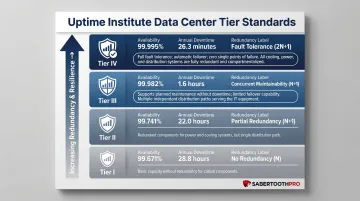
The Uptime Institute Tier classification ranges from Tier I at 99.671% availability (28.8 hours/year downtime) to Tier IV at 99.995% (26.3 minutes/year). Tier III and IV require redundant distribution paths with concurrent maintainability and fault tolerance.
At this tier, failover internet architecture converges with broader HA design:
- Anycast routing for DNS-based traffic distribution
- DDoS scrubbing upstream to maintain availability under attack
- Integration with DNS-based failover for public-facing services
Even minutes of outage make the investment obvious: ITIC's 2024 data shows 41% of enterprises report hourly downtime costs of $1 million to over $5 million.
How to Choose the Right Failover Internet Architecture
Four Core Evaluation Criteria
| Criterion | Key Questions |
|---|---|
| Maximum tolerable downtime (RTO) | Can your site tolerate sub-second, seconds, or minutes of disruption? |
| Data sensitivity & compliance | Are you bound by PCI-DSS (retail), HIPAA (healthcare), or CMMC (government contractors)? |
| Physical infrastructure availability | Do you have wired diversity, LTE coverage, or satellite viability at the site? |
| Budget & total cost of ownership | What are hardware, carrier contracts, and managed monitoring costs over 3-5 years? |
The Cost-Alone Mistake
A common mistake is choosing failover architecture based on cost alone without mapping it to the operational risk profile. A QSR that uses a cold-standby DSL backup instead of an LTE hot-standby will suffer transaction failures during the 3–5 minute failover window. The cost of lost transactions during a single peak-hour outage exceeds the annual cost of the upgrade.
Why Carrier-Neutral Sourcing Matters
Working with a vendor-agnostic technology advisor—rather than a single carrier's sales team—ensures the failover architecture is benchmarked against real-world pricing and carrier coverage data across multiple providers.
SabertoothPro sources across 300+ connectivity partners nationwide — comparing SD-WAN, LTE, fiber ISPs, and satellite options against real contract pricing — so businesses get failover coverage sized to their actual risk profile, not a single carrier's available inventory.
Conclusion
Failover internet architecture is not a single product or configuration—it is a design decision that must be matched to the operational reality of each site type. A mismatch in either direction creates either unacceptable risk or unnecessary cost.
The right architecture for a retail franchise processing hundreds of transactions per hour looks nothing like what a remote construction site or a branch office running cloud productivity apps actually needs. Site type determines RTO tolerance, compliance obligations, and available infrastructure. Those factors — not vendor defaults — should drive whether you deploy cold standby, warm standby, hot standby, or active-active failover.
Ready to assess your current connectivity stack by site type? Contact SabertoothPro for a no-obligation connectivity review. As a vendor-agnostic advisor with access to 300+ carriers and connectivity partners nationwide, we help identify gaps and right-size failover architecture across every location—at +1 888-891-2331.
Frequently Asked Questions
What are the different types of failover?
The four main types are cold standby (backup is offline until needed), warm standby (partially active, synced but not serving traffic), hot standby (fully active backup that takes over immediately), and active-active (all connections live simultaneously with traffic distributed across them).
What are the three types of recovery sites?
NIST SP 800-34 defines cold site (infrastructure in place but not running—longest recovery), warm site (partially operational with equipment ready), and hot site (fully operational mirror with minimal delay). Internet failover architecture mirrors this tiering.
Which architecture is typically used in a datacenter for high scalability, load balancing, and redundancy?
Data centers rely on active-active architectures with BGP multi-homing across diverse ISPs, combined with Anycast routing and hardware load balancers. This distributes traffic and eliminates single points of failure across the network edge and internal switching layers.
What is the difference between DR and HA?
High Availability (HA) prevents downtime through redundant, continuously running systems (measured in seconds to minutes of disruption). Disaster Recovery (DR) restores operations after a major failure event (measured in hours to days). Internet failover is fundamentally an HA tool — DR kicks in when the failure goes deeper than the network layer.
What is the best failover solution for a small retail or QSR location?
A hot-standby LTE failover router — or an entry-level SD-WAN device with a built-in cellular SIM — is the right fit for most retail and QSR locations. Payment systems stay online automatically, with no on-site IT required to trigger the switch.
How does SD-WAN improve internet failover for multi-site businesses?
SD-WAN enables application-aware traffic steering across multiple active connections in real time. When one link degrades (not just fails), traffic automatically shifts without user disruption. Central IT teams gain visibility and policy control across every location from a single dashboard.