Introduction
When your systems go down, the clock doesn't just tick—it bleeds money. Large enterprises face average downtime costs of $23,750 per minute, with over 90% reporting losses exceeding $300,000 per hour. That's not a typo. A single four-hour outage can cost north of $1.2 million before you factor in lost contracts, regulatory penalties, or reputational damage that takes years to rebuild.
The threat landscape makes this worse. 93% of ransomware attacks explicitly target backup repositories, and 79% successfully compromise them in critical infrastructure sectors. Legacy DR approaches — tape backups shipped off-site, secondary data centers untested for 18 months — are no longer meeting modern RTO and RPO demands.
Cloud disaster recovery is now a core infrastructure requirement, not an optional line item. This guide breaks down the top providers for 2026, the evaluation criteria that matter most for enterprise environments, and what separates a reliable DR solution from one that creates compliance gaps when auditors come calling.
TL;DR
- Cloud DR replicates IT systems to cloud infrastructure for rapid recovery after disruptions, replacing legacy tape and secondary data center approaches
- Top 2026 enterprise providers: AWS Elastic Disaster Recovery, Azure Site Recovery, Veeam Data Cloud, Zerto (HPE), Druva
- Evaluate RTO/RPO targets, compliance certifications (HIPAA, SOC 2, PCI-DSS, CMMC), multi-cloud support, and total cost of ownership against verified performance data
- Failed failovers and compliance gaps are common when enterprises skip proof-of-concept testing
What Is Cloud Disaster Recovery and Why Enterprises Need It in 2026
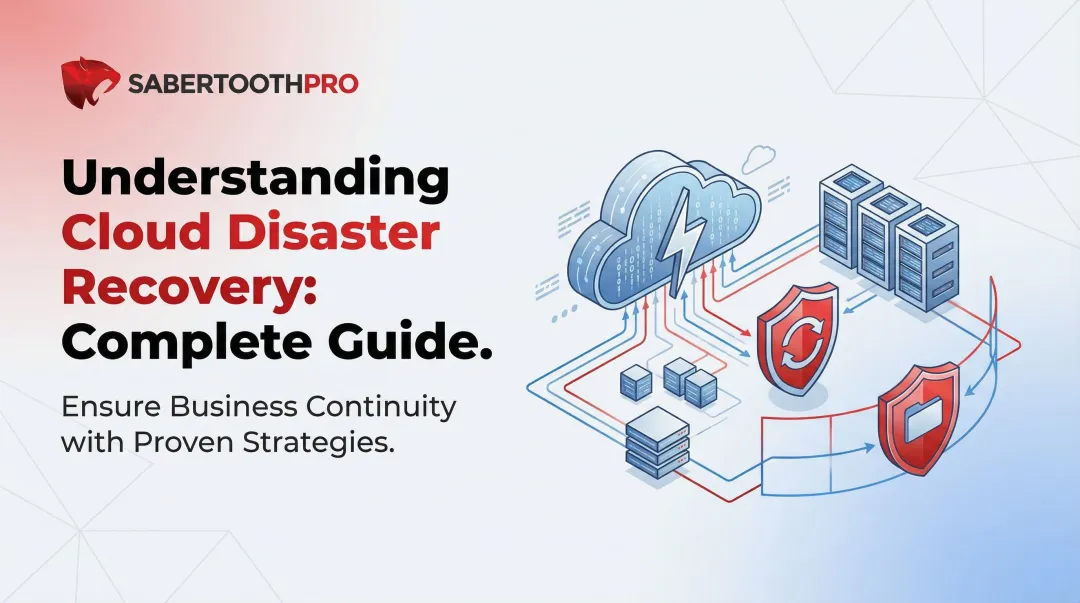
Cloud disaster recovery uses cloud infrastructure to replicate, failover, and restore business-critical systems after a disruptive event. Unlike traditional DR—which relies on tape backups or secondary data centers with recovery windows measured in hours or days—cloud DR delivers speed, scalability, and cost flexibility. Instead of maintaining expensive cold standby infrastructure that sits idle until disaster strikes, cloud DR replicates data continuously and spins up recovery environments only when needed.
The 2026 threat context makes cloud DR non-negotiable. Ransomware attacks now target backup systems in 93% of incidents, with attackers deliberately encrypting recovery points before launching the main ransomware attack on production systems. Multi-site infrastructure failures—from natural disasters, grid instability, or ISP outages—expose the fragility of single-region DR strategies.
Regulatory pressure compounds the operational risk. Three frameworks now mandate specific DR capabilities:
- HIPAA 45 CFR 164.308(a)(7): Covered entities must establish formal contingency and disaster recovery plans
- SOC 2 Trust Services Criteria: Availability controls must include documented DR capabilities
- CMMC: Defense contractors must implement operational incident-handling that includes recovery activities
Given these stakes, choosing the wrong provider isn't just a technical misstep—it's a compliance and business continuity risk. The evaluations below compare enterprise-grade platforms on RTO/RPO performance, security architecture, compliance depth, and verified real-world deployments.
Best Cloud Disaster Recovery Providers for Enterprises in 2026
The providers below were evaluated on production-validated RTO/RPO benchmarks, enterprise compliance certifications, hybrid and multi-cloud support, ransomware recovery capabilities, and market presence among mid-to-large enterprises in regulated industries. This isn't paid placement.
AWS Elastic Disaster Recovery (AWS DRS)
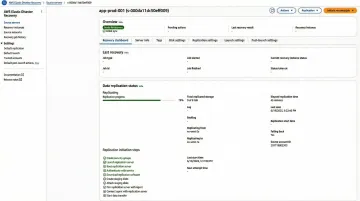
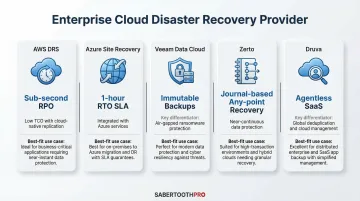
AWS DRS is Amazon's purpose-built continuous replication service that enables enterprises to failover on-premises or cloud workloads to AWS infrastructure. Widely adopted across healthcare, financial services, and government sectors, it delivers sub-second RPO through continuous block-level replication across Amazon's global footprint.
The platform supports source environments ranging from physical servers to VMware, Azure, and GCP workloads — a practical fit for enterprises running mixed-source infrastructure.
Key differentiators include native integration with AWS security services—IAM for granular access control, CloudTrail for audit logging, and KMS for encryption at rest and in transit. The pay-for-what-you-use pricing model eliminates the need to maintain expensive standby infrastructure, charging a flat $0.028 per source server per hour plus underlying AWS resource costs for staging storage and recovery drills.
| Attribute | Detail |
|---|---|
| Recovery Metrics | Sub-second RPO; 5–20 minute RTO |
| Key Features | Continuous block-level replication, automated failover drills, cross-region support, native AWS security integration |
| Best For | Enterprises invested in AWS ecosystem; regulated industries requiring FedRAMP, HIPAA, and SOC 2 compliance |
Microsoft Azure Site Recovery (ASR)
Azure Site Recovery orchestrates replication and failover for Azure VMs, on-premises VMware/Hyper-V, and physical servers. Organizations already running Microsoft 365 and Azure AD benefit most — the native stack integration eliminates the agent sprawl and credential management that third-party DR tools typically add.
Deep integration with Azure Monitor provides real-time replication health visibility, while Microsoft Defender for Cloud adds threat detection across recovery infrastructure. Built-in compliance coverage for GDPR, HIPAA, and ISO 27001 simplifies audit readiness, and centralized management through the Azure portal handles multi-site orchestration without third-party tools.
ASR offers continuous replication for Azure VMs and VMware environments, with replication frequency as low as 30 seconds for Hyper-V. Microsoft backs VM failover with a one-hour RTO SLA.
| Attribute | Detail |
|---|---|
| Recovery Metrics | Near-zero RPO for Azure-to-Azure; one-hour RTO SLA |
| Key Features | Application-consistent snapshots, automated recovery plans, Azure Hybrid Benefit compatibility, replication health monitoring |
| Best For | Microsoft-centric enterprises; organizations in legal, healthcare, or financial sectors needing tight Azure/M365 integration |
Veeam Data Cloud
Veeam Data Cloud is the cloud-delivered evolution of Veeam's market-leading backup and recovery platform, offering fully managed BaaS and DRaaS across Microsoft Azure, AWS, and on-premises environments. Veeam places heavy emphasis on ransomware recovery, with immutable backup storage that prevents attackers from encrypting recovery points—a critical defense given that 93% of ransomware attacks target backup repositories.
The platform's SureBackup automated verification tests restores at scale without impacting production, giving enterprises confidence that recovery points are actually usable before disaster strikes. Veeam's large partner ecosystem reduces deployment complexity for enterprises lacking in-house cloud expertise. The company was named a Leader in the 2025 Gartner Magic Quadrant for Backup and Data Protection Platforms for the ninth consecutive year, positioned highest in Ability to Execute.
| Attribute | Detail |
|---|---|
| Recovery Metrics | Seconds-level RPO with CDP; minutes-level RTO with Instant Recovery |
| Key Features | Immutable cloud backups, ransomware detection alerts, multi-cloud support (Azure, AWS), SureBackup automated verification |
| Best For | Hybrid environments needing ransomware-hardened DR; organizations requiring verified restore confidence before incidents |
Zerto (HPE)
Zerto is an HPE-owned continuous data protection and DR platform that uses journal-based replication to achieve near-zero RPO. Originally built for VMware environments, Zerto now covers hybrid and multi-cloud workloads and is popular among financial services and healthcare enterprises where data loss exposure measured in hours—or even minutes—is unacceptable.
The platform's journal-based architecture enables any-point-in-time recovery down to seconds, not hours, which dramatically reduces data loss exposure after ransomware encryption. Journal history retention is configurable up to 30 days, creating compliance audit trails for regulated industries. Non-disruptive failover testing allows enterprises to validate DR readiness without impacting production systems—addressing the reality that only 27% of organizations test DR plans more than twice a year.
| Attribute | Detail |
|---|---|
| Recovery Metrics | Seconds-level RPO (journal-based); minutes-range RTO |
| Key Features | Continuous journal-based replication, any-point-in-time recovery, non-disruptive DR testing, multi-cloud and on-premises orchestration |
| Best For | Enterprises with strict RPO requirements (financial trading, EHR systems); organizations needing ransomware rollback with granular recovery points |
Druva
Druva is a fully cloud-native SaaS DR and data protection platform built on AWS—no hardware, no software to manage. Designed for enterprises seeking a lightweight, compliance-ready DR approach for SaaS workloads, endpoints, and cloud applications, Druva removes the operational overhead of managing backup infrastructure while providing air-gapped, encrypted cloud storage by design.
Built-in compliance reporting for HIPAA, SOC 2, and GDPR simplifies audit readiness for regulated industries. The per-user or per-workload pricing model cuts through the capacity-based billing complexity that routinely causes bill shock as data footprints grow.
Druva's architecture uses no shared infrastructure — recovery data is logically isolated per tenant, and encryption keys stay under customer control.
| Attribute | Detail |
|---|---|
| Recovery Metrics | Multi-TB/hr local backup and recovery with TurboTier; SLA metrics dependent on deployment tier |
| Key Features | Agentless SaaS architecture, air-gapped encrypted backups, automated compliance reporting, Microsoft 365 and Salesforce DR support |
| Best For | Cloud-first or SaaS-heavy enterprises; regulated industries (healthcare, legal, government) prioritizing compliance simplicity over custom configuration |
Key Features to Look for in an Enterprise Cloud DR Provider
RTO (Recovery Time Objective) and RPO (Recovery Point Objective) are the two most critical performance metrics. RTO defines how quickly systems must be restored after a failure; RPO defines how much data loss is acceptable, measured in time. An RTO of four hours means your business can tolerate four hours of downtime; an RPO of 15 minutes means you can lose up to 15 minutes of data.
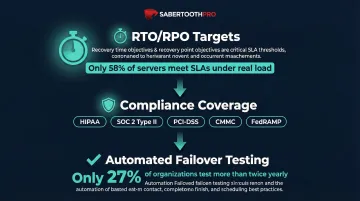
The catch: marketing SLAs reflect best-case scenarios under ideal conditions, not real-world performance under load. Only 58% of servers met their recovery SLA during their last large-scale recovery test, meaning nearly half failed when it mattered. Validate vendor claims with independent testing or a proof-of-concept before signing contracts.
Three additional must-have enterprise criteria:
- Compliance coverage for your industry: HIPAA, SOC 2 Type II, PCI-DSS, CMMC, and FedRAMP certifications directly determine whether your DR architecture passes audit. Providers with built-in compliance reporting reduce the manual effort needed to demonstrate control effectiveness during regulatory reviews.
- Multi-cloud and hybrid environment support: DR shouldn't create new vendor lock-in. Platforms like Veeam, Zerto, and Druva support workloads distributed across AWS, Azure, and on-premises environments, giving you flexibility to recover where it makes operational and cost sense.
- Automated failover testing capabilities: Non-disruptive DR drills that don't impact production systems. Only 27% of organizations test DR plans more than twice a year, which creates gaps when actual disasters occur. Providers offering one-click testing environments reduce the friction that prevents regular validation.
Total cost of ownership extends well beyond licensing. Budget for egress fees (data leaving the cloud network during failback), snapshot storage retained for 7–30 days, professional services for deployment, and ongoing management overhead.
Cloud DR pricing is frequently underestimated. Demand a full breakdown that covers replication servers, staging storage, and compute costs during testing — not just the per-instance licensing fee.
How We Chose the Best Cloud DR Providers
This is not paid placement or vendor promotion. Every provider was evaluated on enterprise-specific criteria:
- RTO/RPO benchmarks verified under real production load
- Compliance certification breadth (HIPAA, SOC 2, FedRAMP, PCI-DSS)
- Hybrid and multi-cloud architecture support
- Ransomware recovery capabilities
- Market presence among mid-to-large enterprises in regulated industries
That methodology matters because enterprises consistently stumble on the same buying mistakes. Here's what to avoid:
- Hidden cost traps: The cheapest per-instance price often conceals egress fees, storage charges, and professional services costs that balloon total TCO significantly.
- Skipping pre-contract testing: Vendor demos don't expose how a platform handles production load with your actual workloads and data change rates. Test failover in your real environment before signing.
- Defaulting to your infrastructure vendor: Running workloads on AWS doesn't make AWS DRS the right DR choice. Evaluate DR performance and compliance requirements separately from your infrastructure provider.
Conclusion
Cloud disaster recovery in 2026 is no longer optional for enterprises. The right provider must align with your specific RTO/RPO targets, compliance obligations, existing infrastructure, and long-term cloud strategy — not brand reputation or sticker price alone.
A four-hour outage costs over $1.2 million for most large enterprises. 93% of ransomware attacks now target backup repositories, which means recovery architecture is a primary security control, not an afterthought.
Before committing to a provider, run a structured evaluation that covers:
- Proof-of-concept failover tests to validate actual RTO/RPO performance
- Compliance gap assessments against your regulatory obligations (HIPAA, PCI-DSS, CMMC)
- TCO analysis comparing full lifecycle costs, not just licensing fees
SabertoothPro's vendor-agnostic advisory model draws on a 300+ partner ecosystem across cloud, security, and infrastructure to match enterprises with the DR architecture that fits their actual operational requirements. Connect with the SabertoothPro team to start with a no-obligation consultation.
Frequently Asked Questions
What is the difference between cloud disaster recovery and traditional disaster recovery?
Traditional DR relies on physical secondary data centers or tape backups with recovery windows measured in hours or days. Cloud DR uses cloud infrastructure to replicate systems continuously and restore operations in minutes, offering better cost efficiency, scalability, and speed without maintaining idle standby infrastructure.
What are RTO and RPO in cloud disaster recovery?
Recovery Time Objective (RTO) defines how quickly systems must be restored after a failure. Recovery Point Objective (RPO) defines how much data loss is acceptable, measured in time. Tighter RTO and RPO targets are achievable but cost more — defining both upfront prevents overpaying for protection you don't need, or underbuilding for what you do.
How much does enterprise cloud disaster recovery cost?
Cloud DR costs vary based on workload volume, replication frequency, and storage footprint. Evaluate total cost of ownership — including egress fees, snapshot retention, and compute during drills — not just licensing fees.
Which cloud DR providers are best for regulated industries like healthcare or finance?
Providers with HIPAA, SOC 2 Type II, PCI-DSS, and FedRAMP certifications — such as AWS DRS, Azure Site Recovery, and Druva — are typically preferred for regulated industries. Built-in compliance reporting is worth prioritizing; it cuts audit preparation time significantly versus assembling evidence manually across disconnected tools.
Can cloud disaster recovery work across multiple cloud providers?
Yes. Platforms like Veeam, Zerto, and Druva support multi-cloud DR, letting enterprises avoid hyperscaler lock-in and recover workloads distributed across AWS, Azure, and on-premises environments to whichever destination is fastest and most cost-efficient at the time of failure.
How often should enterprises test their cloud disaster recovery plan?
Run full failover tests at least annually and partial tests quarterly. Given that only 27% of organizations test more than twice a year, providers like Zerto and Veeam that offer non-disruptive automated testing remove the main barrier: operational risk during the test itself.