
This guide covers the main Wi-Fi options available to Texas truckers, breaks down what each costs, explains how to choose based on whether you're moving or parked, and identifies when individual consumer hotspots no longer make sense for growing fleets.
TLDR
- Mobile hotspots from major carriers (Verizon, AT&T, T-Mobile) are the most practical solution for most truckers
- Satellite internet (Starlink Roam) works best when parked in remote areas with poor cell coverage
- Signal boosters amplify weak tower signals in rural corridors but don't create connectivity from nothing
- In-cab routers provide stronger reception and support more devices than smartphone tethering
- Fleet operators managing 10+ trucks need pooled data plans and multi-carrier failover to control costs and ensure uptime
Why Texas Truckers Need Reliable Connectivity
Connectivity powers every operational aspect of modern trucking. Four tools in particular keep your rig running and your business compliant:
- GPS and routing apps prevent missed turns and late deliveries
- Electronic logging devices (ELDs) keep you compliant with federal hours-of-service regulations
- Load boards let you find your next haul without deadheading home empty
- Dispatch communication keeps you reachable when plans change mid-route
When your connection drops, you're not just inconvenienced. You're losing money and risking compliance violations.
Texas makes reliable connectivity harder to achieve than most states. At 268,596 square miles, it combines major metro corridors with vast rural stretches prone to coverage gaps. West Texas, the Trans-Pecos region, and rural segments between Dallas, Houston, San Antonio, and El Paso frequently have thin or nonexistent LTE coverage.
According to USDA Economic Research Service data, roughly 80% of Texas land area qualifies as rural — yet it holds only 15% of the state's population. That ratio means most highway miles run through coverage-challenged zones.
Truckers face dual connectivity needs: internet while driving (navigation, communication, ELD syncing) and internet while parked (entertainment, paperwork, video calls with family). Each scenario puts different demands on your hardware, data plan, and carrier coverage — which is why a one-size-fits-all solution rarely holds up across a full Texas route.
Best Wi-Fi Options for Truck Drivers on Texas Roads
Mobile Hotspots and Cellular Plans
Dedicated mobile hotspot devices from major carriers (Verizon, AT&T, and T-Mobile) are the most popular and practical solution for most truckers. They create a Wi-Fi bubble inside your cab, connect multiple devices simultaneously, and work wherever LTE or 5G coverage exists.
For Texas specifically, Verizon and AT&T tend to have stronger rural coverage footprints, particularly along I-10, I-20, and I-35 corridors where smaller regional carriers often struggle.
The critical distinction is between "unlimited" marketing and real-world performance. Most unlimited plans throttle hotspot data after a set threshold—typically 30 to 60 GB of high-speed data per month. Once you hit that cap, speeds drop to 600 Kbps or slower, rendering video calls and streaming unusable.
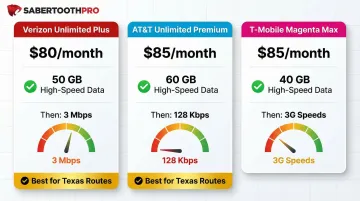
Hotspot Data Cap Comparison (2025):
- Verizon Unlimited Plus: $80/month, 50 GB high-speed hotspot, then throttled to 3 Mbps
- AT&T Unlimited Premium: $85/month, 60 GB high-speed hotspot, then throttled to 128 Kbps
- T-Mobile Magenta Max: $85/month, 40 GB high-speed hotspot, then slowed to 3G speeds
If you stream video, upload dashcam footage, or run multiple devices, factor your actual monthly usage when sizing your plan. Choosing the cheapest option often backfires when throttling kicks in halfway through the month.
Satellite Internet
Starlink Roam is the only truly mobile-capable satellite option for truckers, with speeds capable of supporting HD streaming and video calls. The hardware costs $599, and the Roam plan runs $150/month. Starlink delivers 50–150 Mbps download speeds with latency around 40–60 ms when you have a clear sky view.
Standard Starlink requires a stationary setup and won't maintain connection while moving, making it best suited for parked rest stops rather than in-motion use. Starlink also offers a Mobile Priority plan with in-motion capability, but at $250+/month, most truckers reserve Starlink for overnight stops in dead zones and rely on cellular while driving.
Signal Boosters
Cellular signal boosters, such as the weBoost Drive X RV or SureCall Fusion2Go, amplify weak tower signals in low-coverage rural corridors. They don't create connectivity from nothing; if there's zero signal, a booster can't help. But they can turn one or two bars into a usable 4G connection, extending the range where your existing cellular service remains functional.
Boosters range from $200 to $600 depending on power and antenna quality. They require no additional monthly plan beyond your existing cellular service, making them a cost-effective way to fill gaps on familiar routes where you know signal exists but struggles to penetrate the cab.
In-Cab Routers and MiFi Devices
Dedicated in-cab routers (often called MiFi devices) are a step up from smartphone tethering. They feature external antennas for stronger reception and maintain a steadier Wi-Fi environment inside the cab. Top models include:
- Netgear Nighthawk M6 — 5G capable, Wi-Fi 6 support, up to 12-hour battery
- Inseego MiFi X Pro — 5G capable, supports 30+ simultaneous device connections
- Supports 10–30 connected devices vs. 5–10 for phone tethering
These devices still require a cellular data plan, so monthly costs remain. That said, the improved reception and higher device capacity make them a practical upgrade for anyone running laptops, tablets, and phones simultaneously or depending on real-time dispatch software to stay compliant on the road.
How Much Does Wi-Fi for a Truck Cost?
Costs break into two components: hardware (one-time) and monthly service.
Hardware Investment (Approximate 2025 Pricing):
- Mid-range mobile hotspot device: $150–$300
- Cellular signal booster: $200–$600
- Starlink hardware: $599
Monthly Plan Costs:
| Plan Tier | Monthly Cost | Best For |
|---|---|---|
| Budget cellular plan (5–10 GB) | $20–$35 | Light users: basic navigation and ELD only |
| Mid-tier unlimited (30–50 GB hotspot) | $70–$85 | Moderate users: navigation, dispatch, occasional streaming |
| Premium unlimited (60+ GB hotspot) | $85–$100 | Heavy users: frequent streaming, video calls, multiple devices |
| Starlink Roam | $150 | Parked in remote areas with poor cell coverage |
The hidden cost trap is data overages and throttling. Going over your plan's high-speed hotspot threshold triggers either steep overage fees (on capped plans) or severe speed throttling (on unlimited plans).
Before choosing a plan, estimate your typical monthly usage: streaming video in HD consumes roughly 3 GB/hour, while ELD and dispatch apps use only 1–2 GB/month. Size your plan to actual usage rather than defaulting to the cheapest option.
For owner-operators, Wi-Fi and data plan costs are tax-deductible business expenses. Keep receipts and confirm with a tax professional to ensure you're capturing these deductions correctly.
In-Motion vs. Parked: Choosing the Right Setup
Cellular hotspots are the clear winner for in-motion connectivity. They work at highway speeds with no special mounting or sky-view requirements, and they're the most cost-effective option for navigation, ELD syncing, and dispatch calls while driving. Verizon and AT&T both maintain strong coverage along major Texas interstates, with occasional gaps in the Trans-Pecos region and far West Texas.
Parked scenarios are where Starlink earns its premium cost. When you're stopped overnight in a remote area with poor cell coverage (think a truck stop outside Fort Stockton or a shipper yard in rural East Texas), Starlink Roam provides the consistent 50+ Mbps speeds needed for HD streaming, video calls, and large file uploads.
Pair a cellular hotspot as your primary connection with Starlink as the parked upgrade, and you cover both use cases without overpaying.
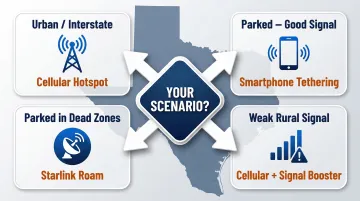
Quick Decision Framework:
- Urban/Interstate → Cellular hotspot
- Parked, good signal → Smartphone tethering
- Parked in dead zones → Starlink Roam
- Weak rural signal → Cellular + signal booster
Fleet Operators: When a Consumer Hotspot Isn't Enough
When a fleet operates 10, 50, or 100+ trucks across Texas, managing individual consumer hotspot plans per driver becomes administratively unworkable. You're juggling separate invoices from multiple carriers, dealing with data caps that don't match actual usage, and you have no centralized visibility into spend or performance.
The imbalance compounds fast: one driver burns through a 50 GB cap by mid-month and gets throttled, while another uses 10 GB and wastes the rest.
Fleet-grade connectivity solves this through carrier-certified Private APNs (Access Point Names)—a dedicated, secure data channel for all vehicles, separate from the public internet. The core advantages over consumer plans include:
- Pooled data lets surplus from light users offset heavy users, eliminating waste
- Centralized billing replaces dozens of individual accounts with a single managed invoice
- Cost reductions of up to $386,000 annually by cutting overage penalties and telecom spend
Those cost savings matter less if the connection drops mid-route. That's where SD-WAN and multi-carrier failover protect fleets that depend on real-time telematics, ELD compliance, and dispatch systems. SD-WAN intelligently routes traffic across multiple carrier connections, maintaining uptime even when one carrier hits a dead zone along a Texas corridor. Dual-modem routers automatically switch between Verizon and AT&T based on signal strength, latency, and jitter—without dropping the VPN tunnel or interrupting ELD sessions.
SabertoothPro works as a vendor-agnostic connectivity advisor for trucking and logistics companies, sourcing Private APNs, pooled data plans, and SD-WAN-enabled fleet networking through a 300+ partner ecosystem—without locking clients into a single carrier.
Fleet operators get real-time price benchmarking across carriers, so they can compare options and negotiate from actual market data rather than a single vendor's quote.
Data Security and Smart Data Management on the Road
Unsecured connections are one of the most common entry points for data breaches in trucking and logistics operations. Driver tablets, dispatch systems, and ELD devices connecting over unmanaged cellular or public Wi-Fi can expose passwords, load details, and financial data to interception.
SD-WAN addresses this directly. By routing all traffic through encrypted tunnels and enforcing centralized security policies, it ensures every device on your fleet network — regardless of location — operates under the same protection standards as your home office.
Practical Data Security Practices for Fleet Networks:
- Enforce encrypted tunnels for all dispatch and ELD communications over cellular
- Apply QoS policies to prioritize critical traffic (GPS, load updates) over background data
- Restrict unauthorized app traffic using application-aware SD-WAN filtering
- Schedule large file transfers (logs, video footage) during terminal dwell time to preserve bandwidth
- Segment driver device traffic from back-office systems using SD-WAN VLANs
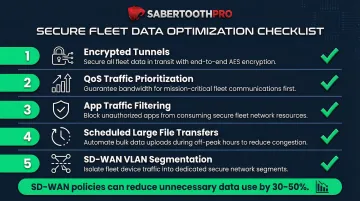
Properly configured SD-WAN traffic policies can reduce unnecessary data consumption by 30–50%, helping fleets stay within pooled data plan thresholds and avoid overage charges on multi-site cellular plans.
Frequently Asked Questions
What do truckers use for Wi-Fi on the road?
Most truckers rely on mobile hotspots from major carriers like Verizon, AT&T, or T-Mobile. Some use smartphone tethering for light tasks, while others deploy Starlink for remote parked locations or signal boosters to extend coverage in weak-signal corridors.
How much does Wi-Fi for a truck cost?
Basic smartphone hotspot plans start around $20–$35/month for 5–10 GB of data. Mid-tier unlimited plans with 30–60 GB of high-speed hotspot data run $70–$100/month. Starlink Roam costs $599 upfront for hardware plus $150/month for service.
Does Starlink work while a truck is moving?
Standard Starlink requires a stationary setup with a clear sky view. Starlink's premium Mobile Priority plan offers in-motion capability at $250+/month, but most truckers use cellular while driving and Starlink while parked in remote areas.
Can trucking companies pay for driver Wi-Fi?
Some large carriers include Wi-Fi or offer partial reimbursement. Owner-operators cover their own costs, which are tax-deductible business expenses. Fleet operators can use pooled data plans to manage costs centrally and eliminate individual invoicing.
Is public Wi-Fi at truck stops safe to use?
Public Wi-Fi networks are unencrypted and carry security risks, including data interception and credential theft. Use a personal hotspot for business tasks and a VPN whenever public Wi-Fi is the only available option.
What is the best connectivity solution for a trucking fleet operating across Texas?
A combination of multi-carrier coverage, pooled data plans, and SD-WAN-enabled fleet networking ensures reliable uptime and controlled costs. A vendor-agnostic advisor like SabertoothPro lets you compare options across 300+ partners without carrier bias — so you're not locked into a single provider's agenda.